
when the spot on the wall should be FAR away

bbb

AzB Gold Member
Gold Member
Silver Member
bob jewett in this 2004 article on long kicks at the end of the aarticle shows the midline method for a 2 rail kick
http://www.sfbilliards.com/articles/2004.pdf
page 14

he mentiond instead of the parrallel shift as commonly taught a target 20 feet away from the midpoint thru the pocket line would work
and asks (paraphrasing)
do you see why the far point works and the short point doesnt
i assume its because farther away the 2 points would intersect
but how do you determine where that intersection point is??
any help is appreciated
 
[edit]

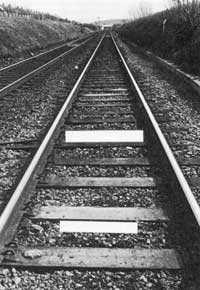
The lines are all parallel, but with our perspective vision the lines get closer and closer the farther away we see them.

Take a perfectly straight railroad:

brain_model_fig7.jpg


Although the two rails don't actually intersect you will see that they visually converge the farther we look down the tracks.

The reason the above works is perspective, and the best distance would be as far away as possible. If you pick a point *very* far away, all three lines appear to point to the same point even though they are actually parallel, and at a far distance the target is converged enough to make a clean kick.
 
Last edited:
[edit]

The lines are all parallel, but with our perspective vision the lines get closer and closer the farther away we see them.

Take a perfectly straight railroad:

brain_model_fig7.jpg


Although the two rails don't actually intersect you will see that they visually converge the farther we look down the tracks.

The reason the above works is perspective, and the best distance would be as far away as possible. If you pick a point *very* far away, all three lines appear to point to the same point even though they are actually parallel, and at a far distance the target is converged enough to make a clean kick.

to be the devils advocate
your situation is looking at 2 lines at the same time and their apparrent conversion in the distance
in this scenario you are only looking at one line
so there is no other line to "converge " on
icbw
 
10,000 feet beyond the rail is far enough because then the railroad tracks (as illustrated above) are in the same direction so far as you can see. One foot beyond the corner of the table is not far enough because you will have a very different direction -- you can still see the distance between the tracks.

To be perfectly correct you need to go out to an infinite distance. To be sufficiently correct on the direction in order to hit the ball, you need to have the tracks nearly converged as far as you can see. You could work out the distance needed if the required accuracy was one ball diameter when the cue ball passes the object ball. Very roughly, if the cue ball starts a foot from the center line, the far point needs to be beyond the corner about five times the total distance the cue ball will travel.

But the cushions don't reflect the ball perfectly, so the "two cushion parallel out of the corner" system works marginally and you need the correct spin to make it close. The main reason I showed the "bar stool reflected target" is that it allows you to try the system with an exact target and no calculation or estimation. That lets you worry about the spin and speed needed to make the system work as opposed to worrying about whether you got the geometry right.

If you don't have a lot of room between the table and the wall, an exact system is also described in that article.
 
10,000 feet beyond the rail is far enough because then the railroad tracks (as illustrated above) are in the same direction so far as you can see. One foot beyond the corner of the table is not far enough because you will have a very different direction -- you can still see the distance between the tracks.

To be perfectly correct you need to go out to an infinite distance. To be sufficiently correct on the direction in order to hit the ball, you need to have the tracks nearly converged as far as you can see. You could work out the distance needed if the required accuracy was one ball diameter when the cue ball passes the object ball. Very roughly, if the cue ball starts a foot from the center line, the far point needs to be beyond the corner about five times the total distance the cue ball will travel.

But the cushions don't reflect the ball perfectly, so the "two cushion parallel out of the corner" system works marginally and you need the correct spin to make it close. The main reason I showed the "bar stool reflected target" is that it allows you to try the system with an exact target and no calculation or estimation. That lets you worry about the spin and speed needed to make the system work as opposed to worrying about whether you got the geometry right.

If you don't have a lot of room between the table and the wall, an exact system is also described in that article.

thanks bob
:)
 
"Parallel" may be too narrow an approach for describing the true effect.
 
Last edited:
"Parallel" may be too narrow an approach for describing the true effect.

Yes, and even if you do get the cue ball to come out of the corner going parallel to its inbound path, there is no guarantee that it will be at the same distance from the center line (mid-point to pocket line). In fact if the cue ball does not reflect at an equal angle off the first cushion, you cannot achieve parallel and equal distance off the second cushion.
 
Back
Top