Can you overcut an object ball frozen to the rail?

I think this sounds like a good project for Dr Dave and his high speed video.
PJ, I see what you are saying, but I believe in a practical application, that the cushion is going to alter the path of the cue ball.

Steve

I don't think you see what I'm saying. See my last drawing.

pj
chgo

P.S. This is still just a semantic point, and doesn't really address the original poster's practical question (Can the OB be moved away from the rail without banking it into the rail?).
 
Last edited:
PJ you are right.....

I don't think you see what I'm saying. See my last drawing.

pj
chgo

P.S. This is still just a semantic point, and doesn't really address the original poster's practical question (Can the OB be moved away from the rail without banking it into the rail?).

The answer to the ops question "without driving the ob into the rail can you miss the pocket?" is yes. If you kick at the ball by compressing the rail prior to contact. You can't do it without hitting the rail first, that is impossible, whether it qualifies as a kick or not is a semantic argument.

Most people will say if it hits the rail first it is a kick though would be my guess.

Neil was correct and then you in pointing out that in the unlikely situation that the ball starts to compress the rail and then strikes the OB, and continues to compress the rail before coming off the rail, then it should probably be considered a cut rather than a kick, but again, that is a semantic argument. You still have to hit the rail first and for the sake of those that have difficulty imaging advanced billiards concepts, I think it would be confusing to call it a cut rather than a kick.

I didn't really want to get into a semantic argument which is why I originally just said to Neil that that was a possibility.

Jaden

One thing though, I'm not sure, maybe Dr. Dave can do a high speed video test of this, that it is possible to do what you are describing without double kissing the OB because of how fast you would have to hit it to compress the rail enough and how close to the OB the CB would have to be when it first strikes the rail to get the CB to hit the rail compress it, then strike the OB and continue compressing the rail. which is why I stated originally that you either have to double kiss it, or kick it.
 
Last edited:
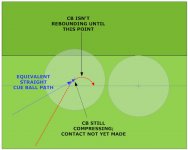
I think the problem might be that people aren't realizing the CB contacts the rail a short distance away from the OB and moves toward the OB while in contact with the rail. Maybe it will help to show a "time lapse series" of drawings showing how the CB approaches the OB while in contact with the rail:

1. Initial contact with the rail. The CB's "equivalent straight line path" is the same as it's initial path into the rail.

railfrozen overcut5.jpg

2. Closer to the OB but not yet in contact with it. The CB's "equivalent straight line path" has changed, but the CB is still moving into and compressing the rail.

railfrozen overcut4.jpg

3. Contact with the OB. The CB's "equivalent straight line path" has changed more, but the CB is still moving into and compressing the rail.

railfrozen overcut3.jpg

pj
chgo
 
Last edited:
Jaden:
in the unlikely situation that the ball starts to compress the rail and then strikes the OB, and continues to compress the rail before coming off the rail

That isn't unlikely at all. In fact, this is half of all the ways the CB can contact the OB while in contact with the rail. I think you guys just have trouble visualizing what's happening while the CB is in contact with the rail.

You still have to hit the rail first and for the sake of those that have difficulty imaging advanced billiards concepts, I think it would be confusing to call it a cut rather than a kick.

Maybe so. I don't really care whether it's called a cut or a kick. I'm more interested in showing what's happening physically. Physically, while the CB is in contact with the rail, it has an equal chance of hitting the OB while it's going into the rail or while it's rebounding out of the rail.

pj
chgo
 
Last edited:
I thought for a second that you might have had a brain....

That isn't unlikely at all. In fact, this is half of all the ways the CB can contact the OB while in contact with the rail. I think you guys just have trouble visualizing what's happening while the CB is in contact with the rail.

pj
chgo

You're saying that the most likely thing that can happen when shooting at a ball frozen to the rail that ends up not going straight down the rail is that the CB will compress the rail, cut the OB continue to compress the rail and then rebound?????

Are you insane or just can't admit when you might be wrong? I have never seen you admit that you might be wrong PJ, this is idiotic.

Dr Dave please do a video, showing whether or not this is even possible and if it is, tell us how many tries it took you to get it on tape. My gues is that if it is even possible it will take more than ten tries, which would make it highly unlikely like I stated and still a semantic argument as to whether or not it qualifies as a kick or a cut.

Jaden
 
It doesn't have an equal chance.

That isn't unlikely at all. In fact, this is half of all the ways the CB can contact the OB while in contact with the rail. I think you guys just have trouble visualizing what's happening while the CB is in contact with the rail.


Maybe so. I don't really care whether it's called a cut or a kick. I'm more interested in showing what's happening physically. Physically, while the CB is in contact with the rail, it has an equal chance of hitting the OB while it's going into the rail or while it's rebounding out of the rail.

pj
chgo

because you are compressing the rail, it doesn't have an equal chance. At best it has a 25% chance...

If you acknowledge that you have to start to compress the rail before contact for the CB to come away from the rail, then it can't possibly have an equal chance.

for what you are saying to occur, you lose all angles where the CB is too close to the OB and will double kiss the OB, you lose all the angles where CB is coming back off of the rail, and that alone takes away atleast 75% of the possible outcomes. plus you have to hit the rail first, so you lose the original angle of 90 degrees and probably a few after that.

Jaden
 
You're saying that the most likely thing that can happen when shooting at a ball frozen to the rail that ends up not going straight down the rail is that the CB will compress the rail, cut the OB continue to compress the rail and then rebound?????

No, Jaden, I said it "isn't unlikely". Later I clarified even more and said it's equally likely.

Are you insane or just can't admit when you might be wrong?

I think that question should be asked of whoever's wrong, in this case, you.

I have never seen you admit that you might be wrong PJ

You haven't paid attention.

this is idiotic.

Yes, it is, but it didn't need to be.

pj
chgo
 
because you are compressing the rail, it doesn't have an equal chance. At best it has a 25% chance...

If you acknowledge that you have to start to compress the rail before contact for the CB to come away from the rail, then it can't possibly have an equal chance.

for what you are saying to occur, you lose all angles where the CB is too close to the OB and will double kiss the OB, you lose all the angles where CB is coming back off of the rail, and that alone takes away atleast 75% of the possible outcomes. plus you have to hit the rail first, so you lose the original angle of 90 degrees and probably a few after that.

Jaden

All of this is nonsense, Jaden. Now you're just thrashing about because you don't want to lose an argument with me. If you hadn't made it an argument in the first place you'd have saved yourself some embarrassment.

pj
chgo
 
I haven't lost PJ....

All of this is nonsense, Jaden. Now you're just thrashing about because you don't want to lose an argument with me. If you hadn't made it an argument in the first place you'd have saved yourself some embarrassment.

pj
chgo

I'm thrashing about because I thought for once you might see reason and logic.

That's on me though.

Don't worry, I won't make that mistake again.

Jaden
 
I think this sounds like a good project for Dr Dave and his high speed video.
PJ, I see what you are saying, but I believe in a practical application, that the cushion is going to alter the path of the cue ball.
I would be happy to film some shots for you guys with the high-speed camera, but I think PJ's diagrams are pretty clear. I will try to film some shots on Tuesday. What exactly do you guys want to see? This is what I will do, unless I get additional requests:

- show the OB being thrown away from the the rail with outside (reverse) English, hitting the ball and rail close to the same time.
- show the OB being cut away from the rail by compressing the rail before or during contact with the OB (with outside/reverse English for the most dramatic effect).

What else would you guys like to see?

FYI, I already have a large collection of rail cut shots covering most of the possible cases in HSV A.128-A.141. Here's the first if you want to step through each shot, one at a time (by clicking on the "Next" button):


I also have some interesting cushion-compression shots here:


Regards,
Dave
 
Dave,
I don't think we are even discussing english, just whether ot not the cue ball can get in behind the object ball and the rail to actually overcut the ball before the cushion alters the direction of travel for the cueball. Adding english might actually change the results.

Steve
 
Dave,
I don't think we are even discussing english, just whether ot not the cue ball can get in behind the object ball and the rail to actually overcut the ball before the cushion alters the direction of travel for the cueball. Adding english might actually change the results.

Steve
OK. I'll film some shots without English also. However, with rail-first rail-cut shots, the rail induces running English, which can help throw the OB back towards the rail. I'll try to film and describe all cases. BTW, Section 4.06 in my book covers this stuff fairly well. Check it out.

Regards,
Dave
 
What I'm asking for is this....

OK. I'll film some shots without English also. However, with rail-first rail-cut shots, the rail induces running English, which can help throw the OB back towards the rail. I'll try to film and describe all cases. BTW, Section 4.06 in my book covers this stuff fairly well. Check it out.

Regards,
Dave

If you can show a CB hitting the rail, striking the OB and continuing to compress the rail without hitting the OB a second time and tell us how many tries it takes where it neither hits the rail and starts to come off the rail before striking the OB or double kisses the OB it takes before you get the shot on tape.

All I've been saying is that you can't cut the ball at greater than a perpendicular angle to the rail without hitting the rail first or employing throw and that anything else should be called a kick into the ball because you're hitting the rail first.

Jaden
 
Are you claiming that this one is evidence of what Patrick said?

I would be happy to film some shots for you guys with the high-speed camera, but I think PJ's diagrams are pretty clear. I will try to film some shots on Tuesday. What exactly do you guys want to see? This is what I will do, unless I get additional requests:

- show the OB being thrown away from the the rail with outside (reverse) English, hitting the ball and rail close to the same time.
- show the OB being cut away from the rail by compressing the rail before or during contact with the OB (with outside/reverse English for the most dramatic effect).

What else would you guys like to see?

FYI, I already have a large collection of rail cut shots covering most of the possible cases in HSV A.128-A.141. Here's the first if you want to step through each shot, one at a time (by clicking on the "Next" button):


I also have some interesting cushion-compression shots here:


Regards,
Dave

http://billiards.colostate.edu/high_speed_videos/new/HSVA-129.htm

That one clearly shows that the OB hits and rebounds from the rail.

The question was if you could overcut the OB without it hitting the rail.

http://billiards.colostate.edu/high_speed_videos/new/HSVA-132.htm

The one above is clearly a kick. The CB hits the rail and hits the OB on it's way out.

http://billiards.colostate.edu/high_speed_videos/new/HSVA-136.htm

This is the only one that comes close to illustrating Patrick's equivocation and it still seems to be hitting the ball on the rebound, not mid stream.

http://billiards.colostate.edu/high_speed_videos/new/HSVA-137.htm

The above would be an iulustration of it, if it weren't for the draw, the CB is actually coming off the rail and upon contact the draw along with running english is pulling it slightly back into the rail before rebounding back out.

Plus none of these shots show the ball coming away from the rail enough to miss the pocket which is what the original op questioned and what we were responding to.

Jaden
 
If I understood the original question correctly, the question would be "can you make cue ball contact with the object ball inside of a centerline on the object ball that would run parallel to the rail, without the cue ball being on the rebound off the cushionl".
That would be what I would consider to be an overcut.

Steve
 
I have to agree with Pooltchr and Jaden. That's the way I understood the op. I would like to see what Dave comes up with.
 
I suppose it's an interesting topic of discussion, but when you really think about it, the question might as well have been "I know you can miss a rail shot by hitting it too full, but is it possible to miss by hitting too thin?"

When all is said and done, it really doesn't matter. If you don't hit it right, you are going to miss the shot.

Steve
 
Back
Top
