Can you overcut an object ball frozen to the rail?

your diagram is inaccurate....

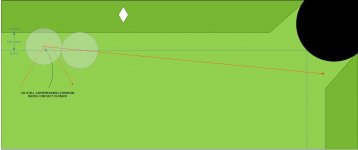
Take a look at my drawing (added to my post above) and explain to me how the OB could travel parallel to the rail if hit on the contact point shown.


The CB can easily hit the OB while the cushion is compressing, and if it does it must hit the OB closer to the rail than 1/2 ball. If it hits the OB closer to the rail than 1/2 ball then the OB must cut away from the rail unless collision-induced throw is as great as the cut angle. The cut angle in the drawing is almost 10 degrees, about twice the maximum angle of throw.

Maybe it's difficult to visualize - that's why I added the drawing.

pj
chgo

If the CB hit the OB as shown in your diagram it would've contacted the rail about a quarter to an eighth of an inch behind the OB and then compressed the rail, hence it would not be a cut but rather a kick....

This is really an argument of semantics....It can technically be stated either way, but it would be a kick rather than a cut IMO.


If like you say it contacts the rail and the OB at the same time it would have to make contact with the OB at an perpendicular angle to the rail and the ball would travel straight down the rail. If it can contact the rail and the ball at the same time and then compress, it would have to hit the OB a second time in order to push it an an angle away from the rail. So you have two possibilities...

1) The CB hits the cushion first, which makes it more of a kick than a cut.

2) It hits the OB and the cushion, compresses into the rail and hits the OB again. I.e. a double kiss.

Jaden
 
Yes, moreso at the slower speeds and moreso with horizontal plane outisde spin (ie 3 o'clock or 9 o'clock).
 
Jaden:
This is really an argument of semantics...
The CB hits the cushion first, which makes it more of a kick than a cut.

The original poster didn't ask a semantic question; he asked a practial question about whether the OB can be contacted closer to the rail than 1/2 ball, causing the OB to be "cut/kicked" away from the rail rather than "banked" away from the rail. The answer to that practical question is "yes".

You've raised the separate semantic question of whether CB/OB contact can ever be called a "cut" if the OB has contacted a rail first. My definition of "cut" depends purely on which direction the CB is going when it hits the OB - if the CB is going in its original general direction past the OB, then I'd say it's a cut; if it's returning in the opposite general direction, rebounding from a rail, then I'd say it's a kick. Since the CB is still going in its original direction past the OB while the cushion is compressing, I'd say if it hits the OB while the cushion is compressing it's a cut.

If like you say it contacts the rail and the OB at the same time

I didn't say that.

pj
chgo
 
Last edited:
?

Yes, moreso at the slower speeds and moreso with horizontal plane outisde spin (ie 3 o'clock or 9 o'clock).

Huh? What does time have to do with the problem at hand ? And who is this moreso guy. I can't seem to find his post.:wink:
 
Arrrgh!!!!

I think you're semantically wrong, but why are we arguing semantics rather than trying to answer the original poster's question? His question was clearly based on whether the CB is traveling into or out of the rail when it hits the OB. His definition of "cut" is clearly when the CB is going in the direction that its own original velocity carries it (into the compressing rail). That's also my definition of the word, by the way, but that's not really relevant to the original question.

So in answer to the original question's intent: yes, you can "overcut" a rail-frozen OB and yes, it can cause you to miss the shot.

pj
chgo

This horse is dead. Let him rest in peace and beat him no more.:(
 
good observation Neil....

Jaden, I understand what you are saying, and I agree that those two things can and do happen. However, you are missing the third option. That is, the cb compresses the rail some, hits the ob, (overcutting it), and then continues to compress the rail more before it rebounds. By the time it rebounds, the struck ob is already out of the way, and the cb does not double hit it.

that is a possibility.

Jaden
 
Here's Dr. Dave's high-speed video of a rail-frozen cut shot. It either shows an overcut or shows that it's definitely possible. I estimate the amount of rail compression is about 3/8 inch, way more than enough to overcut the OB out of the pocket.
FYI, I have a large collection of super-slow-motion rail cut shots covering most of the possible cases in HSV A.128-A.141. Here's the first if you want to step through each shot, one at a time (by clicking on the "Next" button):


I also have some interesting cushion-compression shots here:


Regards,
Dave
 
The simple answer to the original question is NO. You can undercut it and drive it into the rail. You can cut it properly and send it down the rail. But in order to push the ball away from the cushion, you have to get the cue ball behind it first, and then have it contact the ob on it's way back out. That would not be overcutting, but rather just hitting it the wrong way on the rebound. There is no way for the cue ball to get past the contact point for the down the rail shot, and hit it on the other side until the cue ball has reversed direction.

Steve
 
The simple answer to the original question is NO. You can undercut it and drive it into the rail. You can cut it properly and send it down the rail. But in order to push the ball away from the cushion, you have to get the cue ball behind it first, and then have it contact the ob on it's way back out. That would not be overcutting, but rather just hitting it the wrong way on the rebound. There is no way for the cue ball to get past the contact point for the down the rail shot, and hit it on the other side until the cue ball has reversed direction.
You always provide solid advice, imo, so I'm curious as to what it is about Patrick's diagram at the top of the previous page that you believe is wrong? You seem to be saying that the cueball can't contact the object ball on the way in, but can on the way out. Why not?

Jim
 
:speechless:

You always provide solid advice, imo, so I'm curious as to what it is about Patrick's diagram at the top of the previous page that you believe is wrong? You seem to be saying that the cueball can't contact the object ball on the way in, but can on the way out. Why not?

Jim
What I gleaned from pooltchr's explanation is that (absent spin or english)
the CB cannot make contact on the way in with the OB beyond a center line thru the OB which is parallel to the rail because THE RAIL IS IN THE WAY.
If a center line thru the CB and thru the OB line up and are parallel to the rail the OB will be made. If the CB goes beyond that it will hit the rail first,
rebound off the rail and hit the OB driving it away from the rail in a manner
which appears like an overcut. (Actually on the rebound the CB could strike the OB at the correct point so that the OB will be made. But that is another matter)
By gosh this is fun!:grin:
 
Jal,
The only way the cue ball can get past the contact point to cut the ball straight down the rail is to hit the rail. As soon as the cue ball hits the rail from an angle, it's path is altered. The result would look like you over cut the ball, but I believe that would be the result of the cushion changing the path of the cue ball.

Steve
 
No you can't. You can't go past the rail and make contact first. As was pointed out in a very nice diagram. If the cb goes rail first the rebound would then cause an undercut pushing the object ball away from the cushion. Whether it's semantics or not it would still be a rail first or kick shot at that point. JMHO I would like to hear Dr. Dave or Bob Jewett give an explanation and opinion. I'm to lazy to watch his videos right now.
 
pooltchr:
There is no way for the cue ball to get past the contact point for the down the rail shot, and hit it on the other side until the cue ball has reversed direction.

What prevents the CB from hitting the OB while it's going in (compressing the rail)?

pj
chgo
 
stumpie71:
As was pointed out in a very nice diagram. If the cb goes rail first the rebound would then cause an undercut pushing the object ball away from the cushion. Whether it's semantics or not it would still be a rail first or kick shot at that point.

I don't know what you mean by "undercut" (in blue above), but nothing prevents the CB from hitting the OB on its way into the cushion, like this:

railfrozen overcut2.jpg

pj
chgo
 
12310bch:What I gleaned from pooltchr's explanation is that (absent spin or english)
the CB cannot make contact on the way in with the OB beyond a center line thru the OB which is parallel to the rail

This is simply physically wrong. Nothing prevents the CB from making contact with the OB on its way into the cushion, while the cushion is compressing.

I don't know why this is so hard for people to visualize...

pj
chgo
 
pooltchr:
The only way the cue ball can get past the contact point to cut the ball straight down the rail is to hit the rail. As soon as the cue ball hits the rail from an angle, it's path is altered. The result would look like you over cut the ball, but I believe that would be the result of the cushion changing the path of the cue ball.

For the first half of the time it's in contact with the rail the CB is still moving "forward", compressing the rail. Its path changes constantly during this time, but it doesn't begin moving "backward" (rebounding from the rail) until the second half of the time it's in contact with the rail.

Here's a drawing showing the CB contacting the OB before it reaches the "bottom" of its path into the rail (the blue line). Its path has changed, but it's not yet moving in the direction (out of the rail) that would make it a kick. It's the same as if the CB is moving in a straight line in the direction shown by the straight blue line labeled "EQUIVALENT STRAIGHT CB PATH".

railfrozen overcut3.jpg

pj
chgo
 
Last edited:
The rail is preventing the cb from making contact first while compressing. The cb will do 1 of three things. The cb will make contact with ob before the rail at the same time or after contact with the rail. The amount time the cb remains in contact with the ob is so minuscule it doesn't allow for anything else.
Second, if you look at your diagram (sorry not I'm not good at highlighting quotes or doing a diagram). While cutting the ball down the rail the cb is coming from the right side. If it makes contact with the rail first and compresses the rail, it contacts the ob on the way out. At that point it is coming from the left side of the ob and there fore causing an undercut. The cb's path was changed by the rail and is now coming from the opposite side of the ob. If I could do a diagram it would prob make a little more sense but I hope this helped with my explanation.
 
I think this sounds like a good project for Dr Dave and his high speed video.
PJ, I see what you are saying, but I believe in a practical application, that the cushion is going to alter the path of the cue ball.

Steve
 
Back
Top