CTE/ProOne Robotics

Thanks,
I didn't see JAL's pics....

As I said, the CTEL is just a starting point for me.... I concluded that I will just settle on the secondary aim line using my left eye for cuts to the left and my right eye for cuts to the right with my cue stroking under my chin.

I posted some images in the "A CTE test!" thread (here) that show what I believe Stan intended. I also note there a potential for some people to find ambiguity in the exact meaning Stan intended, especially if they feel a particular need to do so.
 
Last edited:
I posted some images in the "A CTE test!" thread (here) that show what I believe Stan intended. I also note there a potential for some people to find ambiguity in the exact meaning Stan intended, especially if they feel a particular need to do so.

Your link "next" doesn't work for me. What post number?
Thanks.
 
I posted some images in the "A CTE test!" thread (here) that show what I believe Stan intended. I also note there a potential for some people to find ambiguity in the exact meaning Stan intended, especially if they feel a particular need to do so.

Your pics or diagrams don't open for me. What software do I need to load to see them? I get a square with a red "X" inside
Thanks
 
Your pics or diagrams don't open for me. What software do I need to load to see them? I get a square with a red "X" inside
Thanks

Is this still a problem? I just (12:30 Central) fixed the link in the above post, and the link now works for me (sorry for not testing it last night). The images are in post #209 in that thread, and they're just JPEGs so the browser should show them.
 
Is this still a problem? I just (12:30 Central) fixed the link in the above post, and the link now works for me (sorry for not testing it last night). The images are in post #209 in that thread, and they're just JPEGs so the browser should show them.

I believe that My browser at home opened the JPEGs, perhaps here at work, we have security filters so that we don't look at porn. They don't realize that I don't have time for that stuff for it isn't Pool related.:wink:

I googled JPEGs with red "X" and it is a problem for other folks as well.

I'll try at home.

Thanks.

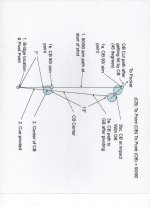
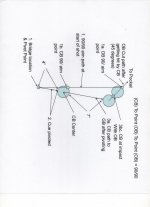
Oh yeah, In ACAD (computer aided drawing tool), with a 12 inch bridge distance behind the CB; and 1/2 tip offset and pivot, at the bridge, to the center of the CB; creates and included angle of 1.35 degrees that sends the CB toward the outside of the OB as the distance between the CB and OB increases - to infinity.

This can't make things "exact." Adjusments need to be made.

Just sayin.
 
Finally, back to some useful discussion/diagrams, you really have to hunt for it through all of the other BS… :)

I still don't know how or why (or even if?) this works, and since my time is limited at the table and my life is busy I've been spending whatever time I have practicing or playing and not doing too much critical thinking about it. But it's been 5 weeks or so now since starting to work with CTE / Pro One and I can't believe the results I'm getting. Playing for 15+ years, at a pretty decent level, and I feel like I finally "get it". I feel so locked in on shots it's unbelievable, my shot making has increased to a point higher than it's ever been, all in 9 or 10 sessions at the table. I've incorporated the system into my normal game, and over my last few sessions am able to adjust when needed for spin etc. and am picking up the visuals very easily and quickly and just getting down and shooting. It is strange, I almost feel like I'm not doing anything, but the feeling of being locked in by virtue of how I arrived at the aim line is like nothing I've ever experienced.

I still don't quite get how it works, or why, or sometimes even if. But I've NEVER shot like this, especially after not playing for a significant period of time. I'm making everything from everywhere as long as I pay attention to the visual part of it and don't jack up my stroke. Sometimes I feel like the visualization gets me very close to the actual aim line, and then my body/bridge ends up in the proper position because of this and the pivot (which I'm doing Pro One style now) aligns the stick. I don't know, I kind of get now how it's difficult to explain, especially on paper, and maybe even more difficult to prove. At this point I'm not worrying much about if it's based on geometric principles or a visual/subconscious thing, and whereas a few weeks ago it was something I was playing around with at this point I can't imagine shooting any other way.

I anxiously look forward to further productive conversations about the CTE / Pro One approach and I hope I can contribute something meaningful one way or the other along the way. For now, I think my next step is to repeat the Colin shotmaking test during my next practice session, I did it before using my old way of aiming, I'm curious if my score increases and how I feel over the various shots. Certainly not proof of anything, but for me at least will confirm a few things.

Scott

 
...I still don't quite get how it works, or why

...Sometimes I feel like the visualization gets me very close to the actual aim line, and then my body/bridge ends up in the proper position because of this

...I don't know, I kind of get now how it's difficult to explain, especially on paper, and maybe even more difficult to prove. At this point I'm not worrying much about if it's based on geometric principles or a visual/subconscious thing
If you're like others who like CTE you'll only tie yourself into logical and emotional knots trying to explain or "prove" it. Just enjoy the ride. If you're interested, it may be possible some day to have a civil conversation about how and why it works, but for now you have to do too much shoveling to find any useful bits.

pj
chgo
 
I accidentally spit my drink all over my monitor reading this :confused: I had to signature that post for the future. Read and do not post PJ and watch how civil the conversation becomes.
 
Last edited:
Finally, back to some useful discussion/diagrams, you really have to hunt for it through all of the other BS… :)

I still don't know how or why (or even if?) this works, and since my time is limited at the table and my life is busy I've been spending whatever time I have practicing or playing and not doing too much critical thinking about it. But it's been 5 weeks or so now since starting to work with CTE / Pro One and I can't believe the results I'm getting. Playing for 15+ years, at a pretty decent level, and I feel like I finally "get it". I feel so locked in on shots it's unbelievable, my shot making has increased to a point higher than it's ever been, all in 9 or 10 sessions at the table. I've incorporated the system into my normal game, and over my last few sessions am able to adjust when needed for spin etc. and am picking up the visuals very easily and quickly and just getting down and shooting. It is strange, I almost feel like I'm not doing anything, but the feeling of being locked in by virtue of how I arrived at the aim line is like nothing I've ever experienced.

I still don't quite get how it works, or why, or sometimes even if. But I've NEVER shot like this, especially after not playing for a significant period of time. I'm making everything from everywhere as long as I pay attention to the visual part of it and don't jack up my stroke. Sometimes I feel like the visualization gets me very close to the actual aim line, and then my body/bridge ends up in the proper position because of this and the pivot (which I'm doing Pro One style now) aligns the stick. I don't know, I kind of get now how it's difficult to explain, especially on paper, and maybe even more difficult to prove. At this point I'm not worrying much about if it's based on geometric principles or a visual/subconscious thing, and whereas a few weeks ago it was something I was playing around with at this point I can't imagine shooting any other way.

I anxiously look forward to further productive conversations about the CTE / Pro One approach and I hope I can contribute something meaningful one way or the other along the way. For now, I think my next step is to repeat the Colin shotmaking test during my next practice session, I did it before using my old way of aiming, I'm curious if my score increases and how I feel over the various shots. Certainly not proof of anything, but for me at least will confirm a few things.

Scott

I have said this before and this tells me you have the visualization down pretty good. I no longer use the lines on 90% on my shots now and i called it a 3rd stage of the system in a few post i made already.
 
Last edited:
champ2107:
I had to signature that post for the future.
Good. Maybe it will sink in for you over time.

Read and do not post PJ and watch how civil the conversation becomes.
Of course you'd be more civil if your ignorance wasn't challenged - but that wouldn't stop the spread of ignorance.

pj
chgo
 
Good. Maybe it will sink in for you over time.


Of course you'd be more civil if your ignorance wasn't challenged - but that wouldn't stop the spread of ignorance.

pj
chgo

Your very funny to laugh at Pj.

First is you are incapable of civil conversation, i know it and everyone knows it.

Second is the wealth of your knowledge you claim to have and shared with us is below, haha. You really opened my eyes with that post, very informative information you have given us PJ, its a wonder how nobody has ever discussed all that user driven info you shared before, I know those points you make are not obvious to anyone 8 years old and under. Maybe you next you can share with us what the white colored ball on the pool table is for?


I don't say I know the system better than" most"; this is another example of your lack of basic comprehension. I say I know it better than any CTE users who post here about it.

And I have made many "points"; this is yet another example of your lack of basic comprehension. As I've said over and over, the system works by giving the user some approximate (not "exact") alignment steps that the user finishes by feel. I've even (many times) pointed out the places where the system is "user-driven":

1. when the "secondary aim line" is chosen by the user
2. when the pivot direction is chosen by the user
3. when the eye position and "CB center" are chosen by the user
4. when the bridge placement and pivot are chosen/performed by the user


Obviously, these user-driven things make up just about the entire "system" - the "systematic steps" are pretty much all pretense that the system is in control so the user won't suffer a distracting crisis of confidence about his ability to do it. That's how the system "works" and what I know that you don't.

It's no surprise to me that you haven't understood these things - you've hardly understood anything in these threads. Now, after making false accusations based on your basic lack of comprehension, you'll claim that my pointing out your lack of comprehension is another example of CTE users being "insulted" and "attacked" (and, of course, so will Saint Joey of Bluefont).

pj
chgo
 
Last edited:
Oh yeah, In ACAD (computer aided drawing tool), with a 12 inch bridge distance behind the CB; and 1/2 tip offset and pivot, at the bridge, to the center of the CB; creates and included angle of 1.35 degrees that sends the CB toward the outside of the OB as the distance between the CB and OB increases - to infinity.

Are you saying that if you do this sequence

1. Place bridge point on ghost ball line at any bridge length whatsoever
2. Place cue on bridge point at any orientation whatsoever
3. Pivot cue around bridge point until the tip points to the center of the CB

then the CB goes to the outside of the OB?

Remember that the point of CTE/ProOne is to put the bridge point directly on the ghost ball line. That must be the final goal of all aiming systems. If that is done, the aiming problem is solved, assuming that the player manages to align the cue directly from the bridge point to the center of the CB - but that's an execution issue. Unfortunately, to the best of my knowledge this was not explicitly stated by Stan.
 
Are you saying that if you do this sequence

1. Place bridge point on ghost ball line at any bridge length whatsoever
2. Place cue on bridge point at any orientation whatsoever
3. Pivot cue around bridge point until the tip points to the center of the CB

then the CB goes to the outside of the OB?

remember that the point of CTE/ProOne is to put the bridge point directly on the ghost ball line. That must be the final goal of all aiming systems. If that is done, the aiming problem is solved, assuming that the player manages to align the cue directly from the bridge point to the center of the CB - but that's an execution issue. Unfortunately, to the best of my knowledge this was not explicitly stated by Stan.

1. Place the bridge hand down after resolving the CTE line and the secondry aim line to the points on the OB - wherever, I still don't know.

2. Place the bridge hand behind the CB by 12 inches - I do know.

3. Shift the cue tip 1/2 tip to the side - whichever.

4. Pivot the cue tip to the center of the OB - shoot.

What I am describing is a triangle with two 12 inch legs and the short leg of 1/2 cue tip or ~1/4 inch = 1.35 degrees. I hold that as the CB and OB are separated, This angle must be reduced by reducing the tip shift or lengthening the distance of the bridge behind the CB - or the CB will travel too far toward the outside of the OB resulting in another cut angle or miss it altogether.

This is the fallicy of a 1/2 tip shift that has been proffered in these threads.

Ghost Ball???? If you can find the GB aim line, you wouldn't need CTE.:(

This is an academic excercise to find the geometry/trig of CTE/Pro-one. I am a double distance aim shooter and GB aim when the CB and OB are very close together and remain so.:):thumbup:

Thanks for the diagrams in the other post.
 
Last edited:
Ghost Ball???? If you can find the GB aim line, you wouldn't need CTE.:(

No, it's the other way around :) The goal of all so-called "aim and pivot" systems is to discover a pivot point that is on the line between the centers of the cue ball and the ghost ball, whether that's explicitly stated or not (the latter being the usual case). The pivot point must be on that line or the shot doesn't go.

In 90/90, for example, suppose the instructions say

1. Aim the right 1/10 line on the cue ball to the right 1/10 line on the object ball.
2. Place your bridge at a point on that line that will give you a 12-inch bridge length.
3. Pivot your hips so that the cue tip is pointed at the cue ball's center.
4. Shoot the shot.

(This was taken from dr_dave's site.) Then what the instructions are saying is that the specified pivot/bridge point lies on the CB-GB line. That must be what those instructions are saying, because if that point is not on the CB-GB line, the ball will not go through the GB center point, and the shot will fail. Therefore, the system is designed to find a pivot/bridge point on the CB-GB line, even though you do not know exactly where the GB is to begin with.
 
No, it's the other way around :) The goal of all so-called "aim and pivot" systems is to discover a pivot point that is on the line between the centers of the cue ball and the ghost ball, whether that's explicitly stated or not (the latter being the usual case). The pivot point must be on that line or the shot doesn't go.

In 90/90, for example, suppose the instructions say

1. Aim the right 1/10 line on the cue ball to the right 1/10 line on the object ball.
2. Place your bridge at a point on that line that will give you a 12-inch bridge length.
3. Pivot your hips so that the cue tip is pointed at the cue ball's center.
4. Shoot the shot.

(This was taken from dr_dave's site.) Then what the instructions are saying is that the specified pivot/bridge point lies on the CB-GB line. That must be what those instructions are saying, because if that point is not on the CB-GB line, the ball will not go through the GB center point, and the shot will fail. Therefore, the system is designed to find a pivot/bridge point on the CB-GB line, even though you do not know exactly where the GB is to begin with.

I concur.
So tell me where to place my bridge hand so that I don't need to find the secondary aim point on the OB, shift or pivot - please.:wink:

Mikjary explained 90/90 and I found it to be more parsimonious, no CTE or parallel shifting. The thread died an early death.

90/90 works when the bridge placement distance behind the CB, pre-pivot is 1/2 the distance between the Cb and OB. When that distance increases, so does the bridge distance behind the CB which narrows the included angle to prevent the CB traveling outside of the contact point on the OB and eventually missing the OB altogether - but you knew that.

:thumbup:

90-90 short.jpg

90-90 long.jpg
 
Last edited:
I concur.
So tell me where to place my bridge hand so that I don't need to find the secondary aim point on the OB, shift or pivot - please.:wink:

The secondary aim point and offsetting the bridge point from the CTEL are fundamental to the system. If you can find the bridge point, then there's really no need to pivot (or at least none that I can find) - the bridge point is on the CB-GB line. Just lay the cue across it pointed at the center of the cue ball. The same is true for 90/90, as far as I can tell. However, pointing the cue as Stan says to may help in finding the bridge point, in which case you do need to pivot on it.
 
The secondary aim point and offsetting the bridge point from the CTEL are fundamental to the system. If you can find the bridge point, then there's really no need to pivot (or at least none that I can find) - the bridge point is on the CB-GB line. Just lay the cue across it pointed at the center of the cue ball. The same is true for 90/90, as far as I can tell. However, pointing the cue as Stan says to may help in finding the bridge point, in which case you do need to pivot on it.

I see what you are saying, but how does one determine where the line (of aim) that intersects the line to the GB lies - to place the bridge?
 
What I take away from this is:
1. The CTEL is where one can start.

2. The secondary aim line from the edge of the CB to the fractional aim points on the OB. This forces one to move one's stance to move laterally.

3. The new location establishes the new stance to effect the shift and pivot or not.

4. How does one having established this new stance, know where to place the bridge hand?

Do you know and can tell? Or is that still a riddle?:wink:
 
Back
Top