

You are using an out of date browser. It may not display this or other websites correctly.
You should upgrade or use an alternative browser.
You should upgrade or use an alternative browser.
what would you do here?
- Thread starter wigglybridge
- Start date
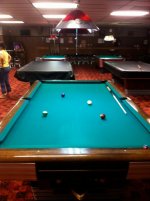

If you knew you were going to miss, did you at least leave a pattern that doesn't allow for a break and run.
Suppose you played perfect and had the break shot, but on the third to last shot you missed, like you described. Is there a shot you can play, legal or foul to avoid leaving the opponent a break and run pattern.
Yes, your strategy supposes you would play perfectly and break and run, but sometimes I plan on leaving a defensive pattern on the table in case something happens on my way to the break and run, that happens frequently.
Suppose you played perfect and had the break shot, but on the third to last shot you missed, like you described. Is there a shot you can play, legal or foul to avoid leaving the opponent a break and run pattern.
Yes, your strategy supposes you would play perfectly and break and run, but sometimes I plan on leaving a defensive pattern on the table in case something happens on my way to the break and run, that happens frequently.

i'll tell you what I did: shot the 2-ball and missed.
I play the 7 ball first then the 2ball leaving the 14 for my break but i'm left handed.

@Rufus
I would choose your pattern perhaps, too- but i don t like the position of the 14 to break with it-just personal preference. And imo the position from the 14 to the keyshot is easy to get, that s why i would run this way. Furthermore imo the 14 is kind of standardshot i usualy never fear bc using this shot to come to the middle of the table is given in almost every rotation game.
It s always hard to discuss *what would be the best pattern*.
lg
Ingo
I would choose your pattern perhaps, too- but i don t like the position of the 14 to break with it-just personal preference. And imo the position from the 14 to the keyshot is easy to get, that s why i would run this way. Furthermore imo the 14 is kind of standardshot i usualy never fear bc using this shot to come to the middle of the table is given in almost every rotation game.
It s always hard to discuss *what would be the best pattern*.
lg
Ingo
Ig, playing the 14 first was my other main alternative, and looking at it from the picture, i think you're correct, it was the right shot.
If you knew you were going to miss, did you at least leave a pattern that doesn't allow for a break and run.
Suppose you played perfect and had the break shot, but on the third to last shot you missed, like you described. Is there a shot you can play, legal or foul to avoid leaving the opponent a break and run pattern.
Yes, your strategy supposes you would play perfectly and break and run, but sometimes I plan on leaving a defensive pattern on the table in case something happens on my way to the break and run, that happens frequently.
This sounds like playing not to lose rather than playing to win. There are conservative approaches for when your not playing well, but it generally involves playing safe routes rather than trying to do more than you feel capable of. For example, if my game is very off I'll shoot the break ball instead of playing a difficult shot that I might have played if I was in better form. In this way I'm only running 10-14 balls at a time and being conservative, but I'm still playing to win as I'm still playing positive shots for the most part.
Generally speaking, if you are always planning for what happens if you miss, you're playing negatively. Furthermore, your mind tends to execute what you think about, so if you're thinking of missing constantly it will happen more often than you'd like.
As for the original question, the 14 is the first shot for sure.
This sounds like playing not to lose rather than playing to win. There are conservative approaches for when your not playing well, but it generally involves playing safe routes rather than trying to do more than you feel capable of. For example, if my game is very off I'll shoot the break ball instead of playing a difficult shot that I might have played if I was in better form. In this way I'm only running 10-14 balls at a time and being conservative, but I'm still playing to win as I'm still playing positive shots for the most part.
Generally speaking, if you are always planning for what happens if you miss, you're playing negatively. Furthermore, your mind tends to execute what you think about, so if you're thinking of missing constantly it will happen more often than you'd like.
As for the original question, the 14 is the first shot for sure.
well chosen words- u nailed it.
Ingo
This sounds like playing not to lose rather than playing to win. There are conservative approaches for when your not playing well, but it generally involves playing safe routes rather than trying to do more than you feel capable of. For example, if my game is very off I'll shoot the break ball instead of playing a difficult shot that I might have played if I was in better form. In this way I'm only running 10-14 balls at a time and being conservative, but I'm still playing to win as I'm still playing positive shots for the most part.
Generally speaking, if you are always planning for what happens if you miss, you're playing negatively. Furthermore, your mind tends to execute what you think about, so if you're thinking of missing constantly it will happen more often than you'd like.
As for the original question, the 14 is the first shot for sure.
Don't rush me, I am on training wheels.
The peer pressure is overwhelming.

If you played onto this, you failed to leave a decent key ball, but if opponent left it, you're not at fault and must make the most of this mess. Fourteen ball looks too high to be an ideal breakshot, so I'd play a pattern onto the seven. You can get there playing two and then fourteen or fourteen and then two, but I'd be inclined to shoot the fourteen first, as you can get onto the seven ball breakshot from almost any leave on the two in the corner.

I shoot the 14 1st get pos off the 2 .
Steve Lipsky has cue table3 diagram with a similar layout that shows (proof) imho the margin of error is much larger playing off the ball up table then the other balls
Steve Lipsky has cue table3 diagram with a similar layout that shows (proof) imho the margin of error is much larger playing off the ball up table then the other balls

I would not criticize the remaining balls. It's not an ideal pattern by any means, but some racks, even for the very best pros, simply get difficult and this layout isn't that bad, or that unusual.
I would use the 7 ball for my break shot. Play the 14 in the corner and come one rail to shoot the 2 in the side. Playing it this way allows to cueball to return on a line that should leave you a reasonable shot at pocketing the 2 ball and getting on the 7 ball. Playing the 2 ball first, with such a small angle, makes in very difficult to get on the 14 ball in a way that would allow position for a breakshot.
I would use the 7 ball for my break shot. Play the 14 in the corner and come one rail to shoot the 2 in the side. Playing it this way allows to cueball to return on a line that should leave you a reasonable shot at pocketing the 2 ball and getting on the 7 ball. Playing the 2 ball first, with such a small angle, makes in very difficult to get on the 14 ball in a way that would allow position for a breakshot.