
Use of Nelsonite or Resolute

Nelsonite or Resolute / Yes or No

  • No and I have been building cues for over 10 years

    Votes: 14 28.6%
  • No and I have been building cues less than 10 years

    Votes: 21 42.9%
  • Yes and I have been building cues for over 10 years

    Votes: 7 14.3%
  • Yes and I have been building cues less than 10 years

    Votes: 7 14.3%

  • Total voters
    49
  • Poll closed .
I'd like to first comment on what Tom said about, "following the grain". This is very true. You should center drill based on 'following the grain'. This is absolutely necessary when you have grain run-off. Grain run-off usually occurs in lower grade and/or less expensive shaft wood squares. When you have to 'follow the grain' you have shafts turning off center, hopping along on your lathe while you're turning them true. They'll be out of round for several cuts until you cut the run-off out of the square. Now, if this is your cup of tea, hey go for it.

I like to think in terms of dollars and sense. My time is worth so much and the less of my time I can use for what I like to term 'busy work', the more time I can spend in more productive areas. For example, I'd much rather spend $8 or $10 for a shaft and get straight grain than buy $4 or $6 shafts with run-off that I have to correct. The extra two or five dollars spent saves me hours of my time (following the grain) which is certainly worth more than I save buying lower priced wood. Some think just the opposite and that's fine. My time is better spent in 100% productive areas moving forward. Cue building is hard enough without having to correct what can be purchased correctly by paying a few dollars more. We have to utilize our time in the most productive areas. Chasing the grain, is in my opinion, a waste of my time when I can cut a straight grained shaft directly in the center without having to figure out where to center drill each stick individually. But hey, that's just me.

And then there is nothing wrong with buying $4 or $6 shafts if you're building sneaky petes, converting house cues or just beginning. Some cue makers have been doing this for 10 years and insist on buying the least expensive shafts and making them better by following the grain. Once again, if the results end in a quality shaft, you've done your job. I just think my time is better spend in other areas.

I'd like to comment next on Tony's post and thank him for the plug. We all learn by our mistakes and this forum can be invaluable when people stay on topic and put their inner hostilities aside for the better of the community as a whole.

As far as letting the "flaming begin", I'd like to think we're all past that and many of us realize that 'flame wars' do nothing to serve the community as a whole. They take an otherwise useful topic and dilute it with unnecessary nonsense aside from being counter productive. Focusing on the positives of playing pool and building cues is so much more fun and engaging. By avoiding the flaming, perhaps many other established cue makers will participate without fear of reprisal or being flamed themselves. There is no reason we can't all just get along and no I'm not quoting Rodney King. :grin:

In the past few threads which I've participated, they've stayed on topic, great information was exchanged and opinions were respected. It's really not all that difficult. We have to tame this and avoid the wild, wild west approach.

In the spirit of good dialogue, intelligent conversation and exchanging opinions in a productive manner, I hope many of you can agree.

Joe,

Are you speaking as a CM or a shaft merchant. Do you process your shaft wood through your doweling machine or do you have someone turning them and following the grain? If so, that higher labor cost is justified in the end product.

I use a doweling machine and do not offset centers and follow the grain during the selection process but I have to go through over 200 5/4 stock kiln dried planks from UP to get a few boards that meet the grade and I still have scrap areas in each board. Sometime I strike out and get nothing but a wasted trip. That's ok because it is the nature of the beast.

Reading the plank face and grain is what it is all about on my process. Classification is a root control mechanism. If you get 10,000 squares delivered on a pallets there are going to be some good ones in there but the AQL ( acceptable quality level ) will always be a random valuation function. There was a guy here in my area that got in and out of this shaft biz very fast after telling many CMs that the grain run out did not matter. Even if it did not matter and was proved by physics, if the customer wants a certain feature to a product, then that is the holy grail you must deliver or suffer the consequences.

Rick

This guy got pallets of squares and found that out the hard way. I let him run them through my doweling machine before the flaming and the good customer service response started on AZ.

IMG_3668.jpg

Boxes of random squares cut into dowels. I got 20 very good pieces hand picked from this batch of 800 for my trouble but there were a lot of bummers in there that I saw. :shocked2:
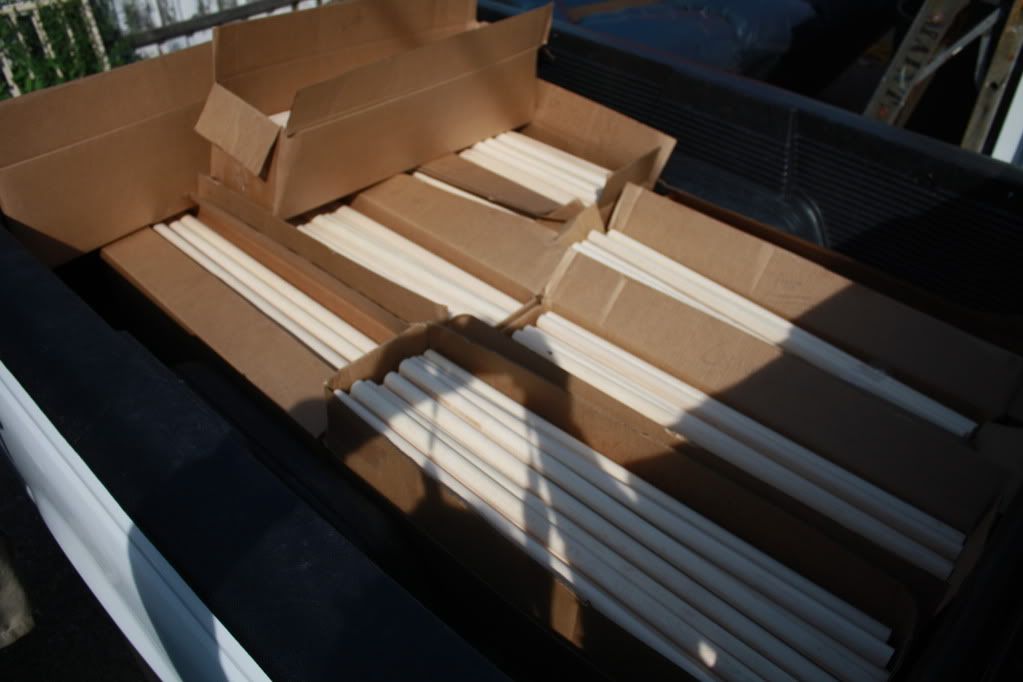
IMG_3669.jpg
 
Shaft dipping

I have been dipping my maple, oak and purple heart shafts in Resolute or Nelsonite for more than 10 years and will continue to do so as I believe the benefits outweigh the down side of which I have not experienced any. Some say you can smell the Resolute when cutting the shaft. I have not found that to be so in my operation where the shaft hangs at least 2 years after dipping.
I dip when the shaft is a blank and again when the shaft joint diameter is around .900. As a side note I use my rejected dowels for plant stakes.

Once I did an experiment and used untreated dowels and treated dowels as plant stakes. After a few seasons of holding marigolds and tomatoes the untreated dowels were bowed and the treated ones where still fairly straight. If I had any doubts about the effectiveness of Resolute (which I did) this garden experiment removed them FWIW.​
 
Joe,

Are you speaking as a CM or a shaft merchant. Do you process your shaft wood through your doweling machine or do you have someone turning them and following the grain? If so, that higher labor cost is justified in the end product.

I use a doweling machine and do not offset centers and follow the grain during the selection process but I have to go through over 200 5/4 stock kiln dried planks from UP to get a few boards that meet the grade and I still have scrap areas in each board. Sometime I strike out and get nothing but a wasted trip. That's ok because it is the nature of the beast.

Reading the plank face and grain is what it is all about on my process. Classification is a root control mechanism. If you get 10,000 squares delivered on a pallets there are going to be some good ones in there but the AQL ( acceptable quality level ) will always be a random valuation function. There was a guy here in my area that got in and out of this shaft biz very fast after telling many CMs that the grain run out did not matter. Even if it did not matter and was proved by physics, if the customer wants a certain feature to a product, then that is the holy grail you must deliver or suffer the consequences.

Rick

This guy got pallets of squares and found that out the hard way. I let him run them through my doweling machine before the flaming and the good customer service response started on AZ.

IMG_3668.jpg

Boxes of random squares cut into dowels. I got 20 very good pieces hand picked from this batch of 800 for my trouble but there were a lot of bummers in there that I saw. :shocked2:
IMG_3669.jpg

So, you found 20 out of 800? I think I might get 4 out of 60.

This thread has been going well and I would like to keep it that way, so I hopefully won't be compelled to say any more about "that" wood.
 
So, you found 20 out of 800? I think I might get 4 out of 60.

This thread has been going well and I would like to keep it that way, so I hopefully won't be compelled to say any more about "that" wood.

You funny Randy.

I bought 5 gallons of Resolute from Joe about 1.5 years ago. I gave it a bit of thought, read the MSDS and then decided not to use it... at least not yet. I figured I would try cutting a bunch of shafts without it and see how it goes.

Now this all comes from a new cuebuilder. Although I spent 14+ years as a Machinist, my experience with cutting wood was limited to things I was going to nail, glue or screw in place.

I've bought a bunch of shaft wood from Joe over the last year and a half. 50 pieces for $200 on Ebay, several cones, a few final tapers, half a dozen matched sets and 5 of the Joe's Gold. Also have 5 marked PV (Premium Vacuum??) but haven't touched them yet. Here is what I have seen so far.

Again, this is from a new CB so take it for what its worth.

As far as I know the only one that were dipped are the Joe's Gold.
I have not dipped any.
I live outside Baltimore, moderate to high humidity.
My shop does have a humidifier (when I remember to empty it).

On the 50 pieces ($4 shaft wood) some are pretty straight, others wavy. A few of the straight ones warped but most were ok. Many of the ones with wandering grain are still straight. The worst looking ones will soon be coring dowels. Again, this is $4 shaft wood bought in bulk.

The Tapered Cones and Matched sets are still straight. I think I did have one of the cones that still wobbled a bit after the 2nd round of cuts.

Final Tapers were all still straight last time I looked

Of the 5 Joe's Gold I bought (these came already dipped), 3 are warped pretty bad. Now, this may mean absolutely nothing. As I am sure you all know, with wood its a luck of the draw. Was it the wood, the Resolute, combo, who knows?!

So from my limited experience, dipping of the more expensive wood seems to have caused problems. Would it have fixed some of those $4 shafts? How can I be sure one way or the other?! If Resolute would go completely to the center of the wood so I had to only do it once, then maybe I would use it. I could then dip and let them dry for a couple months. So for me at this point, soaking the wood twice and exposing myself to yet another chemical isn't the direction I'm headed. If I notice problems, I'll revisit this.


*
 
It would seem the logical route would be to avoid using any chemicals until the shaft was nearly finished. If the wood is naturally wanting to move, it is better to let it move as much as it wants before you remove a bunch of wood. If you retard movement too much, it may still have some movement to do late in the process. it would seem to me that if you let the wood shift through the entire process as it would naturally, then when you've treated the wood at the end, it should move less after it leaves the shop. Wood may move due to machining OR moisture movement. Why not let it do it's thing while you still have a chance to use it for a stake?
 
I'll just say that I've been using Nelsonite for around 15 years and wouldn't even consider not using it or some other stabilizer. I make 8 passes from start to finish and dip a minimum of 3 times and usually 4.

When I first started using Nelsonite I figured I was getting between 15 and 20% more yield. If I thought I was only getting a 1 in a 1000 better ratio I would still take the effort and expense which is slight, as that means less chance for that one going south after cue has been built and sold.

Dick
 
Hi,

I take all passes on each shaft at a 6 minute feed rate and monitor the shaft racks all of the time. I recently changed my protocol as I was hogging at a faster feed rate. After visiting the shop of a big top tier cue maker, he advised me to take all my cuts at the slow feed rate as not to shock the wood even when hogging the initial taper

I also used to cut the initial taper and land about .960 then take cuts once a week then park all stored units at .900 until I selected them for a cue. I was culling anything that wiggled even slightly at .910.

About 18 months ago I saw a very poignant comment by Murray Tucker here where he said,"I find it is better to park shafts closer to final size". Since his statement, I have been parking all my shafts at .860. Now, when ready to make it for a cue, I take 4 .004 passes to .844, then one more burnishing pass at the same indictor elevation. If they are seasoning closer to final for a long period and they don't wiggle at all at .860, I feel I have a quality shaft to put into the field.

Since doing the Murray method, I have much more confidence with straight shafts staying straight after they leave the nest. A very good tip indeed.

Rick
 
Last edited:
this thread just reminded me that I have a group of shafts in the dunk tank and they have been there for....... at least 4 months lol ill have to go see what they look like as ive never forgotten anything in the tank for that long before.

its about time for me to cut a bunch anyways, I only cut shafts about every 4-6 months that need dipped.

How long do you guys typically submerge your shafts for? I usually go till I quit seeing bubbles or overnight. groups of 3-6 at a time the lower the resolute gets in the tube the more shafts I can fit. :-)
 
Last edited:
Hi,

I take all passes on each shaft at a 6 minute feed rate and monitor the shaft racks all of the time. I recently changed my protocol as I was hogging at a faster feed rate. After visiting the shop of a big top tier cue maker, he advised me to take all my cuts at the slow feed rate as not to shock the wood even when hogging the initial taper

I also used to cut the initial taper and land about .960 then take cuts once a week then park all stored units at .900 until I selected them for a cue. I was culling anything that wiggled even slightly at .910.

About 18 months ago I saw a very poignant comment by Murray Tucker here where he said,"I find it is better to park shafts closer to final size". Since his statement, I have been parking all my shafts at .860. Now, when ready to make it for a cue, I take 4 .004 passes to .844, then one more burnishing pass at the same indictor elevation. If they are seasoning closer to final for a long period and they don't wiggle at all at .860, I feel I have a quality shaft to put into the field.

Since doing the Murray method, I have much more confidence with straight shafts staying straight after they leave the nest. A very good tip indeed.

Rick


I geuss ive never thought about this before, I cant quite wrap my head around why it would matter??? but if it works for you kewl beans.

Ive found that with my new cutter I can cut at about 20 inches a minute when hogging but I cone first then dip then cut to about .100 oversize with a taper and redip. my final passes take about 5 minutes for a 30 inch shaft blank and require very little sanding.

ive seen a good change in the amount of shafts I keep compared to a couple yrs ago.
 
I bought all of my shaft wood from Joe on EBay several years ago when I was starting. Approx 120 shafts. Guys are probably going to laugh at me now.
I admit, I am shaft challenged at the moment.

12 PH shafts all good to this day.

24 dipped cones. Obviously they were already center drilled and were straight as an arrow when put between centers and still good.

The rest were dowels. I center drilled and some were a tad wobbly. Straight after the first pass.

The only shaft I have from Joe that warped was one I did all in one shot as I was setting the taper bar on the Deluxe. Its actually sitting in my home made shaft warp taker outter.

Probably end up being good enuff for me as a spare shaft.
 
Hey Guys....

It's a short week and tomorrow's the 4th; I don't have time right now to come out and play but will respond when time permits.

Happy 4th to All!
 
Joe, I received the 2 sample packs of American Eagle brown and black.

Fast shipping as usual. I have a couple of cues that will be in need of tips soon and will try them shortly.

They are sky scrappers and look to be well built.

Nice that we are starting to get good alternatives for a decent price.
I can afford to charge the same amount for an install, yet give my customers a break and not lose money in the process.

There are only a few players here that are using Kamuis and if I have my way, that will change soon.

Looking forward to testing these out in the near future.
 
Joe, I received the 2 sample packs of American Eagle brown and black.

Fast shipping as usual. I have a couple of cues that will be in need of tips soon and will try them shortly.

They are sky scrappers and look to be well built.

Nice that we are starting to get good alternatives for a decent price.
I can afford to charge the same amount for an install, yet give my customers a break and not lose money in the process.

There are only a few players here that are using Kamuis and if I have my way, that will change soon.

Looking forward to testing these out in the near future.


Shhhhhhhhhhh!!!! You weren't suppose to mention that we send freebies or samples! What are you trying to do; ruin our reputation. :grin: And for those of you who would like to chime in and say something sarcastic, please allow me. We don't need anyone trying to ruin our reputation as we do a fine job of that all by ourselves. OK, so now there won't be any need for controversy on that subject. Back to the topic at hand...

It's nice to see many of you exchanging cutting schedules. Our cutting schedule is varied because we also sell the shafts we produce but we have to cut them in line with what we also use for our own cues (when we make them). So, our cutting techniques may not be appropriate for you but works wonders for us.

I'll share something with you and I don't want to go back and forth over it. So take it for what it's worth. Doweling is very intrusive; no argument there but no matter how you go from square to round it's intrusive; it's only a matter how intrusive. When we dowel our shafts, yes some have a slight wiggle (and I mean slight) and we don't care because we're not using them as 1" dowels. Some are downright wobblers which we discard; those are very few. You have to understand that some wood just doesn't want to be a shaft no matter how hard you try. The doweling gets a lot of the movement out of the stick. Our process works well for producing stable shafts and that's our largest concern.

A side note: the shafts you purchase have a lot to do with the movement. If you buy shafts from a guy doweling them in the back of a pick-up truck, call me crazy but you're asking for trouble. If you buy your shafts from a guy who needs money to buy more wood and doesn't care about how he dries his wood, call me crazy but you're asking for trouble. There are many guys buying wood from a particular fast dry artist. His wood is cheap so they buy it and wonder why they lose up to 50% due to movement. The faster he dries his wood, the faster he can sell it and the faster he can load up his kiln again. Time is money and when you're looking to make money as fast as you can, drying time is only a hindrance so dry it as fast as you can. That's his motto. Who is this guy? Well there are three of them and you all know them; some of you buy from them. Hey if it's working for you and you're happy with your purchases, then stay with it. I'm only making an observation based on experience and knowledge.

ACA Suppliers: This won't endear me to anyone but as you all know, I call it like I see it and I don't pull any punches. I'm not a politician nor a diplomat and don't ever plan on being one. I don't remember who said it but someone mentioned the ACA only to stick it up my butt as a list of worthwhile suppliers and that he assumes they (the suppliers) know what they are doing because they are ACA listed suppliers. The problem is just because you are listed on the ACA web site as a supplier, that doesn't mean anything. If you can follow along, if you don't create controversy, if you keep your mouth shut and you have the $100 application fee, this will put you on the ACA list of preferred suppliers. Mickey Mouse could be a supplier! We're not on the list because we choose not to be on it and I have my own opinion and I'm not afraid to voice it. Let me go on record as saying that the membership list of cue makers at the ACA is impressive and I have great respect for each and every cue maker who is a member. The sad part is that they can't grow the membership to more than 43 cuemakers is a shame. How many cue makers are out there doing simply fantastic work and are not members? The list of cue makers who are not members is equally as impressive. Sorry I had to bring this up but someone just had to stick it in so here's my take on it.

Back to cutting:

We let the 1" rounds sit to relax as they've been traumatized. They sit and relax with pina coladas on the white sandy beaches of Daytona for about 4 to 6 weeks. At that point they are tired from relaxing and looking for action. We oblige them and put them on our 4 head CNC and cone them immediately down to .750 x .960. Too aggressive you say? Well, we don't think so and it works for us. We then dip them in Resolute (now we use Shaft Dip) and hang them for a month or two. From this point we go down from there from .750 to .675 to .625 to .575 (dipped again in Resolute; now Shaft Dip) to.550. All cuts are a minimum of 4-6 weeks apart and sometimes more depending on our laziness.

Now the keyword here to remember is that our shop is professionally run. We have air condition in the summer. We have heat in the winter and we have dehumidifiers running all the time. The shop also has 8 fans on the ceiling constantly circulating air 24 hours a day. Our shafts are immediately hung from the business end immediately after each pass. We don't let them sit around for a day or two or until we have the time to hang them; we make the time. The program works for us and it works quite well as we ship shafts all over the world with complete confidence.

This program may not be for you. The way you cut your shafts rests soley on your area, humidity or lack of, and how it's set-up with temperature control. If you are working in a garage with no heat or A/C - that's a problem. How you work and the results you achieve are in direct correlation.

Final cuts and "parking" shafts. We cannot "park" our shafts at .860 due to the fact that we're resellers of fine shaft wood. I think .860 is a tad too small (for us as resellers) and would strive for .875 but if .860 works, then go for it.

As far as final passes. YES!! It is imperative to take your final passes slowly. Our final pass runs about 14 minutes.

I hope this proves helpful.

And on that note, I am out of here: Happy 4th! :grin:
 
Last edited:
Shhhhhhhhhhh!!!! You weren't suppose to mention that we send freebies or samples! What are you trying to do; ruin our reputation. :grin: And for those of you who would like to chime in and say something sarcastic, please allow me. We don't need anyone trying to ruin our reputation as we do a fine job of that all by ourselves. OK, so now there won't be any need for controversy on that subject. Back to the topic at hand...

It's nice to see many of you exchanging cutting schedules. Our cutting schedule is varied because we also sell the shafts we produce but we have to cut them in line with what we also use for our own cues (when we make them). So, our cutting techniques may not be appropriate for you but works wonders for us.

I'll share something with you and I don't want to go back and forth over it. So take it for what it's worth. Doweling is very intrusive; no argument there but no matter how you go from square to round it's intrusive; it's only a matter how intrusive. When we dowel our shafts, yes some have a slight wiggle (and I mean slight) and we don't care because we're not using them as 1" dowels. Some are downright wobblers which we discard; those are very few. You have to understand that some wood just doesn't want to be a shaft no matter how hard you try. The doweling gets a lot of the movement out of the stick. Our process works well for producing stable shafts and that's our largest concern.

A side note: the shafts you purchase have a lot to do with the movement. If you buy shafts from a guy doweling them in the back of a pick-up truck, call me crazy but you're asking for trouble. If you buy your shafts from a guy who needs money to buy more wood and doesn't care about how he dries his wood, call me crazy but you're asking for trouble. There are many guys buying wood from a particular fast dry artist. His wood is cheap so they buy it and wonder why they lose up to 50% due to movement. The faster he dries his wood, the faster he can sell it and the faster he can load up his kiln again. Time is money and when you're looking to make money as fast as you can, drying time is only a hindrance so dry it as fast as you can. That's his motto. Who is this guy? Well there are three of them and you all know them; some of you buy from them. Hey if it's working for you and you're happy with your purchases, then stay with it. I'm only making an observation based on experience and knowledge.

ACA Suppliers: This won't endear me to anyone but as you all know, I call it like I see it and I don't pull any punches. I'm not a politician nor a diplomat and don't ever plan on being one. I don't remember who said it but someone mentioned the ACA only to stick it up my butt as a list of worthwhile suppliers and that he assumes they (the suppliers) know what they are doing because they are ACA listed suppliers. The problem is just because you are listed on the ACA web site as a supplier, that doesn't mean anything. If you can follow along, if you don't create controversy, if you keep your mouth shut and you have the $100 application fee, this will put you on the ACA list of preferred suppliers. Mickey Mouse could be a supplier! We're not on the list because we choose not to be on it and I have my own opinion and I'm not afraid to voice it. Let me go on record as saying that the membership list of cue makers at the ACA is impressive and I have great respect for each and every cue maker who is a member. The sad part is that they can't grow the membership to more than 43 cuemakers is a shame. How many cue makers are out there doing simply fantastic work and are not members? The list of cue makers who are not members is equally as impressive. Sorry I had to bring this up but someone just had to stick it in so here's my take on it.

Back to cutting:

We let the 1" rounds sit to relax as they've been traumatized. They sit and relax with pina coladas on the white sandy beaches of Daytona for about 4 to 6 weeks. At that point they are tired from relaxing and looking for action. We oblige them and put them on our 4 head CNC and cone them immediately down to .750 x .960. Too aggressive you say? Well, we don't think so and it works for us. We then dip them in Resolute (now we use Shaft Dip) and hang them for a month or two. From this point we go down from there from .750 to .675 to .625 to .575 (dipped again in Resolute; now Shaft Dip) to.550. All cuts are a minimum of 4-6 weeks apart and sometimes more depending on our laziness.

Now the keyword here to remember is that our shop is professionally run. We have air condition in the summer. We have heat in the winter and we have dehumidifiers running all the time. The shop also has 8 fans on the ceiling constantly circulating air 24 hours a day. Our shafts are immediately hung from the business end immediately after each pass. We don't let them sit around for a day or two or until we have the time to hang them; we make the time. The program works for us and it works quite well as we ship shafts all over the world with complete confidence.

This program may not be for you. The way you cut your shafts rests soley on your area, humidity or lack of, and how it's set-up with temperature control. If you are working in a garage with no heat or A/C - that's a problem. How you work and the results you achieve are in direct correlation.

Final cuts and "parking" shafts. We cannot "park" our shafts at .860 due to the fact that we're resellers of fine shaft wood. I think .860 is a tad too small (for us as resellers) and would strive for .875 but if .860 works, then go for it.

As far as final passes. YES!! It is imperative to take your final passes slowly. Our final pass runs about 14 minutes.

I hope this proves helpful.

And on that note, I am out of here: Happy 4th! :grin:

What a great post!!
 
Back
Top