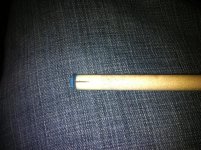
Marking The Ferrule

LifeAt35mm

Registered
Last week I worked with an instructor and I noticed that he had all of his cue shaft ferrules marked similar to the pic below. The tonight I went to Mr Cue's II (in Metro-Atlanta) and noticed a player in the tournament also had their ferrules marked. The instructor compared it to having sights on a rifle.

Is this a common practice? What are you alls opinions on this?
 

Attachments

  • image.jpg
    image.jpg
    101.6 KB · Views: 630
Good idea, I may do this with my ferrule, not like I care about it, just plastic and already sanded and scratched from making the upper part match the smaller tip lol. Placeholder for the i3 shaft anyways.
 
I did it more than 20 years ago but because the shaft had a very slight roll to it. So I marked it for straight up & straight down.

I did not find that it helped in aiming that much but maybe that was because I was using english on almost every shot.
 
I have a practice cue that has 1/8" black graphics tape running from the tip all the way down to the joint that I use to get my stick lined up properly.

Its pretty cool. Seeing the line in your peripheral vision lets you know immediately if the cue is in line with the shot line, twisting the cue or not stroking the cue straight back and forth.

The line sticks out like a soar thumb. A good practice tool.

John :smile:
 
I have a practice cue that has 1/8" black graphics tape running from the tip all the way down to the joint that I use to get my stick lined up properly.

Its pretty cool. Seeing the line in your peripheral vision lets you know immediately if the cue is in line with the shot line, twisting the cue or not stroking the cue straight back and forth.

The line sticks out like a soar thumb. A good practice tool.

John :smile:

Hi John,

I know black contrasts with the shaft, but a brighter color might even work better. When you first open your closed eyes, one sees white, bright yellows, & bright reds 'first'. Those 'colors' might show better in your periperal vision.

Just a thought. Hit em well,
 
hmmm, interesting, will give it a try. I guess it will help you to see the flaws more than helping the aiming.
I have always played using parallel aiming and now I´m starting to use pivoting for english, don´t have the right feeling for it yet but it works out pretty good, think this will be a good indicator also.

Thanks!

Chrippa
 
How does marking the shaft help aiming more than the line the shaft creates?

I heard someone mention that they marked their shaft for deflection. How does that help?
 
I mark my normal bridge length and the top of my ferrule.

I sometimes have a wrist turn problem and the ferrule will show me what happens on each stroke.

randyg

That's an interesting way to get a consistent bridge length.

Wouldn't wrist curl cause the cue to move off line, which would indicate the wrist curled?
 
How does marking the shaft help aiming more than the line the shaft creates?

I heard someone mention that they marked their shaft for deflection. How does that help?
Some measurements have shown different amounts of squirt for different rotations of the shaft. If that's true, it's better to have your shaft the same way all the time.
 
... Wouldn't wrist curl cause the cue to move off line, which would indicate the wrist curled?
Not always. There could be a compensating in or out motion of the hand. If you want simple mechanics, it's important for neither one to be present.
 
So I was playing with a marked shaft in the Galveston event and my opponent notices it and goes off to ask the TD if that's allowed. He came back in about five minutes saying that the TD said it was OK. My opponent's opinion was that it was an "aiming device" and therefor forbidden by the rules.
 
The new Viking ld shaft has a steel frame in the shaft that gives you this line from the joint to the ferrule. I'd like to try one out, but not for the amount they are asking.... :eek:
 
I do this as well. I use a red permanent sharpie to draw the line on the ferrule.

Use a straight edge to ensure that the line is straight. I actually have a sand paper tip shaper that has both the curved side and a flat side. There is a small groove that runs the length of it. The groove lines up to the right height of the ferrule and as long as you don't wiggle, the line will come out straight.

Once you get used to having it, you probably will decide to keep it.

For me, it offers 3 things.

First, I mark the ferrule along the line of where my shaft appears to be at its strongest point which to some degree does cut down on some deflection but not all.

Secondly, since I can't see exactly see where the actual dime or smaller radius is contacting the CB, it still allows me to fine tune where I'm striking the CB much like a front sight on a rifle.

Thirdly, as Randy G states, if you twist the wrist, you'll notice it immediately since the line will turn to the side.

Even though I use a permanent marker, occasionally part of or almost all of the line will fade. Possibly due to the movement of the ferrule in between the fingers during a PSR or using a closed bridge and sometime over a period of time of putting into my case.

When I see it fading, I just re-draw the line.

Sorry. I'm not an instructor (yet) but thought I'd chime in anyway.

 
Back
Top