
The Key To A Powerful Stroke

Pidge

AzB Silver Member
Silver Member
Over the past 2 nearly 3 months I've changed my stroke somewhat. More to the point I've changed what happens with my wrist. Previously my wrist stayed locked which helped with keeping my stroke straight but because I don't drop my elbow I really struggled when I needed to power through the CB. I had no option but to generate extra power with a snap of the wrist, but because I did it on the odd occasion it wasn't consistent so I started using it in every shot. Here is a quick run through what I do - hold the cue with a light grip between your thumb, index and middle finger and start the backward phase of the stroke by moving your wrist back first, then your forearm from the elbow joint then start the forward motion by moving your forearm forward first then your wrist should naturally move forward.

After the fist few weeks my stroke started to straighten out and up until last week I was trying to get used to speed control. Now the two have finally clicked and the results are crushing balls. I've been getting more spin, too. Well the same amount of spin but with less effort, and the Max amount of spin I can create has increased. Its added more shots to my arsenal. A shot came up where the 2 was 1ft away from the pocket, with only half the pocket available and the CB was about 6-7ft from the 2. I had to draw straight back to the bottom rail and come off the rail back up table and land 2ft away from the top rail. I failed. I got too much spin and the CB bounced off the top rail and landed middle table snookering me. Definitely a wtf moment.

I would urge anyone who doesn't have a 'wristy' stroke to experiment with it. Its helped me out, but it may not help you out. There is only 1 way to find out though.

So yeah - I've come to the conclusion that it doesn't matter if you can curl 100lbs, wrestle a bear that's just been castrated or drink protein shakes until it flows out of your nose - the movement in the wrist is a major part, if not the biggest part of a truely powerful stroke.
 
Pool's no exception, it's "all in the hands".

Over the past 2 nearly 3 months I've changed my stroke somewhat. More to the point I've changed what happens with my wrist. Previously my wrist stayed locked which helped with keeping my stroke straight but because I don't drop my elbow I really struggled when I needed to power through the CB. I had no option but to generate extra power with a snap of the wrist, but because I did it on the odd occasion it wasn't consistent so I started using it in every shot. Here is a quick run through what I do - hold the cue with a light grip between your thumb, index and middle finger and start the backward phase of the stroke by moving your wrist back first, then your forearm from the elbow joint then start the forward motion by moving your forearm forward first then your wrist should naturally move forward.

After the fist few weeks my stroke started to straighten out and up until last week I was trying to get used to speed control. Now the two have finally clicked and the results are crushing balls. I've been getting more spin, too. Well the same amount of spin but with less effort, and the Max amount of spin I can create has increased. Its added more shots to my arsenal. A shot came up where the 2 was 1ft away from the pocket, with only half the pocket available and the CB was about 6-7ft from the 2. I had to draw straight back to the bottom rail and come off the rail back up table and land 2ft away from the top rail. I failed. I got too much spin and the CB bounced off the top rail and landed middle table snookering me. Definitely a wtf moment.

I would urge anyone who doesn't have a 'wristy' stroke to experiment with it. Its helped me out, but it may not help you out. There is only 1 way to find out though.

So yeah - I've come to the conclusion that it doesn't matter if you can curl 100lbs, wrestle a bear that's just been castrated or drink protein shakes until it flows out of your nose - the movement in the wrist is a major part, if not the biggest part of a truely powerful stroke.

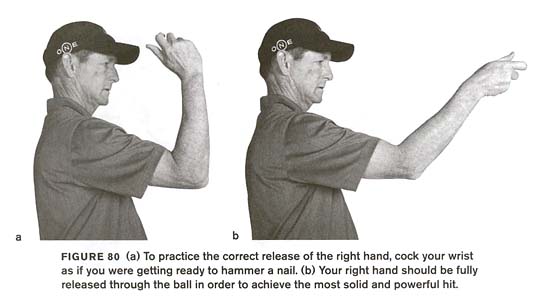
Get a hammer and hammer some nails, then play pool and try to incorporate the same wrist motion AND try holding the cue in the same manner. I played tennis and golf, so my grip was influenced by these other sports, however, my father was a carpenter, and I grew up on a lumber yard hammering a LOT of nails.

Earl Stickland also grew up hammering nails, and Rafael Martinez's father taught him the stroke with a hammer and nail, pounding them into a log.

The "hidden power" is in the hand/wrist/fingers, this is true throwing balls, in the golf swing and even casting a fishing rod. Pool's no exception, it's "all in the hands". Here's an AZ Thread that has extensive information on this subject - http://forums.azbilliards.com/showthread.php?t=294085&highlight=Wrist+ride

HaneyRightHandRelease.jpg
Hank Haney, Tiger Woods past golf swing coach demonstrates the hand motion and wrist release.
 
Last edited:
Get a hammer and hammer some nails, then play pool and try to incorporate the same wrist motion AND try holding the cue in the same manner. I played tennis and golf, so my grip was influenced by these other sports, however, my father was a carpenter, and I grew up on a lumber yard hammering a LOT of nails.

Earl Stickland also grew up hammering nails, and Rafael Martinez's father taught him the stroke with a hammer and nail, pounding them into a log.

The "hidden power" is in the hand/wrist/fingers, this is true throwing balls, in the golf swing and even casting a fishing rod. Pool's no exception, it's "all in the hands". Here's an AZ Thread that has extensive information on this subject - http://forums.azbilliards.com/showthread.php?t=294085&highlight=Wrist+ride

HaneyRightHandRelease.jpg
Hank Haney, Tiger Woods past golf swing coach demonstrates the hand motion and wrist release.
Thanks for the link and the picture, it kind of looks like he's casting a fishing rod. I played tennis a lot as a youngster and into my teens but I broke my wrist, whilst playing tennis weirdly enough and I can't do the hammer style momement when playing with a lot of power - it causes pain, even now. My movement is more of a 'reverse hammer' if that makes sense.

Its weird how such a small component of the stroke anatomy can have such an influence on the outcome. I remember when I was being taught as a child that the intructor spent no time on the grip and wrist, other than saying don't grip too tight and keep the wrist locked. I've been missing out for far too long.
 
Last edited:
this is what's happening in the golf swing, the baseball throw and the pool stroke.

Thanks for the link and the picture, it kind of looks like he's casting a fishing rod. I played tennis a lot as a youngster and into my teens but I broke my wrist, whilst playing tennis weirdly enough and I can't do the hammer style momement when playing with a lot of power - it causes pain, even now. My movement is more of a 'reverse hammer' if that makes sense.

Its weird how such a small component of the stroke anatomy can have such an influence on the outcome. I remember when I was being taught as a child that the intructor spent no time on the grip and wrist, other than saying don't grip too tight and keep the wrist locked. I've been missing out for far too long.

Yes, it's like he's casting a rod and reel....and this is what's happening in the golf swing, the baseball throw and the pool stroke. You can do it with the wrist moving the opposite way, but it's worth trying it the other way.

Notice the second picture, this is the normal follow through position in many champion's strokes.

shane-van-boening-ts.jpg
2008predator10ballchampionshipsfinalfourfranciscobustamante.jpg
th
 
Over the past 2 nearly 3 months I've changed my stroke somewhat. More to the point I've changed what happens with my wrist. Previously my wrist stayed locked which helped with keeping my stroke straight but because I don't drop my elbow I really struggled when I needed to power through the CB. I had no option but to generate extra power with a snap of the wrist, but because I did it on the odd occasion it wasn't consistent so I started using it in every shot. Here is a quick run through what I do - hold the cue with a light grip between your thumb, index and middle finger and start the backward phase of the stroke by moving your wrist back first, then your forearm from the elbow joint then start the forward motion by moving your forearm forward first then your wrist should naturally move forward.

After the fist few weeks my stroke started to straighten out and up until last week I was trying to get used to speed control. Now the two have finally clicked and the results are crushing balls. I've been getting more spin, too. Well the same amount of spin but with less effort, and the Max amount of spin I can create has increased. Its added more shots to my arsenal. A shot came up where the 2 was 1ft away from the pocket, with only half the pocket available and the CB was about 6-7ft from the 2. I had to draw straight back to the bottom rail and come off the rail back up table and land 2ft away from the top rail. I failed. I got too much spin and the CB bounced off the top rail and landed middle table snookering me. Definitely a wtf moment.

I would urge anyone who doesn't have a 'wristy' stroke to experiment with it. Its helped me out, but it may not help you out. There is only 1 way to find out though.

So yeah - I've come to the conclusion that it doesn't matter if you can curl 100lbs, wrestle a bear that's just been castrated or drink protein shakes until it flows out of your nose - the movement in the wrist is a major part, if not the biggest part of a truely powerful stroke.

Carlo Biado's recent shot is a great example of what you are talking about.

http://www.youtube.com/watch?v=XfRx5w-D3fE

36:00 minute mark.
 
Learning the "wrist break" was also a key part of my developing a decent stroke. Before taking a lesson from Liz Ford (my local APA league operator), I kept my wrist locked through the stroke. She showed me how to "break" my wrist, and that alone was worth the entire cost of the lesson.

It is surprising to me that this is never mentioned in any of the otherwise excellent books & videos I've seen.
 
Over the past 2 nearly 3 months I've changed my stroke somewhat. More to the point I've changed what happens with my wrist. Previously my wrist stayed locked which helped with keeping my stroke straight but because I don't drop my elbow I really struggled when I needed to power through the CB. I had no option but to generate extra power with a snap of the wrist, but because I did it on the odd occasion it wasn't consistent so I started using it in every shot. Here is a quick run through what I do - hold the cue with a light grip between your thumb, index and middle finger and start the backward phase of the stroke by moving your wrist back first, then your forearm from the elbow joint then start the forward motion by moving your forearm forward first then your wrist should naturally move forward.

After the fist few weeks my stroke started to straighten out and up until last week I was trying to get used to speed control. Now the two have finally clicked and the results are crushing balls. I've been getting more spin, too. Well the same amount of spin but with less effort, and the Max amount of spin I can create has increased. Its added more shots to my arsenal. A shot came up where the 2 was 1ft away from the pocket, with only half the pocket available and the CB was about 6-7ft from the 2. I had to draw straight back to the bottom rail and come off the rail back up table and land 2ft away from the top rail. I failed. I got too much spin and the CB bounced off the top rail and landed middle table snookering me. Definitely a wtf moment.

I would urge anyone who doesn't have a 'wristy' stroke to experiment with it. Its helped me out, but it may not help you out. There is only 1 way to find out though.

So yeah - I've come to the conclusion that it doesn't matter if you can curl 100lbs, wrestle a bear that's just been castrated or drink protein shakes until it flows out of your nose - the movement in the wrist is a major part, if not the biggest part of a truely powerful stroke.

Sorry, but I would never recommend flicking your wrist on every stroke. I do in on break shots and when a rare shot comes up where I need a little extra and have no stroke room, such as force follow shots where the cb and ob are close to each other. Doing it on every shot is only asking for problems down the line, IMO. What pros today do you know who flick their wrist on every shot? I can't think of one.
 
Just for the sake of clarity, perhaps some 'definitions' might be in order.

Locked wrist: purposefully inhibiting any wrist action

loose wrist: allowing ones wrist to move naturally with the stroke

wrist flip: to move one's wrist back & forth on purpose as a source of adding power

'reverse' wrist action: where the wrist & not the hand moves in the same direction as the cue

These are just off the top of my head & by no means are meant to be 'official'. Please tweak or discuss as needed for clarity sake.

FYI I have found since going to CJ's TOI that my grip has firmed up, my stroke has gotten shorter, & I am hitting more shots with just my wrist & fingers with the wrist action being what CJ calls a hammer action. I have done none of these things on purpose. They have just evolved as a result of 'hitting' the cue ball just off center with the intention of forcing it to squirt. When I finish playing I always shoot a rack going back to my longer more loose wrist stroke while rolling & spinning the ball. I don't want to sacrifice one for the other. At least not just yet.
 
Last edited:
Wrist may help, but TBH the first thing I notice from those lack a 'powerful' stroke...
they're scared to hit way out there on the cue ball.
Not far enough to the sides and definitely not low enough for draw.

You might be able to add a half mph of speed with the wrist or other tricks,
but for the maximum effectiveness at any given speed it's all tip placement.
 
Just for the sake of clarity, perhaps some 'definitions' might be in order.

Locked wrist: purposefully inhibiting any wrist action

loose wrist: allowing ones wrist to move naturally with the stroke

wrist flip: to move one's wrist back & forth on purpose as a source of adding power

'reverse' wrist action: where the wrist & not the hand moves in the same direction as the cue

These are just off the top of my head & by no means are meant to be 'official'. Please tweak or discuss as needed for clarity sake.

FYI I have found since going to CJ's TOI that my grip has firmed up, my stroke has gotten shorter, & I am hitting more shots with just my wrist & fingers with the wrist action being what CJ calls a hammer action. I have done none of these things on purpose. They have just evolved as a result of 'hitting' the cue ball just off center with the intention of forcing it to squirt. When I finish playing I always shoot a rack going back to my longer more loose wrist stroke while rolling & spinning the ball. I don't want to sacrifice one for the other. At least not just yet.

I guess I must be a little confused, Rick. I watched a few videos of C. J. playing and he starts with his wrist in a cocked position and finishes with it in that same cocked position. Maybe I'm just missing it but I didn't see any wrist movement.
 
I guess I must be a little confused, Rick. I watched a few videos of C. J. playing and he starts with his wrist in a cocked position and finishes with it in that same cocked position. Maybe I'm just missing it but I didn't see any wrist movement.

Good morning Fran,

Yeah, he certainly does not do it all of the time. But I think I saw him do it several times in the vid with The Miz where he sets it 'cocked' & then un-cocks it in the other direction with the wrist forward. It's almost like just a wrist stroke only, with very little arm movement.

The 'funny' thing is that it is the opposite of what I have done my whole pool playing life & then when learning to play with TOI, I notice all the changes that just happened by 'gravitation' with no real intention on my part. In fact, when I first tried the wrist thing many many months ago I could not do it & get the cue to move straight. I had to rotate my hand clockwise, what I thought, was quite a bit to get the cue to move close to straight.

I guess that is why I so often say that I would rather trust my subconscious mind than my brain. (opening for a personal slur by those that do that)

I never consciously think about any of my anatomy when playing. I have always used a light 17 oz. cue (until recently) because I could always add power when ever I wanted to do so. I never think about how I am going to do it. I just send or pull the cue ball where I want it to go. I don't restrict anything so everything is available when I need or want it.

Does that make any sense?
 
Sorry, but I would never recommend flicking your wrist on every stroke. I do in on break shots and when a rare shot comes up where I need a little extra and have no stroke room, such as force follow shots where the cb and ob are close to each other. Doing it on every shot is only asking for problems down the line, IMO. What pros today do you know who flick their wrist on every shot? I can't think of one.
I don't use it on every shot, I said I started using it on every shot purely as a means to familiarise my self with the movement. I do use it on the majority of shots though. The movement of my wrist is reduced with slower shots, but there is still some movement.

With time I plan to try and incorporate it into 99% of the shots I take - the same wrist movement for every shot and adjusting the power by limiting how far back I extend my forearm at the elbow. As it stands the wrist movement, or the amount of wrist movement isn't the same on every shot. The amount of movement is determined by how far I extend my elbow, so I think the previous will aid me with speed control, accuracy and hopefully resulting in more consistency.
 
Pidge,

There is an old farm implement called a 'flail'. Basically it was two pieces of wood connected by either leather or a chain. As the harvester would swing one piece of the wood the other piece of wood would whip around & increase the force of the 2nd. piece of wood that hit the wheat or whatever. It is similar to numb chucks. Your forearm is the 1st. piece of wood & the cue is the 2nd. piece of wood & your wrist is the leather or chain that makes the loose connection of the two.

Good luck with your journey. Getting their if more than half of the fun.

Best Regards,
Rick
 
I guess I must be a little confused, Rick. I watched a few videos of C. J. playing and he starts with his wrist in a cocked position and finishes with it in that same cocked position. Maybe I'm just missing it but I didn't see any wrist movement.

me too Fran--- also was sometimes confused about it.
 
we all will have to deal with various strengths and weaknesses in our grip.

I guess I must be a little confused, Rick. I watched a few videos of C. J. playing and he starts with his wrist in a cocked position and finishes with it in that same cocked position. Maybe I'm just missing it but I didn't see any wrist movement.

Yes, my wrist is "cocked and locked" however on impact it is uncocking slightly the stored kinetic energy.

I had some recent trouble with my grip because I've been teaching a lot and conforming to players that I'm instructing. Through this process I understand my grip and it's effectiveness better than I ever have.

In my stoke training I have a sword I use to show how to get through the cue ball powerfully WITHOUT much shoulder movement. When teaching others I have them keep the blade of the sword "up and down" on it's edge. For my personal stroke I turn the blade on it's side and control the top of the blade (or cue). This allows me to put the grip emphasis on TOP of the cue, because I hit most of my shots with the TOP of the tip.

I can teach other players how to play this way now, because I understand (through the sword) exactly how my grip differs from what's "conventional". My grip allows me to do some things better than others, and it also has some slight drawbacks. I believe we all will have to deal with various strengths and weaknesses in our grip.

I also believe we can ALL improve our grips and strokes by using a sword, yardstick or something similar to understand our own "slot/groove," that is essential to hit the cue ball precise and accurate time after time. The snooker players have a flat side on their cues that may serve a similar purpose of creating a "super slot/groove" to their stroke. imo 'The Game is the Teacher'
 
Like some of the others stated, you use different strokes for different shots. When I play I'm shooting most shots with a fairly locked wrist, but when I need a lot of juice then definitely it's all about the wrist. There are some YouTube vids of an Asian guy doing trick shots (he is some kind of equip rep I think), and he gets monstrous juice on the ball. You can see as he pulls his arm back his wrist cocks all the way back at the top of the backstroke, and as he swings thru his wrist breaks all the way forward. I try to do something similar.
 
Back
Top