
World Pool Masters: Fargo Ratings

mikepage

AzB Silver Member
Silver Member
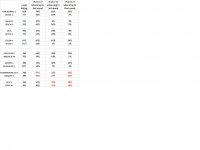
Here is an analysis of the upcoming World Pool Masters single-elimination event using Fargo Ratings.

All players are rated thoroughly with the exception of Tevez from Peru and Georgiadis from Australia. For the purpose of the analysis, we put them both at the rating of Majid--the lowest rated of the rated players.

The draw is as shown. So the probabliity a player reaches the second round is the probability he wins the first match. That we can calculate from Fargo-Rating differences.

The chance of advancing to the third round is more complicated. For Peach as an example, to reach the third round, he MUST win his first match (63% chance) and then he must win his second match. For the second match he has a 74% chance of facing SVB and then a 20% chance of prevailing if he does. He also has a 26% chance of facing Morra, and a 42% chance of beating Morra if that happened. Altogether Peach has a 16% chance of advancing the the third round and a 5% chance of reaching the finals (by beating Liu, Boyes, Feijen, or Tevez)

[numbers in red are edited from a previous incorrect chart]
 

Attachments
  • masters2.JPG
    masters2.JPG
    66 KB · Views: 657
Last edited:
Interesting! So the detailed computations have the two favorites (top two Fargo ratings) most likely to meet in the finals. I just looked, the draw has been out for a while, (since June) had not paid attention to that & suprized they drew so early. Maybe they always do that, and I never noticed. The press release announcing the draw was portraying a SBV vs Morra battle, Fargo has it a bit differently.
 
Interesting! So the detailed computations have the two favorites (top two Fargo ratings) most likely to meet in the finals. I just looked, the draw has been out for a while, (since June) had not paid attention to that & suprized they drew so early. Maybe they always do that, and I never noticed. The press release announcing the draw was portraying a SBV vs Morra battle, Fargo has it a bit differently.

Actually the two top-rated players (SVB and Feijen) cannot meet in the finals: it's one or the other.
 
Thanks for the info, Mike.

What are the match lengths in the tournament?

If anyone wants to check the arithmetic, note that the total chance for someone in each pair to advance to the second round is 100% (within rounding error), the total chance for each bracket of 4 to advance to third round is 100% and the total chance for each bracket of 8 to advance to the final is 100%. And, obviously, the total chance of winning the event for all players is 100%, but that column is not shown.

If all the players were the same strength, the chances above would all go 50% 25% 12.5% 6.25% for successive rounds.
 
As a daily number cruncher, I love this type of analysis. One question about the difference in ratings and perceived win %. For two players that are 9 points apart, the win rate is 50%. For two players that are 12 points apart, the rate jumps to 57%. This seems like a large jump for only 3 points difference. Is there a certain scale/ratio you use to determine the win %?

You don't have to go into any detail. It's just something that jumped out.

Kelly
 
As a daily number cruncher, I love this type of analysis. One question about the difference in ratings and perceived win %. For two players that are 9 points apart, the win rate is 50%. For two players that are 12 points apart, the rate jumps to 57%. This seems like a large jump for only 3 points difference. Is there a certain scale/ratio you use to determine the win %?

You don't have to go into any detail. It's just something that jumped out.

Kelly

You uncovered an error Kelly. I think I inadvertantly typed in Niko's rating as 790 rather than 780. So my 50/50 for his match with Souquet should be 45%/55%

What a 9-point gap says is Ralf is a 51.6 to 48.4% favorite over Nick for a *single game*.

That's 1-1/[1+2^(9-point-gap/100)]

Figuring out how to translate that into probability of winning a match is more complicated. Need to consider separately all the possible winning scores, and for each all the myriad ways that final score can be achieved--lots of factorials in that...
 
I thank you for your work!

So, you have been teasing us for the past several weeks. Now that you have our attention, when will the website/app be available for our own use?

Also, I know your results are based on 8, 9, and 10 ball matches. I'd love to see what Efren's rating would be in One Pocket. I "think" this may be "relatively" easy for you to do, because almost all the One Pocket data is from the DCC, and that is all in spreadsheet format, at least for the last few years. I think for Efren to have won as many times as he did, going 14 or so rounds deep in every DCC he won, that his rating might be 200 points higher than his nearest competitor. He was absolutely dominant (and surprisingly still is right up there!).
 
In an email announcement from Luke Riches, Tevez has been replaced by Marcus Chamat. That should tighten things up a little in the top half.
 
Here are the apparent changes in the Fargo Ratings since the event. I assume only the World Pool Masters is the difference. Since the values are rounded, the changes might be off by a little.

It's a little surprising how small the changes are, but most of the players have a lot of history to counterbalance their performance in one tournament. Shane dominated in the last two matches in the WPM but he has about 7500 previous games in the system.

Van Boening 824 to 825 +1
Feijen 813 to 811 -2
Ko 795 to 792 -3
Appleton 790 to 791 +1
Souquet 789 -- 789
Archer 789 to 788 -1
Gray 782 to 783 +1
Economopoulos 780 to 777 -3
Morra 777 to 776 -1
Boyes 777 to 776 -1
Liu 764 to 763 -1
Peach 762 to 760 -1
Sniegocki 759 to 756 -3
Majid 737 -- 737
(Chamat? to 771)
Georgiadis ??
 
Looks like the Fargo Favorite (the higher-rated player) won 10 of the 15 matches -- 5 of 8 in the first round, 2 of 4 in the quarterfinals, 2 of 2 in the semifinals, and 1 of 1 in the finals.
 
Here are the apparent changes in the Fargo Ratings since the event. I assume only the World Pool Masters is the difference. Since the values are rounded, the changes might be off by a little.

It's a little surprising how small the changes are, but most of the players have a lot of history to counterbalance their performance in one tournament. Shane dominated in the last two matches in the WPM but he has about 7500 previous games in the system.

Van Boening 824 to 825 +1
Feijen 813 to 811 -2
Ko 795 to 792 -3
Appleton 790 to 791 +1
Souquet 789 -- 789
Archer 789 to 788 -1
Gray 782 to 783 +1
Economopoulos 780 to 777 -3
Morra 777 to 776 -1
Boyes 777 to 776 -1
Liu 764 to 763 -1
Peach 762 to 760 -1
Sniegocki 759 to 756 -3
Majid 737 -- 737
(Chamat? to 771)
Georgiadis ??

In addition to the large priors, I would think it would be hard to move your points much when you're playing in a group that are all so closely rated. It's true that SVB dominated in a couple of matches, but when your expectation is to win 8-6, you're not going to move up much by winning 8-2. On the other hand, if I beat Darren 8-2, my Fargo rating would skyrocket. :grin:
 
Here are the apparent changes in the Fargo Ratings since the event. I assume only the World Pool Masters is the difference. Since the values are rounded, the changes might be off by a little.

It's a little surprising how small the changes are, but most of the players have a lot of history to counterbalance their performance in one tournament. Shane dominated in the last two matches in the WPM but he has about 7500 previous games in the system. [...]

It's kind of a triple whammy here: short races, few players so few rounds, single elimination.

Most pro tournaments involve a more games and bigger jumps.

Despite having 2000 games in the system, Bergman jumped 5 points from his recent streamed match with Orcollo (and then another 7 points from the Smokin Aces race-to-15 tournament). (from 772 to 784).

Here is an approximate way to analyze the bergman/orcollo match

Bergman won 15 to 8 --23 games total

When Bergman and Orcollo play 23 games, their rating difference says Bergman is supposed to win 10 and Orcollo is supposed to win 13.

So Bergman's EXPECTATION was 10 games, and he actually won 15 games.

An approximate formula for a rating change against well established opponents is

rating change = [1200/R] * [actual games won - expected games won]

R is your effective current robustness. Bergman has played 2000 games, but the ones from 3 years ago only count half, etc. So his current effective robustness might be more like 1200

So for Bergman it is 1200/1200 *[10-5] = 5
 
I read up on the Wikipedia page for ELO ratings. I'm certain Mike Page knows everything on that page:)

A few things the chess players run into that I think we are already seeing or will be seeing in the pool FargoRatings:

1. Some very high level players "babysit" their ELO rating. They don't play very often, so their rating does not move.

2. Some very high level players will only play selected opponents. One's they think are overrated. This way, they figure they are the favorite to win, AND, because they think the opponent has an artificially high rating, they will gain more ELO points when they do win.

3. Players "on the move" may have incorrect ratings. We can see this as a player gets old and is near retiring, or as a player is young and moving up. So in our pool example, Efren and Archer for example are super high. But, father time will eventually catch up to them, and their ratings will be on the downward move. In contrast, young players like Bergman are on the way up, and their ratings will be on the upswing.

4. In the ELO page, they mentioned how the overall available points in the system can grow, or can shrink (like the national money supply changing). This causes an inflation or deflation in the value of points. So in the chess example, a 2800 ELO today, might be equivalent to a 2600 ELO rating from 20 years ago.

I think the chess world probably has the highest collective brain power of any hobby/sport/industry. Their system is not perfect, but its probably as good as its going to get. I think in pool, we are doing great to use a similar system. There will always be some limitations, such as the above, and probably more that I missed. But, nothing is perfect:)

Thanks again Mike for putting this together.
 
You uncovered an error Kelly. I think I inadvertantly typed in Niko's rating as 790 rather than 780. So my 50/50 for his match with Souquet should be 45%/55%

What a 9-point gap says is Ralf is a 51.6 to 48.4% favorite over Nick for a *single game*.

That's 1-1/[1+2^(9-point-gap/100)]

Figuring out how to translate that into probability of winning a match is more complicated. Need to consider separately all the possible winning scores, and for each all the myriad ways that final score can be achieved--lots of factorials in that...

Actually Mike that's just a simple little binomial mental calculation. Ralf's probabilty of winning a race to 8 is 55.0%. Give us another one, my 5th grader wants to try it.
 
Back
Top