
cooking wood

ShootingArts

Smorg is giving St Peter the 7!
Silver Member
I'm still working with wood, I'll try adding a picture of a current project but this post is to talk about something I stumbled on while visiting a private wood turning forum. There is information on this process out there but I'm just giving a little introduction for a few cue builder friends and anyone else interested.

A turner heats some blanks in an oven eventually reaching a temperature of 400-450 degrees Fahrenheit. His primary reason for doing it is that it darkens wood the size of cue blanks and larger all of the way through. Some woods like maple that have a little figure but it doesn't show well really pop after doing this.

The user of this process says that there are substantial dimensional changes so it would have to be done on raw blanks. He says there is no appreciable loss of strength and the wood becomes stiffer. Also the tone is raised. He sometimes does this to raise the pitch of wooden bells. I personally don't like a tink sound when hitting the cue ball but obviously a lot of people do. I really think the biggest thing going for the old cues that people rave about the hit of is the fifty year old plus wood. I think this process may create that sound. One thing it does is cook out the stuff that bugs like to eat, which I think also dampens sound.

Anyone who wants to explore this deeper is pretty much on their own, I'm just putting this out for food for thought for anyone interested. I don't think it would work for a shaft, aside from darkening it pretty drastically I would think that there might be some danger of a shaft breaking or even shattering.

Anyway, just something I would be interested in playing with if I still wanted to build cues, thought some of you might be interested.

I hope everyone is doing great! RIP Edwin. I still think about him often.

Hu

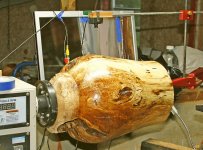
Here's my latest in progress. Guaranteed to hit a ton but not the easiest thing to play with. It's about 16" tall, 13" diameter. The monitor and camera are for real time video letting me see how thin the wall thickness is getting as I hollow the vessel.
 

Attachments

  • vaseinprogress.jpg
    vaseinprogress.jpg
    99.3 KB · Views: 652
Look up roasted maple necks on guitars!
Also "caramelized maple" (or some variation of the spelling) seems to be used.

Cheers,
M
 
I have a bit of experience with this stuff....not recently, but I assume it hasn't changed much. There's nothing particularly wrong with the wood, and it has a lot of benefits, namely the wood is more resistant to warping and is actually a bit harder if I remember correctly (and more benefits that are of no interest to anyone here).

The wood becomes rather brittle, and it does loose a little bending strength. It's probably not significant for something like a cue, but they admonish you from using it for structural purposes, i.e. you wouldn't want to use it to build an airplane wing, or as 2x4s or part of an engineered beam. That's what is generally meant by "structural". But it is different, no doubt, so standard load calculations for engineering purposes don't apply. If I remember correctly, it's actually a bit stiffer than regular wood, but it can't carry as much load.

It doesn't hold threads as well as regular wood due to the brittleness. Does it hold them well enough for cue work? I have no idea. It holds them well enough for guitar work, but you need to be careful.

I seem to recall that it didn't really like Titebond too well. I'm not sure about epoxy. The point is that it glues a bit differently.

It makes a bit of a mess when you machine it, giving off finer dust, but in this respect it's no different than a lot of other things that make a mess, and anyhow we all have great dust collection, right? ;)

It's really quite a nice advancement for guitar necks. You always worry a bit when you use figured wood for necks. Maybe not so much birdseye, but certainly curly maple always has some potential to do funny things and it takes very very little movement to go from perfection to unplayable. I don't know that torrefied wood is necessarily more stable than natural as a blanket statement, but it's at least as good as those special pieces that have been sitting around for 20 years and you know they've done all the moving and squirming they're ever going to do, and probably better. I was actually thinking of picking some up myself now that it's readily available and just playing with it to see what it does.

edit:
One more thing to add. All torrefied lumber wood is not the same. It ranges from practically turning it into charcoal for heating purposes, to gently heating/drying it and then bringing it back up to EMC. Taylor guitars has been doing a similar thing for a long time in house, and it's a relatively gentle and controlled process and you'd never know they did anything just by looking at it.
 
Last edited:
I have a bit of experience with this stuff....not recently, but I assume it hasn't changed much. There's nothing particularly wrong with the wood, and it has a lot of benefits, namely the wood is more resistant to warping and is actually a bit harder if I remember correctly (and more benefits that are of no interest to anyone here).

The wood becomes rather brittle, and it does loose a little bending strength. It's probably not significant for something like a cue, but they admonish you from using it for structural purposes, i.e. you wouldn't want to use it to build an airplane wing, or as 2x4s or part of an engineered beam. That's what is generally meant by "structural". But it is different, no doubt, so standard load calculations for engineering purposes don't apply. If I remember correctly, it's actually a bit stiffer than regular wood, but it can't carry as much load.

It doesn't hold threads as well as regular wood due to the brittleness. Does it hold them well enough for cue work? I have no idea. It holds them well enough for guitar work, but you need to be careful.

I seem to recall that it didn't really like Titebond too well. I'm not sure about epoxy. The point is that it glues a bit differently.

It makes a bit of a mess when you machine it, giving off finer dust, but in this respect it's no different than a lot of other things that make a mess, and anyhow we all have great dust collection, right? ;)

It's really quite a nice advancement for guitar necks. You always worry a bit when you use figured wood for necks. Maybe not so much birdseye, but certainly curly maple always has some potential to do funny things and it takes very very little movement to go from perfection to unplayable. I don't know that torrefied wood is necessarily more stable than natural as a blanket statement, but it's at least as good as those special pieces that have been sitting around for 20 years and you know they've done all the moving and squirming they're ever going to do, and probably better. I was actually thinking of picking some up myself now that it's readily available and just playing with it to see what it does.

edit:
One more thing to add. All torrefied lumber wood is not the same. It ranges from practically turning it into charcoal for heating purposes, to gently heating/drying it and then bringing it back up to EMC. Taylor guitars has been doing a similar thing for a long time in house, and it's a relatively gentle and controlled process and you'd never know they did anything just by looking at it.


I see from other posts you are quite familiar with guitars & wondered what your take is on tonal properties of guitars now using this for Fretboards.
 
I see from other posts you are quite familiar with guitars & wondered what your take is on tonal properties of guitars now using this for Fretboards.

I don't have an opinion one way or another, to be honest. I've never tried it for a fretboard. It's probably A-OK, okey dokey. :) Assuming good craftsmanship and design, you would be surprised just how difficult it is to actually build a bad sounding guitar. It's normally not the case that you just change a wood species and then something dramatic happens. As long as you get the mechanical properties you need, you can make a fingerboard out of just about anything, and they may all sound a little different but they'll all sound good.

I suspect it's much like pool cues. When you build the same thing over and over again, you start to notice things the casual hobby builder doesn't, and at the same time your consistency just keeps getting better and better. Yes, the kind of wood you use is important, but the actual design of the guitar and the craftsmanship is at least as important, and there's a tremendous amount of variation within a species too. As hard as it is to truly make a bad sounding guitar, it's really a challenge getting guitars to all sound the same,and I mean the same model with the same wood, hardware and electronics. It doesn't happen until you build a bunch of them and really get your process and judgement down. The wood species is just one part of a complex equation. Much like pool cues, it's just not that hard to make a pool cue that's pleasant to play with, but even as a rank amatuer, completely green cue builder (and I'm just barely even that) I can tell already that it will take an awful lot of practice until you have the precision, consistency and experience so that all of your cues play the same.

For example, I have some shafts here that I'm experimenting with. One's my magic shaft...it's my main playing shaft now and I love it. So does everyone else who's tried it and several people have been hounding me to build them one. LOL...I'm not nearly ready for that yet, but it really does play and feel very very nice. Then I have a couple of more shafts that are just like it. They're my so-so meh shafts. I don't like them at all, actually. Neither does anyone else. What's difference? Who the hell knows. I suspect that over time things just magically become a lot more consistent as your process becomes more consistent, and I don't think there's any shortcut other than doing it over and over and over again. That probably counts for a lot more than just changing a little piece of wood here and there. :)
 
Last edited:
cool beans!

Bounced back through to see where the thread was at and I learned a few things, didn't know that the "cooked" wood was used in musical instruments. A friend years ago bought a $30,000 fiddle. The builder said that about one in twenty or thirty stringed instruments were great, he didn't know why many were just very good then a great one.

My friend played with a big band, suit and tie type. He said that he bought the fiddle to move from third chair to second chair or something like that. Seems to me that the chair would have been cheaper to buy!

Hu
 
If I remember correctly, Chris talks about this a little bit in his cuemaking book (I let a friend borrow the book and I never saw it again). Of course, it could have also been here that it was discussed years ago when this was essentially a one thread board. But someone talked about the difference between the old kiln drying methods and the newer vacuum drying methods. The older methods made the wood darker and a little harder since the temperatures were necessarily higher. The newer methods don't do that and leave a whiter shaft material. At least I think that's what I remember...
 
Back
Top