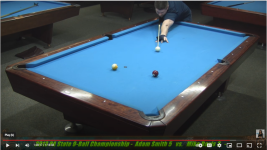
You'd lie.I would lay down on the table if I could.
Just saying.

You'd lie.I would lay down on the table if I could.
I also noticed when Hunter Lombardo instructed Rollie Williams to melt into the table with his bridge arm. Too bad covid derailed Rollie's trip to the US Open.You should avoid excess muscular tension or "quivering" in the left arm, which would add unnecessary movement to the bridge hand. The left arm also should not be in contact with the bed of the table; the bent left elbow from such positioning will cause lack of stability during shooting and it provides less resistance to head and body movement. Only the palm and fingertips of your left hand (bridge hand) are in contact with the table bed during an ideal stroke.


As I mentioned before, I think planting the elbow on cloth increases rather than decreases stability. Of course you have to assume the elbow does not move from its spot during the shot. Does anyone see how it could make your upper body less stable?In "Play Great Pool", p. 18, Mark Wilson advocates keeping your bridge arm straight: ---
Sure. If you keep your arm straight your arm is locked against your shoulder, preventing swaying forward or back along the shot line. If you bend your bridge arm, it's easier to move your upper body forward or back.As I mentioned before, I think planting the elbow on cloth increases rather than decreases stability. Of course you have to assume the elbow does not move from its spot during the shot. Does anyone see how it could make your upper body less stable?
It seems to me that is not how that mechanical linkage will work if the elbow is fixed on the table. It seems to me that a planted elbow is more restrictive of motion than a planted bridge hand and a stiff, raised arm.Sure. If you keep your arm straight your arm is locked against your shoulder, preventing swaying forward or back along the shot line. If you bend your bridge arm, it's easier to move your upper body forward or back.
...

College did nuttin for my grammar and command of the English language.You'd lie.
Just saying.


I can see if you have a bad back, it would be painful to get low enough to plant the elbow. Not to mention the pain of getting back up again.Why on earth someone would opt to float their bridge arm when the option of laying it on the table presents itself, is beyond me. I can't come up with a single advantage of floating the bridge arm. Unless you missed the gym a couple times during the week and you wanted to work in some shoulder isometrics.
You're completely right... I had the blinders on when I made my first comment. I forgot to consider that not all players have the same low stance snooker players do. Clearly, if you have an upright shooting stance resting your elbow down could be near impossible without reinventing your game.I can see if you have a bad back, it would be painful to get low enough to plant the elbow. Not to mention the pain of getting back up again.
I agree with you Bob. Mike Davis Jr usually keeps his bridge arm very straight/locked and it's always looked very uncomfortable and unnecessary to me. I could never understand it.It seems to me that is not how that mechanical linkage will work if the elbow is fixed on the table. It seems to me that a planted elbow is more restrictive of motion than a planted bridge hand and a stiff, raised arm.
I do it as a function of the bridge angle. There's nowhere in my parts to stretch out and play for a few hours so I lost any session habits I might have had and haven't developed any new ones. I'm good for an hour or two but my chops are up to at least that.Why on earth someone would opt to float their bridge arm when the option of laying it on the table presents itself, is beyond me. I can't come up with a single advantage of floating the bridge arm. Unless you missed the gym a couple times during the week and you wanted to work in some shoulder isometrics.
I don't know if it's an appropriate analogy or not, but if someone bet that they could bend your hand to your chest, wouldn't you start with a straight arm rather than a bent arm? In any case, I never quite bought into the teachings that your stance needs to be able to withstand someone pushing you in some direction. I think if someone pushes you while you are shooting, it doesn't matter what your stance is, you are going to miss the shot. Should maximum stability be the goal, or is enough stability to move the stick along the shot line good enough?It seems to me that is not how that mechanical linkage will work if the elbow is fixed on the table. It seems to me that a planted elbow is more restrictive of motion than a planted bridge hand and a stiff, raised arm.
I think "just be comfortable" is a very bad way for a beginner to approach mechanics. Being solid is a lot more important than being comfortable at first. Comfort will come with practice. I changed my bridge hand to be more solid about six months after I started playing because Mosconi told me to. It was very uncomfortable for the first two weeks. Then it was fine.If your comfortable either way it doesn't matter. Imo. Just shoot.

An instructor doesn't push you while shooting. I can make any pro miss that way. They push on you when you are in your stance and addressing the ball. Just to show you any instability you might have.I don't know if it's an appropriate analogy or not, but if someone bet that they could bend your hand to your chest, wouldn't you start with a straight arm rather than a bent arm? In any case, I never quite bought into the teachings that your stance needs to be able to withstand someone pushing you in some direction. I think if someone pushes you while you are shooting, it doesn't matter what your stance is, you are going to miss the shot. Should maximum stability be the goal, or is enough stability to move the stick along the shot line good enough?
Like one student I had who naturally put his left foot to the right of his right foot. I would have thought that was impossible before I saw it. But evidently it was comfortable for him.An instructor doesn't push you while shooting. I can make any pro miss that way. They push on you when you are in your stance and addressing the ball. Just to show you any instability you might have.