Hard to Find the Center of the Cue Ball

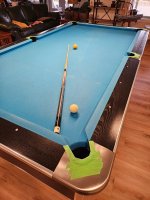
I'm guilty of not being more strict with my PSR and it causes misses due to laziness. I need to be more diligent when aiming and keep a tighter leash on myself. The pic is one of my practice routines for stun and follow and should practice more often. The tape is for a one handed shot with follow to make both balls.
 

Attachments

  • 20250105_154604.jpg
    20250105_154604.jpg
    228.6 KB · Views: 15
to be clear, the center of the cue ball is the point on the ball that is closest to you. for the purpose of the shot.

if your stick is raised it is the same point but you may be hitting downward slightly on it.
 
I'm guilty of not being more strict with my PSR and it causes misses due to laziness. I need to be more diligent when aiming and keep a tighter leash on myself. The pic is one of my practice routines for stun and follow and should practice more often. The tape is for a one handed shot with follow to make both balls.
why dont you place the balls so your bridge hand is comfortable?
 
Last edited:
I place the CB in various spots depending on what hit I'm working on. If in the jaws it's for one handed or stun follow thru. Farther out for a straight stun or follow thru. It's nice to have a variety.
thanks for the reply
and
you did a great job understanding my poorly written post which i edited to correct the spelling errors....... (y)
 
to be clear, the center of the cue ball is the point on the ball that is closest to you. for the purpose of the shot.

if your stick is raised it is the same point but you may be hitting downward slightly on it.
I think it's most accurate to think of the CB's "equator" as being slightly tilted to match the cue's elevation, so "center ball" is really slightly higher than we usually think of it. Not essential for good play; just like to visualize in real terms.

pj
chgo
 
im casting the center as along the direct line of the shot from you, so then it stays the same.
not in relation to your cue. or your position at the table. but noted the difference in perspective it can have.
 
I think it's most accurate to think of the CB's "equator" as being slightly tilted to match the cue's elevation, so "center ball" is really slightly higher than we usually think of it. Not essential for good play; just like to visualize in real terms.

pj
chgo

All depends on what you are calling centerball. You can't hit that spot in the center of the ball. If you aim at it you are going to get a different result than aiming at the center of the outside of the ball. Which is right can be argued until the cows come home. Doesn't really matter as long as you decide on one.

The centerpoint on the outside of the cue ball has the advantage of being able to see and hit it. If you tell somebody to put a marking on a cue ball on the center of the ball nine out of ten will put it on that outside center. One will put it on top, got to be one in every crowd! None will put the mark on the cue ball at the point you reference, well maybe if I run into you!

For consistency I go with the spot directly behind the real centerpoint. That puts me inline with the vast majority of players. I have used that as the centerpoint and I have aimed at the point you are talking about, that changes with the cue's elevation. That causes one more complication which I prefer to avoid.

The main thing isn't in the initial set up but in the cue ball's behavior. If I hit the spot directly behind the true centerball the cue ball doesn't bind or hop. Hitting above that point the cue ball does both.

From an engineering standpoint I want to aim at the true centerpoint of the cue ball equidistant from all points on the surface of the cue ball. From a pool playing standpoint I want to use the point on the outside level with the centerpoint. I have done both, didn't see any gain to hitting the cue ball above the horizontal centerline and hitting the same location on the horizontal centerline or using it to calculate from simplifies things.

Hu
 
All depends on what you are calling centerball. You can't hit that spot in the center of the ball. If you aim at it you are going to get a different result than aiming at the center of the outside of the ball. Which is right can be argued until the cows come home. Doesn't really matter as long as you decide on one.
I like visualizing the 3D center of the CB because (as you understand) that's the real "boundary" between putting top vs. bottom spin on it. If your cue points through the tip/ball contact point above the CB's 3D center, you're putting top spin on it - vice verse if your cue points below the CB's 3D center (as it does when hitting the CB 1 1/8" off the cloth).

Like I said, it's probably not that important, since we all "see" things differently and this is a minor physical difference.

pj
chgo
 
Last edited:
you simply are not stroking straight all the time or just on your draw shots. only you can figure out which. and need to do.

when hitting to extremes on the cue ball each little bit moves things a lot more off course.

start by practicing hitting stop shots that actually stop with no spin. until you can do that you have no stroke that goes straight.

then slowly go down a tiny bit and draw back a certain amount of inches. till you can do that to what you think is your ability. keep going back until your reach your limit.

then until you can go more don't draw past that point as you are just going to miss the shot.
funnily enough I actually have been trying to practice stop shots recently. When I started playing I was focussed on learnig how to hit follow and draw and never occured to me stop shot was something I needed to learn. Was only recently I tried to do the Billiard University playing exam on here and it struck me there was quite a funadmental skill I'd missed. Actually feel it has had lots of positive knock on effects to my game so will definitely keep working on it.
 
For vertical center...it has already been pointed out that you can find that where the ball touches the cloth.....

For Horizontal center. On any table that has overhead lights....you can see a lighted portion of the ball and a shaded portion of the ball (below horizontal center)....horizontal center is the transition point between light and dark......(most people just don't pay attention that it is there)

However....it is very rare to shoot exactly horizontal center.........for a stop shot...most times you are hitting about 1/4 or 1/2 tip below center....or.....just barely into the shaded area.....for draw you are hitting further into the shaded area.......for follow......you shoot into the lighted area

Unless of course you are jacked up....you may shoot into the lighted area for draw since the CB axis changes....but you can still use the lighted/shaded area as a guide on where you intend to hit.
If you are hitting true center ball follow or draw will still travel in a straight line, sidespin causes the cueball to swerve, how much depends on shaft deflection, how far off center you are cueing, ect.
 
With center ball, your alignment has to be close to perfect... With some sidespin, you have the additional variable of speed to "sense" the appropriate stroke with your gut in order to get your desired result. Effectively you are curving the CB than sending it in a straight line.

Something that is overlooked is that playing center ball puts you in a 'measuring and aligning' type of mindset, rather than 'aiming by feel' mindset. I want to avoid any kind of aligning and checking when I am down on the shot so I avoid playing center ball in familiar table conditions. It does offer significantly increased consistency in unfamiliar table conditions... brand new cloth for instance.
 
'measuring and aligning' type of mindset, rather than 'aiming by feel' mindset.
When shooting right handed my process is more analytical and measuring. When shooting left handed I am more along the "just feel the shot" mindset. The right is linear and left is creative and flowing. I do however try to leave whitey on an angle that facilitates strikes on the center axis with either hand. Variation from center strikes brings more variables to the equation. I prefer simple calculations. 🤷‍♂️
Regarding "Feel", a favorite memory comes to mind. In the final game of the league, My first year of league play I was facing a decision on the final 8 ball. I was considering either a cut to the corner vs a cut to the side. I was not sure if either or both cuts had a scratch in the outcome. I called my captain to the table for input. He was unable to approve of one cut over the other, so I asked him, "how about the bank" as it was almost straight. His reply was, "Well , Can You Feel it?" My reply was, "One way to find out." 🤷‍♂️ That was followed by, the call of "cross corner". Followed by Pow Splat and we became the league champions for the season.
Bank shots are very sensitive to speed and spin so I first measure and align then I try to Feel the shot. 🤷‍♂️

 
Back in the day. 😉 Brag alert.
It would take me 45 minutes to an hour to get The Feel of the table.The conditions of the whole environment as well. 😉 A stealthy hunt would apply. 🤷‍♂️
So walking in cold to a money game made that warm up period a measuring time. Well calculations modifications need dialing in. Provided a natural stall, I could be stuck in the neighborhood of 10 barrels before getting my mind right. "Raise the bet?" Is my favorite decision after being down 10 games with 3 barrels left at 10 per game. and feeling good.
Another lesson in credit at the end of that contest. He disappeared with the rail marker showing him down in excess of a hundred. 🤷‍♂️
 
When shooting right handed my process is more analytical and measuring. When shooting left handed I am more along the "just feel the shot" mindset. The right is linear and left is creative and flowing. I do however try to leave whitey on an angle that facilitates strikes on the center axis with either hand. Variation from center strikes brings more variables to the equation. I prefer simple calculations. 🤷‍♂️
Regarding "Feel", a favorite memory comes to mind. In the final game of the league, My first year of league play I was facing a decision on the final 8 ball. I was considering either a cut to the corner vs a cut to the side. I was not sure if either or both cuts had a scratch in the outcome. I called my captain to the table for input. He was unable to approve of one cut over the other, so I asked him, "how about the bank" as it was almost straight. His reply was, "Well , Can You Feel it?" My reply was, "One way to find out." 🤷‍♂️ That was followed by, the call of "cross corner". Followed by Pow Splat and we became the league champions for the season.
Bank shots are very sensitive to speed and spin so I first measure and align then I try to Feel the shot. 🤷‍♂️
Despite the saying never bank when you can cut there are times when the bank is better. In my fairly early days playing I used to battle regularlly with a stoner. He was maybe six-six, 98 pounds soaking wet, and not a nerve in his body. To this day I have never encountered someone that cut balls better. He could slice a ball at about 88 degrees the length of a nine foot table out in the open, not running a rail. I would hook up with him in hours long battles with both of us only cutting balls and it could go either way. When I wanted to win, I would take the bank shots I liked better than cuts. He stood no chance when I added banks because he couldn't bank. We would draw crowds putting on cutting exhibitions though.

To my way of thinking, cuts you measure, banks you feel. There were times when my cutting was off, I was banking as good as ever. I remember one day I was banging points unintentionally and feeling frustrated. I had an almost straight in shot but called it four rails to the same pocket. The ball went in like it had eyes!

Hu

Hu
 
Back
Top