Hard to Find the Center of the Cue Ball

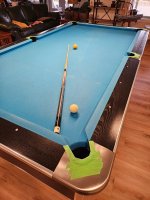
I'm guilty of not being more strict with my PSR and it causes misses due to laziness. I need to be more diligent when aiming and keep a tighter leash on myself. The pic is one of my practice routines for stun and follow and should practice more often. The tape is for a one handed shot with follow to make both balls.
 

Attachments

  • 20250105_154604.jpg
    20250105_154604.jpg
    228.6 KB · Views: 10
to be clear, the center of the cue ball is the point on the ball that is closest to you. for the purpose of the shot.

if your stick is raised it is the same point but you may be hitting downward slightly on it.
 
I'm guilty of not being more strict with my PSR and it causes misses due to laziness. I need to be more diligent when aiming and keep a tighter leash on myself. The pic is one of my practice routines for stun and follow and should practice more often. The tape is for a one handed shot with follow to make both balls.
why dont you place the balls so your bridge hand is comfortable?
 
Last edited:
I place the CB in various spots depending on what hit I'm working on. If in the jaws it's for one handed or stun follow thru. Farther out for a straight stun or follow thru. It's nice to have a variety.
thanks for the reply
and
you did a great job understanding my poorly written post which i edited to correct the spelling errors....... (y)
 
to be clear, the center of the cue ball is the point on the ball that is closest to you. for the purpose of the shot.

if your stick is raised it is the same point but you may be hitting downward slightly on it.
I think it's most accurate to think of the CB's "equator" as being slightly tilted to match the cue's elevation, so "center ball" is really slightly higher than we usually think of it. Not essential for good play; just like to visualize in real terms.

pj
chgo
 
im casting the center as along the direct line of the shot from you, so then it stays the same.
not in relation to your cue. or your position at the table. but noted the difference in perspective it can have.
 
I think it's most accurate to think of the CB's "equator" as being slightly tilted to match the cue's elevation, so "center ball" is really slightly higher than we usually think of it. Not essential for good play; just like to visualize in real terms.

pj
chgo

All depends on what you are calling centerball. You can't hit that spot in the center of the ball. If you aim at it you are going to get a different result than aiming at the center of the outside of the ball. Which is right can be argued until the cows come home. Doesn't really matter as long as you decide on one.

The centerpoint on the outside of the cue ball has the advantage of being able to see and hit it. If you tell somebody to put a marking on a cue ball on the center of the ball nine out of ten will put it on that outside center. One will put it on top, got to be one in every crowd! None will put the mark on the cue ball at the point you reference, well maybe if I run into you!

For consistency I go with the spot directly behind the real centerpoint. That puts me inline with the vast majority of players. I have used that as the centerpoint and I have aimed at the point you are talking about, that changes with the cue's elevation. That causes one more complication which I prefer to avoid.

The main thing isn't in the initial set up but in the cue ball's behavior. If I hit the spot directly behind the true centerball the cue ball doesn't bind or hop. Hitting above that point the cue ball does both.

From an engineering standpoint I want to aim at the true centerpoint of the cue ball equidistant from all points on the surface of the cue ball. From a pool playing standpoint I want to use the point on the outside level with the centerpoint. I have done both, didn't see any gain to hitting the cue ball above the horizontal centerline and hitting the same location on the horizontal centerline or using it to calculate from simplifies things.

Hu
 
All depends on what you are calling centerball. You can't hit that spot in the center of the ball. If you aim at it you are going to get a different result than aiming at the center of the outside of the ball. Which is right can be argued until the cows come home. Doesn't really matter as long as you decide on one.
I like visualizing the 3D center of the CB because (as you understand) that's the real "boundary" between putting top vs. bottom spin on it. If your cue points through the tip/ball contact point above the CB's 3D center, you're putting top spin on it - vice verse if your cue points below the CB's 3D center (as it does when hitting the CB's horizontal center).

Like I said, it's probably not that important, since we all "see" things differently and this is a minor physical difference.

pj
chgo
 
Last edited:
Back
Top