
You are using an out of date browser. It may not display this or other websites correctly.
You should upgrade or use an alternative browser.
You should upgrade or use an alternative browser.
Identify these billiard balls
- Thread starter tpoppa
- Start date
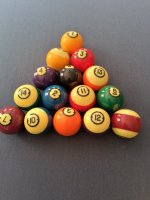

Looks like Centennials. Made for Brunswick by Aramith.
That's what I was hoping, but I'm not sure. I just purchased a used table, and these are the balls it came with.Looks like Centennials. Made for Brunswick by Aramith.
Nice! Enjoy!

Looks like the Centennials that I have.

They are Centennials, but if they are old, they could have been made by Albany/Hyatt instead of SALUC (which also makes Aramith). The change in manufacturer to SALUC happened about 1988.

Def Centennials. They were probably the most popular ball of all time until about 2010. Every single pool room I ever went to had them on their tables.That's what I was hoping, but I'm not sure. I just purchased a used table, and these are the balls it came with.
Do you have the CB? It is supposed to be a blue hollow circle. If its anything else, its not original.
Thanks for the confirmation 
The guy I bought the table from just bought the house and the table came with it. He just wants it out of there and didn't have any information other than the table was about 5 years old.
I was expecting whatever cheap balls come free with a new table. So, Centennials are a bonus
I also wasn't sure if any cheaper balls are meant to look the same.
The guy I bought the table from just bought the house and the table came with it. He just wants it out of there and didn't have any information other than the table was about 5 years old.
I was expecting whatever cheap balls come free with a new table. So, Centennials are a bonus
I also wasn't sure if any cheaper balls are meant to look the same.
Last edited:
I’ve never seen a direct knock off of Centennials. Maybe someone else has?Thanks for the confirmation
The guy I bought the table from just bought the house and the table came with it. He just wants it out of there and didn't have any information other than the table was about 5 years old.
I was expecting whatever cheap balls come free with a new table. So, Centennials are a bonus
I also wasn't sure if any cheaper balls are meant to look the same.
If I remember correctly, that change was accompanied by the change from a 'red dot' cue ball to the current 'blue dot' cue ball. Of course, I don't know how you'd ascertain whether the cue ball with your set is original to the set.They are Centennials, but if they are old, they could have been made by Albany/Hyatt instead of SALUC (which also makes Aramith). The change in manufacturer to SALUC happened about 1988.
no, the older sets were blue circle, NOT blue dot, as well. never seen any Cennt. balls with a rd./bd cueball.If I remember correctly, that change was accompanied by the change from a 'red dot' cue ball to the current 'blue dot' cue ball. Of course, I don't know how you'd ascertain whether the cue ball with your set is original to the set.
You are correct. I misspoke and got sloppy with my terminology. But I believe the current and modern Centennials have the 'blue circle' cue, while the older, pre-Aramith Centennials had the 'red circle'.no, the older sets were blue circle, NOT blue dot, as well. never seen any Cennt. balls with a rd./bd cueball.
I remember blue circles (we called them blue dots) from the 70s like they'd always been around. Don't know where red circles came from but I suspect they were sold separately and just filtered into the Centennial "mass".
The red circle balls were always aftermarket 3rd party cue balls.

I have purchased many sets of Centennials starting in mid 80’s and I never saw a red dot/ circle cue ball included in the set.
In fact, my recollection is that the red circle CB’s are several grams lighter than the Centennial pool balls so it would be badly mismatched. Cue Balls and object balls should be the same weight & diameter or the pool balls will not play the same as a set of pool balls with identically matching weights. That’s the actual, irrefutable law of physics that every player should know.
In fact, my recollection is that the red circle CB’s are several grams lighter than the Centennial pool balls so it would be badly mismatched. Cue Balls and object balls should be the same weight & diameter or the pool balls will not play the same as a set of pool balls with identically matching weights. That’s the actual, irrefutable law of physics that every player should know.
here is an AI generated answer to red circle vs blue circle cue ball
..........
The primary differences between the Red Circle and Blue Circle cue balls lie in their material composition, density, and playing characteristics, despite both being manufactured by Aramith/Saluc and generally adhering to similar size specifications.
Material and Composition The Red Circle cue ball is made from carom resin, a harder, more resilient material that is less prone to staining and provides a "sluggish" or controlled feel. In contrast, the Blue Circle cue ball is made from standard pool ball phenolic resin (used in Brunswick Centennial sets), which is slightly softer and tends to play with a more "lively" response.
Playing Characteristics
..........
The primary differences between the Red Circle and Blue Circle cue balls lie in their material composition, density, and playing characteristics, despite both being manufactured by Aramith/Saluc and generally adhering to similar size specifications.
Material and Composition The Red Circle cue ball is made from carom resin, a harder, more resilient material that is less prone to staining and provides a "sluggish" or controlled feel. In contrast, the Blue Circle cue ball is made from standard pool ball phenolic resin (used in Brunswick Centennial sets), which is slightly softer and tends to play with a more "lively" response.
Playing Characteristics
- Spin Retention: The Red Circle’s denser, carom-resin compound allows it to take and retain spin more effectively, making it easier to draw and harder to follow. The Blue Circle holds spin less aggressively, resulting in better line stability for safeties and easier follow shots.
- Weight and Density: While many players perceive the Red Circle as lighter, experts note that new balls of both types weigh approximately the same (around 168 grams). The perceived difference in weight and behavior is due to density distribution; the Red Circle’s higher density and material composition affect how force is transferred, while the Blue Circle’s weight distribution may be more centered.
- Durability: The Red Circle is noted for being more durable and resistant to chipping or staining compared to the Blue Circle, which can show wear and "bruising" more quickly.
Well, a light cue ball will draw more easily and a heavy ball will follow more easily. But the thread on ball weights says there is not much difference in the various types, as I recall.how can a more dense ball be the same weight as a less dense one that is the same weight and size.
explain how it can be easier to draw and harder to follow. im not sure of that.
Also important is how "elastic" the balls are. More elastic means less energy is lost in the ball-ball contact. A dead or inelastic ball will follow more easily and is harder to draw.
Personally, I wouldn't trust AI for this info.
As for a more dense ball ball of the same size being the same weight?!? I would definitely not trust AI on that one.