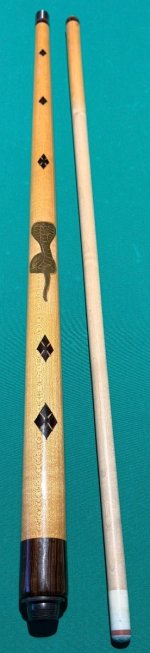
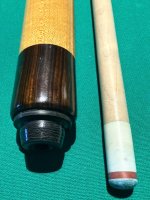
I recently acquired this older custom cue from the family of the original owner and am hoping to identify the maker.
The original owner reportedly had the cue before meeting his wife, so it likely dates back several decades, but unfortunately there is very little provenance beyond that.
Specifications:
I’m also curious whether the dark diamond inlays are made from the same wood as the butt sleeve, and whether the lighter cross accents are the same material used in the thin accent rings. The figured ring material also makes me wonder if it may be snakewood, although I’m certainly open to correction on any of the wood identifications.
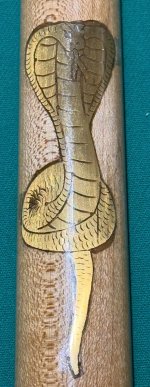
Does anyone recognize the cobra motif, the inlay pattern, the joint construction, or any of these design elements that might point to the builder? I’d appreciate any thoughts on the maker, era, or region where it may have originated.
Thanks in advance for any insight!
The original owner reportedly had the cue before meeting his wife, so it likely dates back several decades, but unfortunately there is very little provenance beyond that.
Specifications:
- Overall length: 60.5”
- Weight: 18.8 oz
- Butt: 13.7 oz
- Shaft: 5.2 oz
- Joint diameter: .84”
- Shaft collar: .83”
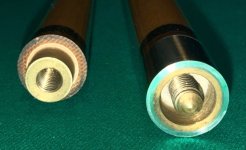
- Pin diameter: approximately .30”
- Brass pilot: .54” diameter × .42” long
- Ferrule: 13 mm
- Balance point: 22” from the bumper
- Large engraved brass cobra inlay in the forearm.
- Graduated dark hardwood diamond inlays with contrasting light wood cross accents.
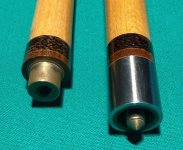
- Stainless joint collar with a large brass piloted joint.
- Figured exotic wood accent rings, possibly snakewood.
- Dark figured hardwood butt sleeve.
I’m also curious whether the dark diamond inlays are made from the same wood as the butt sleeve, and whether the lighter cross accents are the same material used in the thin accent rings. The figured ring material also makes me wonder if it may be snakewood, although I’m certainly open to correction on any of the wood identifications.
Does anyone recognize the cobra motif, the inlay pattern, the joint construction, or any of these design elements that might point to the builder? I’d appreciate any thoughts on the maker, era, or region where it may have originated.
Thanks in advance for any insight!