................................

I wanted to say JB but since he gave you another brand, I'll go with his advice. :rolleyes:
 
I go with Whitten.

Ernie (Ginacue) tested the leading cases with a hydrometer (I think that's the moisture measuring tool) and found that the Whitten design was best. Ginacues come with Whitten cases based on his study.

Their shaft tube design may be the key. I'm far from the expert but if it is good enough for Ernie and many others, I'll trust it.
 
Drawman623 said:
I go with Whitten.

Ernie (Ginacue) tested the leading cases with a hydrometer (I think that's the moisture measuring tool) and found that the Whitten design was best. Ginacues come with Whitten cases based on his study.

Their shaft tube design may be the key. I'm far from the expert but if it is good enough for Ernie and many others, I'll trust it.

I never heard that. What other cases were tested?

It really depends on what is being tested and how the test was conducted. Nothing that is not hermetically sealed is going to keep out moisture. If you put your cases in a moldy damp basement then the inside of them is going to have moldy moisture inside.

Of course you can construct barriers to the moisture like foam and certain fabrics that act as one-way valves. Most cue cases aren't built that way however.

With Instroke cases I sealed the bottoms and then wrapped the tubes in foam rubber before putting the exterior shell on. The weak point was the top. I'd try to make the top fit snugly but not be cumbersome to open and close. Thus I was able to build somewhat of a moisture barrier while still allowing moisture in the case to evaporate and escape.

None of it was done scientifically however. We did do stuff like throw the case off the fifth floor, submerge them in water, put them out in the rain, in the snow, put them over a heating vent and crank it with a thermometer inside and stuff like that. I was to lazy to set up proper experiments and document my findings.

For long term storage I feel that the place the cues are going to be stored is more important than the case it will be stored in. The case should of course not contribute to the deterioration of the cue by scratching it or wrapping it in moisture and it should protect against the cue getting bruised. Just about any good custom case fulfills these requirements.

I also forgot to mention Danbuilt cases. Dan Dishaw builds a line of cases that are basically flight cases for cues. Those are also excellent for storage I think. A lot of high end cuemakers depend on Dan's cases to get their cues around the world to shows and you can bet that they wouldn't touch them if the cases weren't good enough. I don't know if Dan makes a 3x6 but he probably could.
 
JB Cases said:
I never heard that. What other cases were tested?

It really depends on what is being tested and how the test was conducted. Nothing that is not hermetically sealed is going to keep out moisture. If you put your cases in a moldy damp basement then the inside of them is going to have moldy moisture inside.

Of course you can construct barriers to the moisture like foam and certain fabrics that act as one-way valves. Most cue cases aren't built that way however.

With Instroke cases I sealed the bottoms and then wrapped the tubes in foam rubber before putting the exterior shell on. The weak point was the top. I'd try to make the top fit snugly but not be cumbersome to open and close. Thus I was able to build somewhat of a moisture barrier while still allowing moisture in the case to evaporate and escape.

I have been told that warpage occurs when moisture is present unevenly. Leave a shaft lying on the ground and the air cannot circulate to the portion touching the ground. That can lead to warpage. Thus, to a degree, it isn't about keeping all moisture out, but allowing even moisture or air circualtion in the storage environment.

Again, I make no assertion that I understand the subtleties of this process, but I have had cues warp in some cases but not my Whittens. My reasoning may not be scientific, or readily provable, but I have owned many cues for many years and done well storing them in Whitten cases. My only hard data is empiracle...my cues are still straight.

As for Ernie's test, I didn't ask him to name those cases he tested and rejected. It was enough for me that he chose Whitten.
 
Drawman623 said:
I have been told that warpage occurs when moisture is present unevenly. Leave a shaft lying on the ground and the air cannot circulate to the portion touching the ground. That can lead to warpage. Thus, to a degree, it isn't about keeping all moisture out, but allowing even moisture or air circualtion in the storage environment.

Again, I make no assertion that I understand the subtleties of this process, but I have had cues warp in some cases but not my Whittens. My reasoning may not be scientific, or readily provable, but I have owned many cues for many years and done well storing them in Whitten cases. My only hard data is empiracle...my cues are still straight.

As for Ernie's test, I didn't ask him to name those cases he tested and rejected. It was enough for me that he chose Whitten.

I trust Ernie's judgement as well but I kinda doubt that he spent much time testing cases. Whitten makes a fine case that is a perfect compliment to Ernie's cues.

I don't happen to think that they are made to be particularly moisture resistant though. As for moisture being unevenly present I have no idea how all that really works. I would assume that a closed container is probably going to be less moist than an open one in a humid environment.

I think that the next test to do is to take a case into a steam bath. I don't know why I never thought of that before since I did all the other stuff.

Maybe it's time to start documenting this stuff.

By the way, a cue that stays straight is more due to the cue's construction than the case it's kept in. Ernie's cues for example are more likely to stay straight than most due to how he makes them and allows the wood to stabilize slowly with long periods between cuts.

If you get a piece of wood really stable and seal it you can pretty much dunk it in water and it's not going to warp on you. I have seen fighting staffs that are straight and stay straight no matter what you do to them.

In the last 25 years I have been dealing with cues from so many sources I have lost count. I have had cues from dozens of custom makers and hundreds of "import" brands. And kept them stored in various cases for transport to places all over the world.

Believe me when I tell you that no case is going to make a cue prone to warping safe from warping.

We all need to remember that we live with many other fine products made from wood and that those products are all subject to the same environment that our cues are in.

Here is an excellent read on why wood warps: http://www.woodweb.com/knowledge_base/Warp_in_Drying.html

http://4umi.com/wood/conservation/endingthebending.htm

http://answers.google.com/answers/threadview/id/536274.html This one is good.

So even though a case can keep a cue somewhat safer from the environment it's in unless the case is truly made to keep out what's out and keep in what's in then there is going to be interaction on some level.

My conclusion is that when a cue is made properly then it doesn't warp. I have kept cues in the same environment, in the same cases, for long periods of time and some warped and some didn't, names withheld on which brands did which :-) I am pretty sure that those of you with experience with lots of different cues over long periods have similar experiences.
I would love to be able to conclude that a case I made would protect any cue from warping due to moisture but I could never make that claim as the cue construction is not under my control. All I can do is to provide some what of a barrier against short term exposure such as going from a cold building to a hot car and back into a cold building.

Anyway once again this is too long an answer.

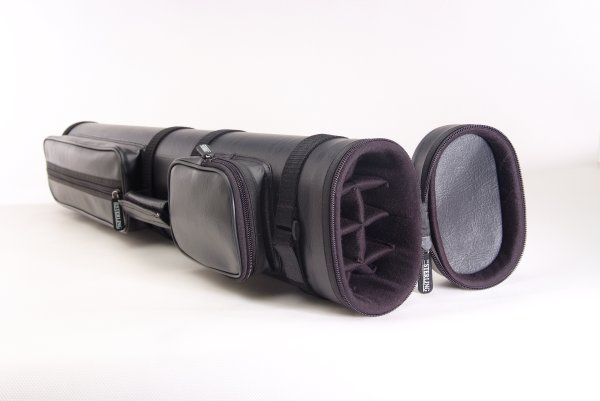
John, get the new Sterling 4x8 cases. Your cues will be cradled and cushioned in foam and soft fabric held inside a polypropylene tube. The case is like $80-$100 and does everything (and more) that any high end case of similar construction does.

Here is a picture: empty
STH12K-CU-E.JPG


And full.
STH12K-CU-F.JPG


I'd also recommend GTF cases as the GTF does in fact form a tighter barrier due to the fact that the lid compresses the fabric liner. Sometimes the seal is so tight that it requires some effort to break it. I have an experimental one where I drilled holes in the body to see the effect and measure the pressure. You can literally see the case breath when the lid is put on and removed. However I know your particular sensibility here so if you want these then it's probably best to handle it through me. There are several cue collectors who are using GTF to store their cues in.
 
Last edited:
Tube type cases like It's George, Ron Thomas, Gtf, and other's, I think are
Best for long Storage. When you put the Tops on, you can feel the air being
pushed out. Any case with a zipper is not doing this. I also don't like case's
with built with wood on the tops or bottoms.
 
as long as the case seals well, put some desiccant packets in there and it will help with any moisture getting in.
 
burns420 said:
as long as the case seals well, put some desiccant packets in there and it will help with any moisture getting in.

The thing with desiccant packages is that the crystals fill up and then no longer absorb moisture.

I just did a little reading on desiccant and silica to understand what it is and how they work.

For long term storage they will absorb as much moisture as they can and then won't be effective any more. Putting them in a case that does seal would definitely reduce the moisture left inside.

I found that there are many different types for different applications.
 
JB Cases said:
The thing with desiccant packages is that the crystals fill up and then no longer absorb moisture.

I just did a little reading on desiccant and silica to understand what it is and how they work.

For long term storage they will absorb as much moisture as they can and then won't be effective any more. Putting them in a case that does seal would definitely reduce the moisture left inside.

I found that there are many different types for different applications.

Having been a firearms dealer for over a decade, I'm very familiar with desiccants and their short comings (no one wants a rusty gun). John is spot on about the loss of functionaliy of desiccant over time. Unless your long term storage case will be opened every month or so to replace the desiccant (whichever type you choose), then it becomes useless. About the only way to be sure of the humidity, is to have the cues stored in a controlled environment. If their value is high enough, perhaps allocating one entire closet to that purpose would be cost efficient.

Just my 2 cents worth,

Chris.
 
runout1961 said:
Hey Folks, I will be looking for a 3x6 case to hold three nice cues. My question to ya'll is what case is the best to get for storage of nicer cues. I was thinking along the lines of a George, Whitten or who? It has to be a 3x6 and the cues might be sitting in the case for months at a time so what case should I go with for the best all around protection of my cues? All opinions and comments are greatly appreciated.

Thanks, John
For the BEST all around protection see post #2.....Also Instroke..But Haliburton cannot be beat for durability..
 
It would be good to.....

check out the various dealers of flight cases. Pelican for example makes many cases that would work. Or high performance gun cases. These are the ones I would pick if I were really serious about performance with long term stationary storage.

I have toyed with making Pelican style cases for pool. The Longoni case is close to this. Basically a rotomolded shell with a seal gully running around the perimeter. Inside to be reconfigurable foam inserts to cradle the cues securely and separately.

The thing that stops me cold is the setup costs and the idea that there really isn't much of a market there. Besides with the cuemakers making cues that don't warp and cases like Danbuilt, Zero Halliburton, us, and others then there is really no reason to make another good one.

I think that there are plenty of good solutions to handle cue storage already on the market.
 
runout1961 said:
Thanks John. Let's say if Dan can build a 3x6 case do you think that would be ok to keep them in the closet for instance(temperature controlled house)? I was also thinking about the Old George 3x6 but have never had them so I am unsure. Because of my job the case would most likely sit in one spot for about four months at a time.

Thanks, John

John, while you're away and the cues are sitting for that 4 month period, will anyone be at your house regularly? If so, then you could go with the case you decide upon and add the additional protection of a desiccant. As long as the person at your house would be able to replace the packets at intervals suggested by the manufacturers. In the gun business, there are also large canister type desiccants made specifically for the purpose of controlling humidity in a closet. They have to be changed as well, but handle much larger areas than a cue/gun case. I can check those out if you'd like.

Chris
 
runout1961 said:
Thanks Chris. Do you have a link for me to check them out? There is a person who permanently lives at my house so your suggestion might be possible. I'll look into it. Thanks again buddy.

John

My pleasure, John. The link I'm adding to this is for gun safe dehumidifiers and desiccants. The usual desiccant is only good for about 3 cubic feet. These will work on an area 15 to 300 cubic feet. There are several types as you will see. The canisters can all have the desiccant reactivated by heating them in an oven to remove the moisture they've collected. The electric rod type needs no reactivation. Here's the link:

http://www.midwayusa.com/ebrowse.exe/browse?TabID=15&Categoryid=10489&categorystring=10615***

Chris
 
runout1961 said:
I greatly appreciate the link Chris. I will be sure to check them out.

Thanks Buddy, John

No problem, John. Gotta keep those beautiful cues of yours in perfect condition =)

Chris
 
runout1961 said:
Thanks John. Let's say if Dan can build a 3x6 case do you think that would be ok to keep them in the closet for instance(temperature controlled house)? I was also thinking about the Old George 3x6 but have never had them so I am unsure. Because of my job the case would most likely sit in one spot for about four months at a time.

Thanks, John

I think the best person to talk to would be Dan. As a cue maker and supplier to other cuemakers he definitely can tell you. I'd bet that some of the cuemakers he deals with put cues into their Danbuilts and leave them in there for months at a time.
 
Back
Top
