
You are using an out of date browser. It may not display this or other websites correctly.
You should upgrade or use an alternative browser.
You should upgrade or use an alternative browser.
A joint??
- Thread starter Madrakr
- Start date
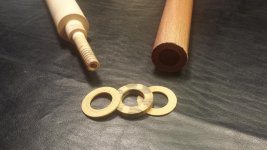

....Will this work???? Don't beat me up too bad, it took some time to for "me"do this this evening.......
Just trying to make a player........again.......:thud:
Not glued yet, but spins pretty true without a final facing....
Attachments
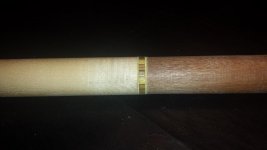

Configuration looks good ( assuming the threads are snug ).
Might wanna use sharper tooling and collets though.
Make a mock up and leave it in your car for a while.
Check for buzzing a few weeks later.
Might wanna use sharper tooling and collets though.
Make a mock up and leave it in your car for a while.
Check for buzzing a few weeks later.
Configuration looks good ( assuming the threads are snug ).
Might wanna use sharper tooling and collets though.
Make a mock up and leave it in your car for a while.
Check for buzzing a few weeks later.
It is still at .1300.......Long ways to go.....like it tight in the chuck when tapping by hand....basic tooling at my place.......lol
It is still at .1300.......Long ways to go.....like it tight in the chuck when tapping by hand....basic tooling at my place.......lol
Get a live threader set-up. You won't look back after that.

It is still at .1300.......Long ways to go.....like it tight in the chuck when tapping by hand....basic tooling at my place.......lol
Throw this answer out. Gibberish.
If you can machine an A-joint you can make collets. If you can't make collets, how can you make cues?
If the collet ID is tapered to match the taper of the cue and you are chucking on the collet next to where you are tapping, you can get it PLENTY tight for tapping an A-joint. Even if you are using a dull tap, back out and clean it a few times.
Regardless of whether the impressions will turn out, you are still introducing error in the set up as the jaws crush the wood.
Do you have a dial indicator to say exactly what "pretty true" is regarding the dry fit spin?
Not beating you up, just explaining you need to embrace both the praise and constructive comments equally.
Depending on the glue you use, it may work ok. You have it configured so that the rings are load bearing components. On top of that, the dark piece of wood looks to be a type of mahogany & is very porous, so it's going to soak up a lot of adhesive unless the adhesive is viscous enough. I'm not going to tell you how to do an "A" joint, but those issues are things I notice that may give you trouble. I learned that lesson the hard way. Good luck & don't be afraid of failing. Every time you fail, you learn something.

how does it take side pressure?
Throw this answer out. Gibberish.
If you can machine an A-joint you can make collets. If you can't make collets, how can you make cues?
If the collet ID is tapered to match the taper of the cue and you are chucking on the collet next to where you are tapping, you can get it PLENTY tight for tapping an A-joint. Even if you are using a dull tap, back out and clean it a few times.
Regardless of whether the impressions will turn out, you are still introducing error in the set up as the jaws crush the wood.
Do you have a dial indicator to say exactly what "pretty true" is regarding the dry fit spin?
Not beating you up, just explaining you need to embrace both the praise and constructive comments equally.
I have collets, but I just didn't use them on my first try at threading. I will from now on. Thanks There is .010 difference when spinning between centers.
The ring's are of bocote and yellow heart. The yellow heart has a lot of "give". Probably going to change the outer rings to something harder.Depending on the glue you use, it may work ok. You have it configured so that the rings are load bearing components. On top of that, the dark piece of wood looks to be a type of mahogany & is very porous, so it's going to soak up a lot of adhesive unless the adhesive is viscous enough. I'm not going to tell you how to do an "A" joint, but those issues are things I notice that may give you trouble. I learned that lesson the hard way. Good luck & don't be afraid of failing. Every time you fail, you learn something.
If your handle is still at 1.300, you're going to have too much
movement after a corrective pass.
You need to taper and season your handles.
Assemble whent they're seasoned and have shown you they are stable.
movement after a corrective pass.
You need to taper and season your handles.
Assemble whent they're seasoned and have shown you they are stable.
Too spongy.....Not an epic failure, but a failure. Lol. I scraped the idea and turned it around......thanks everyone....how does it take side pressure?
not a failure, but you tried something new :smile:
There are three things to always consider when designing an "A" joint.
First of all, the threaded part, whether a screw or a threaded tenon, is merely an internal clamp to hold forearm/handle together while adhesive cures. Design the joint so that once your epoxy is cured, it wouldn't weaken the cue by removing the threaded part. The threads are only there to act as a clamp, and become obsolete/non-critical once the epoxy has fully hardened.
Secondly, rings between the fore & handle are considered "accent" rings for a reason. They are aesthetic in nature ONLY, and are not intended to be structural. The more rings you have sandwiched in there, the more faces you have to contend with. Not only is the cue going to most likely move, but almost certainly will eventually buzz. If you are going to use rings in that location, then figure out a way to make them non-structural. You do not want them bearing the load or being a buffer between the forearm & handle, or else you'll keep having the issues you're having.
Last but certainly not least is the tenon. It's purpose is not alignment, but rather increasing glue surface. With that in mind, the larger the diameter gets, the more glue surface area you have, and the more surface area you have the stronger your joint will be. With that said, there is a point of too much. A tenon too thick will weaken the side walls of the bore, so find a nice balance. Doesn't have to be a mile deep, either.
These are a few things that if considered while designing your joint, will make a world of difference for you. It's nice to see you are experimenting & learning hands on. There's no mystique or mystery to doing a solid "A" joint, so don't over engineer it. Once it's a solid joint, it's as good as it can ever be. And use better glue. I suggest T-88 by System Three, at least until you have learned enough from experience to find the glue that works best for you. T-88 is a superb, idiot proof, over night epoxy. It's gooey & thick & sticky & messy but it doesn't fail and isn't expensive.
First of all, the threaded part, whether a screw or a threaded tenon, is merely an internal clamp to hold forearm/handle together while adhesive cures. Design the joint so that once your epoxy is cured, it wouldn't weaken the cue by removing the threaded part. The threads are only there to act as a clamp, and become obsolete/non-critical once the epoxy has fully hardened.
Secondly, rings between the fore & handle are considered "accent" rings for a reason. They are aesthetic in nature ONLY, and are not intended to be structural. The more rings you have sandwiched in there, the more faces you have to contend with. Not only is the cue going to most likely move, but almost certainly will eventually buzz. If you are going to use rings in that location, then figure out a way to make them non-structural. You do not want them bearing the load or being a buffer between the forearm & handle, or else you'll keep having the issues you're having.
Last but certainly not least is the tenon. It's purpose is not alignment, but rather increasing glue surface. With that in mind, the larger the diameter gets, the more glue surface area you have, and the more surface area you have the stronger your joint will be. With that said, there is a point of too much. A tenon too thick will weaken the side walls of the bore, so find a nice balance. Doesn't have to be a mile deep, either.
These are a few things that if considered while designing your joint, will make a world of difference for you. It's nice to see you are experimenting & learning hands on. There's no mystique or mystery to doing a solid "A" joint, so don't over engineer it. Once it's a solid joint, it's as good as it can ever be. And use better glue. I suggest T-88 by System Three, at least until you have learned enough from experience to find the glue that works best for you. T-88 is a superb, idiot proof, over night epoxy. It's gooey & thick & sticky & messy but it doesn't fail and isn't expensive.

If your handle is still at 1.300, you're going to have too much
movement after a corrective pass.
You need to taper and season your handles.
Assemble whent they're seasoned and have shown you they are stable.
Good advice..it will keep you out of trouble.

If you're going to use T-88 epoxy as Erik suggest is probably a good idea to mix it and heated a bit. I hold it under the lathe lamp and stir. This helps reduce the back pressure issues and also the saturation, specially true if you're using wood threads.
Mario
Last edited: