
I am looking for any materials on the "area method" of aiming.
Thanks
Thanks


I haven't heard this name used specifically. Is it a cut shot aiming system, or is it referring to CB control for position play?I am looking for any materials on the "area method" of aiming.

I am looking for any materials on the "area method" of aiming.
Thanks

Good luck in your search, oh and by the way you need to be at least 3.6 miles from the detonation to survey the initial radiation and the blast!:smile:
Tuck and cover!!!
I haven't heard this name used specifically. Is it a cut shot aiming system, or is it referring to CB control for position play?
If it is a cut shot aiming system, it might be related to or the same as one of the well known aiming systems (e.g., the double-the-overlap system).
Regards,
Dave

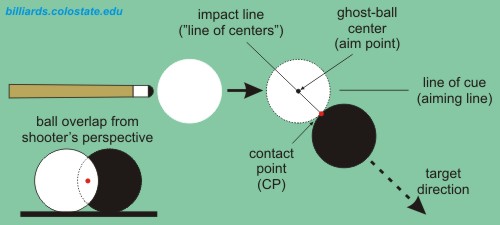
Both Joe and Steve Davis have this in their books on Snooker.Basically, the shooter visualizes the cue ball overlapping the object ball. Rather than picking a single point to focus on, you visualize the entire "C" shaped arc as defined by the outside edge of the CB where it overlaps the OB.
This gives a nice, big target to aim at.

Basically, the shooter visualizes the cue ball overlapping the object ball. Rather than picking a single point to focus on, you visualize the entire "C" shaped arc as defined by the outside edge of the CB where it overlaps the OB.
This gives a nice, big target to aim at.
To me, "visualizing the overlap" is simply a useful interpretation of ghost-ball aiming.Basically, the shooter visualizes the cue ball overlapping the object ball. Rather than picking a single point to focus on, you visualize the entire "C" shaped arc as defined by the outside edge of the CB where it overlaps the OB.
This gives a nice, big target to aim at.
Looks like you forgot to tell your dog?

To me, "visualizing the overlap" is simply a useful interpretation of ghost-ball aiming.
It is the same visualization used for the double-the-overlap and fractional-ball aiming systems. To me, these "systems" are just different ways of interpreting or visualizing ghost-ball aiming.
Now, consistently knowing or having a feel for how much overlap there should be for every shot doesn't come easy (and takes lots of practice). That's one reason why pool is challenging and fun, IMO.
Regards,
Dave