Cue Joint Size Question

So would a SW shaft on Cuetec hit the same?

I'm not familiar with Cuetec products, but from what i've heard, i doubt it.
It hits em pretty sporty on a converted house cue tho:cool:

A cues hit comes from the materials used, and the taper. I've never heard of a cuemaker changing the joint diameter much, to change the hit, unless they're making a whole different kind of cue, such as a carom, or snooker cue. The quality of construction plays a huge role as well. Don't get me started on people that "think" they don't need an a-joint, and that they can just skip that step:o Unless you're making a fullsplice, you need a proper a-joint. Not just a small tenon that you've scribed some glue lines on, but a tapped hole with a pin in it:thumbup:
 
I think Cuetecs and SW's would hit exactly the same if both were built by the same people using the same methods, otherwise......NO
 
Then there's the customs..........
I strongly believe that in the custom arena there should be no standards.
I feel that the builder should have the freedom to build as he wishes.
And they do.........Viva Le Difference.
That difference is what makes us special. We build what we feel is the best.
At the end of the day, joint diameter is just the beginning.

KJ

If I commission a custom cue from someone, I don't expect ANY standards...the ONLY standards are MY STANDARDS if I am getting it "custom made" for ME.

What I DON'T like, as a consumer, of ANY product is when the maker designs things of such a unique nature that it FORCES the consumer to return to "them" in order to get work done on the product they purchased. If a customer ordered that particular design for themselves, that is another matter.

If makers of a product are designing something that "improves" what is considered "standard", I have NO PROBLEM with that. I figure if it is eventually found to be "better", then that will become the de facto "standard" until a new improvement comes along.

A prime example of what I am talking about is the Sony company. They have EXCELLENT products, for the most part, but they will design things where you HAVE TO buy stuff from THEM in order to fix your "whatever is broken". I HATE THAT! I received a several-hundred dollar Sony digital camera as a gift once and I IMMEDIATELY returned it because it used proprietary Sony batteries that cost about $40 each at the time. I exchanged it for a Minolta (similar price), with way better specs, that used AA batteries that could be bought anywhere on the planet. As a matter of fact, the camera came with rechargeable AA batteries and a universal charger that could be used anywhere in the world.

If Sony could have convinced me that THEIR battery was somehow WAY better than something that could be obtained, 10 times cheaper, anywhere else, I may have stayed with the Sony.

When I buy a cue from someone, I usually always go back to that person to get work done or to buy a replacement for something. However, there are sometimes that the maker is no longer making cues or too busy to do whatever you need in a timely manner and you may want to look elsewhere for your needs. In that case, it is MUCH easier to get something if there is "somewhat" of a "standard" for the product.

Aloha. :) Stepping off my stump.
 
If I commission a custom cue from someone, I don't expect ANY standards...the ONLY standards are MY STANDARDS if I am getting it "custom made" for ME.

What I DON'T like, as a consumer, of ANY product is when the maker designs things of such a unique nature that it FORCES the consumer to return to "them" in order to get work done on the product they purchased. If a customer ordered that particular design for themselves, that is another matter.

If makers of a product are designing something that "improves" what is considered "standard", I have NO PROBLEM with that. I figure if it is eventually found to be "better", then that will become the de facto "standard" until a new improvement comes along.

A prime example of what I am talking about is the Sony company. They have EXCELLENT products, for the most part, but they will design things where you HAVE TO buy stuff from THEM in order to fix your "whatever is broken". I HATE THAT! I received a several-hundred dollar Sony digital camera as a gift once and I IMMEDIATELY returned it because it used proprietary Sony batteries that cost about $40 each at the time. I exchanged it for a Minolta (similar price), with way better specs, that used AA batteries that could be bought anywhere on the planet. As a matter of fact, the camera came with rechargeable AA batteries and a universal charger that could be used anywhere in the world.

If Sony could have convinced me that THEIR battery was somehow WAY better than something that could be obtained, 10 times cheaper, anywhere else, I may have stayed with the Sony.

When I buy a cue from someone, I usually always go back to that person to get work done or to buy a replacement for something. However, there are sometimes that the maker is no longer making cues or too busy to do whatever you need in a timely manner and you may want to look elsewhere for your needs. In that case, it is MUCH easier to get something if there is "somewhat" of a "standard" for the product.

Aloha. :) Stepping off my stump.

If a cuemaker doesn't meet or exceed your standards.....something is wrong. Either way, I don't know of a cuemaker that will change their joint size to suit YOU. Maybe someone starting out who is trying to figure things out(like me), but I believe once a guy gets settled on a joint size then you would have a hard time convincing him to do it differently.

You aren't referring to an inlay or a color, but construction.
 
If a cuemaker doesn't meet or exceed your standards.....something is wrong. Either way, I don't know of a cuemaker that will change their joint size to suit YOU. Maybe someone starting out who is trying to figure things out(like me), but I believe once a guy gets settled on a joint size then you would have a hard time convincing him to do it differently.

You aren't referring to an inlay or a color, but construction.

When I used the word "standards", I meant "specs", in addition to what I expect in quality and workmanship. I won't ask for someone to build me a "masterpiece" and then try to get them to do it for "dirt cheap", but I would expect it to be top quaility, in line with whatever price was charged.

I haven't commissioned a cue in quite a few years, but when I did it the first and second time, I had leeway on ANY aspect of the cue. The FIRST "starting out" guy I bought a cue from was Richard Black, way back in 1978, when he had only been making cues for a few years.

I don't expect a cuemaker to "retool" his entire shop to make a cue, but I think the majority would make your cue any way you wanted it...within reason and IF THE PRICE IS RIGHT!

I know several people who have commissioned cues from some of the biggest names over the last few years and they got WHATEVER they asked for. I know one guy who had a cue made by one of the BIGGEST names in the business. This guy had EVERY dimension he wanted...from tip to rubber bumper. He wasn't a cue designer by any means, but he was a pretty good player and he thought his ideas would get him the "HOLY GRAIL" of cues. He came up with some sort of tapers where it changed every so many inches and he told the cuemaker everything he wanted done...from type of tip, size and type of ferrule, shaft diameter (including all his weird tapers), joint collar types, joint type and size, types of wood for the butt...etc., etc., etc. I saw it when he got it and it looked nice, but I don't know how it hit or played.

If a cuemaker can't or won't make whatever a customer wants "customized" then they shouldn't be called "custom cuemakers".
 
Last edited:
When I used the word "standards", I meant "specs", in addition to what I expect in quality and workmanship. I won't ask for someone to build me a "masterpiece" and then try to get them to do it for "dirt cheap", but I would expect it to be top quaility, in line with whatever price was charged.

I haven't commissioned a cue in quite a few years, but when I did it the first and second time, I had leeway on ANY aspect of the cue. The FIRST "starting out" guy I bought a cue from was Richard Black, way back in 1978, when he had only been making cues for a few years.

I don't expect a cuemaker to "retool" his entire shop to make a cue, but I think the majority would make your cue any way you wanted it...within reason and IF THE PRICE IS RIGHT!

I know several people who have commissioned cues from some of the biggest names over the last few years and they got WHATEVER they asked for. I know one guy who had a cue made by one of the BIGGEST names in the business. This guy had EVERY dimension he wanted...from tip to rubber bumper. He wasn't a cue designer by any means, but he was a pretty good player and he thought his ideas would get him the "HOLY GRAIL" of cues. He came up with some sort of tapers where it changed every so many inches and he told the cuemaker everything he wanted done...from type of tip, size and type of ferrule, shaft diameter (including all his weird tapers), joint collar types, joint type and size, types of wood for the butt...etc., etc., etc. I saw it when he got it and it looked nice, but I don't know how it hit or played.

If a cuemaker can't or won't make whatever a customer wants "customized" then they shouldn't be called "custom cuemakers".

You can name call all you want, but in the end his/her name is on it. I think we can agree on that.
 
When I think of custom, I think aesthetics, weight, shaft diameter/taper, and balance point. Once I settle in to construction, I'll settle on what I think is best. A customer will have to live with that. The innards are what will define my cue. If they want something else, they can buy it from someone else.
 
When I think of custom, I think aesthetics, weight, shaft diameter/taper, and balance point. Once I settle in to construction, I'll settle on what I think is best. A customer will have to live with that. The innards are what will define my cue. If they want something else, they can buy it from someone else.

If a cuemaker can't or won't make whatever a customer wants "customized" then they shouldn't be called "custom cuemakers".


Than I guess I am glad that you are not dictating how I run my business. That a cuemaker can't or won't do something has nothing to do with if they are a custom cue maker or not. As Lex says how the cue is put together is what defines his cue, if a customer wants something different that he or any other cue maker is not willing or can't do, he has every right to tell the customer so and to call himself a custom cue maker. I personally will not put a SS joint collar on a cue, does that mean I am not a custom cue maker? No, it just means I will not get certain orders.
Doesn't the cuemaker have a right to maintain how his cues perform? If a customer asks for a cue with specs that the cue maker believes will deter from the quality of play or simply look like sh*t doesn't the cue maker have the right to say no? While some may simply make the cue, pocket the money and go from there others might actually have some pride and not want their name associated with certain cues that a customer might be interested in. EVERY business owner has the right to say no to a customer without the definition of who he is or what he does being changed.

Bob Danielson
www.bdcuesandcomix.com
 
When I think of custom, I think aesthetics, weight, shaft diameter/taper, and balance point. Once I settle in to construction, I'll settle on what I think is best. A customer will have to live with that. The innards are what will define my cue. If they want something else, they can buy it from someone else.


That is fair and I have no arguments with that. I'm not a cuemaker, nor a custom car maker, but if I were to do either I would make "whatever" a customer wanted, while letting them know where I stood during the entire process. If I KNEW for a FACT that the shaft would break off during the first hit of the cue ball, I would tell the customer that and have him sign off on building it HIS way. I'm ALL for "the customer is ALWAYS right", up to the point where the maker can say "WHOOOOPS...WHAT DID I TELL YOU AND YOU DIDN'T LISTEN?"

If I were a cuemaker, any cue that I designed and built "MY WAY" would be my "signature" stamp of approval. Any cue that I built "YOUR WAY" would be "YOUR" stamp of approval and it just happened to be built by me, with the best of my abilities using YOUR criteria.

I can argue either side of the argument, but I don't really see anything as an argument. I see it as satisfying the customer's wishes and him living with the outcome knowing that it was HIS PREFERENCES that were used.
 
Dale Perry

I think its funny that people argue about the construction specs and how the cuemaker has the right to keep his specs and it be "custom". But when Dale Perry has all of his equipment set up to his specs and he can pump out 200 cues a year for $150 each people want to argue whether he's making customs or production cues. Hell DP will even give you the option of shaft taper whether it be a pro taper, straight or whatever you ask for. I'm not taking sides, I just find it amusing.
 
My point was they only make shafts one joint size and for the most part cuemakers would make cue butts to match the size.

So, since Schon and Joss and probably others were using .840 as a standard joint size, were they doing this because they thought it was essential to the hit of the cue based on their butt taper or did they just make them that sized because they thought that the only thing that mattered was the tip, ferrule and taper of the shaft and .840 just sounded like a nice number?

Bob Danielson
www.bdcuesandcomix.com

You might be over thinking this a little. I believe when Joss started they bought parts from Palmer. Most cue makers used SS joints that were pre-manufactured and tapered. All the SS joints of that time were pretty much the same dimensions including length and the cue makers used them. I don't think they were sitting there with slid rules trying to come up with some magic formula. They put together cues and sold them. New cue makers followed suit just as they do today.
I remember seeing an interview with John Lennon and the interviewer was going into some deep meaning in one of his songs. When he asked Lennon what he was trying to say with the lyric, Lennon said "Nothing, I picked words because they rhymed".
 
Last edited:
That is fair and I have no arguments with that. I'm not a cuemaker, nor a custom car maker, but if I were to do either I would make "whatever" a customer wanted, while letting them know where I stood during the entire process. If I KNEW for a FACT that the shaft would break off during the first hit of the cue ball, I would tell the customer that and have him sign off on building it HIS way. I'm ALL for "the customer is ALWAYS right", up to the point where the maker can say "WHOOOOPS...WHAT DID I TELL YOU AND YOU DIDN'T LISTEN?"

If I were a cuemaker, any cue that I designed and built "MY WAY" would be my "signature" stamp of approval. Any cue that I built "YOUR WAY" would be "YOUR" stamp of approval and it just happened to be built by me, with the best of my abilities using YOUR criteria.

I can argue either side of the argument, but I don't really see anything as an argument. I see it as satisfying the customer's wishes and him living with the outcome knowing that it was HIS PREFERENCES that were used.
If your preference does not fall within the maker's standards or liking, then I suggest you look for another maker who approves your preference.
The customer is always right might be fine and dandy in most service industry but when a maker tells you if I did the cue to your specs, it'll hit like s ha it , he's most likely right.
 
I think its funny that people argue about the construction specs and how the cuemaker has the right to keep his specs and it be "custom". But when Dale Perry has all of his equipment set up to his specs and he can pump out 200 cues a year for $150 each people want to argue whether he's making customs or production cues. Hell DP will even give you the option of shaft taper whether it be a pro taper, straight or whatever you ask for. I'm not taking sides, I just find it amusing.

That would be customized production.
Shaft taper is easy to alter.
 
You might be over thinking this a little. I believe when Joss started they bought parts from Palmer. Most cue makers used SS joints that were pre-manufactured and tapered. All the SS joints of that time were pretty much the same dimensions including length and the cue makers used them. I don't think they were sitting there with slid rules trying to come up with some magic formula. They put together cues and sold them. New cue makers followed suit just as they do today.
I remember seeing an interview with John Lennon and the interviewer was going into some deep meaning in one of his songs. When he asked Lennon what he was trying to say with the lyric, Lennon said "Nothing, I picked words because they rhymed".
I did start in this business later than many, but the pretapered joint collars were new to me several years after I started. 7/8" or .875" straight with no taper was the only way I saw the stainless joints for years. Uni-Loc introduced the pretapered ones in the 90's as far as I know. But I have not seen the Palmer parts so you could be right. But .830" was more popular than .840 when I started. It was just Joss and Schon using the .840" and most of the rest of production makers varied joint size with .830" being the average.
 
I did start in this business later than many, but the pretapered joint collars were new to me several years after I started. 7/8" or .875" straight with no taper was the only way I saw the stainless joints for years. Uni-Loc introduced the pretapered ones in the 90's as far as I know. But I have not seen the Palmer parts so you could be right. But .830" was more popular than .840 when I started. It was just Joss and Schon using the .840" and most of the rest of production makers varied joint size with .830" being the average.
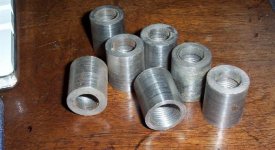
It got me thinking so I went to where I have a lot of stuff stored and found a bunch of junk I had from a pool room I owned in the 70's through the beginning of the 80's. I found a lot of time cards and receipts and stuff from that pool room. I had a lathe back then in the pool room and was fooling with cues. I am not certain where I got these joints but they are pretty old. My guess is Palmer because I got some Irish lined and ferrules from them back then. They came rough unfinished (need polishing) and all measure .841 at the smallest and .851 at the biggest. I just measured them. So they were around back then if someone wanted them. Must have been a lot of work to make something like that before cnc. They are nicely made when you look at them close. I hope Bill Stroud or someone chimes in to correct some of the historical stuff. You have to wonder how some of this stuff really got started. I remember reading that the 3/8 x 10 screw was actually a mistake.
 

Attachments

  • joints.jpg
    joints.jpg
    48.2 KB · Views: 591
Last edited:
Aloha all,
I've seen cues with joint sizes less than .800 to larger than .860 from a variety of sources (custom and production), but some cuemakers tend to "gravitate" to a particular size and stay with it. I think Schon and Southwest use .835, or so, but they use different types of joints. I think Cuetec (calling them a cuemaker or not is up to you) uses a .790. Meucci tends to make smaller diameter joints as well.

Cues are amazingly close to 1.000 at the wrap start, no matter what the end dimentions are. As the diameters diminsh, at some point, power diminishes with it. Which is not necessarily a bad thing. Especially where the predictability of position play is concerned. The way some of my first cues played, it seemed like the cue ball was hitting the cue instead of visa versa. Sort of like hitting a regular 2 1/4'' ball with a snooker cue. So i went to the other extreme with dimentions and thought i could eventually train myself or get used to the power difference, but i couldnt stay in line if you held a gun on me. I ended up settleing for .850 at the joint. In my view, players that mostly play on coin op tables with the oversized cb or the weighted cb and use their playing cue to break with, need a fairly powerful cue. The same with 9' tables. Of coarse thats just an opininon.
Shaft taper and tip size is the only diameter variance i use anymore. Personally, no matter how good they feel, i dont like shafts that immidiately start to dive from the joint.
 
You have to wonder how some of this stuff really got started. I remember reading that the 3/8 x 10 screw was actually a mistake.

So that's where you're going to leave it??? a mistake???
Surely you can clarify that statement. Don't stop now, I'm all eyes.
I know you're repeating what you've read (or heard) but is there more to it?
I mean, making that statement with no follow-up, certainly raises some questions.
For a mistake, I'd have to conclude that it's enjoyed a fair degree of success.
If nothing else, it may be an interesting story.
Got any more?
KJ
 
So that's where you're going to leave it??? a mistake???
Surely you can clarify that statement. Don't stop now, I'm all eyes.
I know you're repeating what you've read (or heard) but is there more to it?
I mean, making that statement with no follow-up, certainly raises some questions.
For a mistake, I'd have to conclude that it's enjoyed a fair degree of success.
If nothing else, it may be an interesting story.
Got any more?
KJ

I believe I heard it from Bill Stroud. Something with making the screws wrong or ordering them wrong and going on to use them anyway creating a new standard. I am sure he will comment he reads this board or someone else knows the details of the story.
 
I believe I heard it from Bill Stroud. Something with making the screws wrong or ordering them wrong and going on to use them anyway creating a new standard. I am sure he will comment he reads this board or someone else knows the details of the story.

Sounds plausible to me.

BTW, is that a Colt 1911 in your avatar?
 
Back
Top