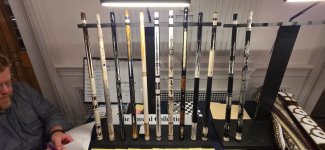
I guess it depends on what you mean by quality of the materials chosen, a CF cue transfers power more efficiently than MOST but not all wood cues, however the wood cue is dependent on the quality of the wood, the same type of wood can transfer power very differently, CF manufacturered by companies like Predator, Mezz, Becue will have consistent quality, I can't speak for cues/shafts coming from places that do zero testing and are selling on were the cheapest but generally products like those don't stand the test of time, the quality of materials in CF is going to be more consistent.
It’s been my experience that the best cue makers pay attention to their materials. They are very selective in what they buy. And they invest in a having a good inventory. Ernie Gutierrez epitomizes that approach as do many other noteworthy names. They have the best stock or access to it and pay close attention to how it matches the cue design.
They understand the anatomy of the pool cue and you don’t see light weight shafts. The best names always adhered to weight proportionality and that’s been the case for 50-60 years. Lightweight shafts are rare unless the customer wanted
more deflection. glued veneers are not rushed & get to sit for a couple months drying. You don’t see inlays, rings or veneers becoming raised and the shafts are commonly approaching 4 ozs. and heavier. It depends on what weight the butt is to maintain weight proportionality. Nothing was ever rushed.
The final cue price directly reflects the materials expense, the number of hrs. and cost of labor to complete the cue, allocation of fully absorbed hourly operating expenses inclusive of occupancy, equipment & maintenance, inventory, general administrative costs, insurance ( liability, worker’s comp, health, etc), advertising (marketing, trade shows, bldg.power and heating, literature, merchandise) and lastly markup for final profit. Custom cue makers don’t produce the volume that catalog type cue brands which can distribute through retailers and wholesalers, as well as direct.
Now does it mean your $5000 cue plays better than a $500 cue? It depends if there’s any differences. But keep in mind some cue makers can’t build what other cue makers can. I found out searching for 4 oz. uncored, sans any wt. insert, Kielwood shaft. It took me 3 months and talking with a lot of cue makers before I located someone who said, “No problem.” I spoke with over a dozen cue makers and only a handful were up to the task. A few told me it can’t be done because KW shafts come out lighter afterward. Well, I though that was a lame excuse when I heard it and then I learned they were terribly misinformed. I have two 29” KW shafts that weigh 4.0 & 4.15 ozs ( 12.6 & 12.75 mm) flat faced wood and no inserts were used. All you need to do this is procure the right weight blanks for your inventory.
Schmelke could do it but wanted to build 29.5” or 30” shafts. Jacoby eventually did it using 29.5” shafts but I had already ordered my KW shafts before they let me know. There are going to be other cue makers that could build what I wanted, like SC Diver who built a gorgeous curly maple KW shaft. I think individual cue makers can tackle what other firms are reluctant to do because it does not generate sufficient income to justify any special inventory requirements.
The reality of playing pool is a cue can make your playing time more enjoyable but it doesn’t make you a better player.
Remember that pool is always played between your ears before you stroke the cue ball. The player determines the shot
outcome, never the pool cue. It just helps the player to own and play with a cue that meets all of their expectations.
Last edited: