Do you want to learn more about your stroke?

Happy New Year to All! Did anyone get any brand new shiny gear?

Thanks again to all the players who have provided video for analysis, I hope the feedback has been useful to help you improve your stroke and technique!

I've been working away on the front-end website to accompany the analysis better and I'm happy to say it's almost ready to go. There's some great features and data which will definitely make it worth it.

I'll be looking to launch in a few weeks but I'm still happy to do another couple of free analysis sessions if anyone else is interested.

I'll set up the new analysis sessions on the website so the players can log in and look at the data etc. I'll also credit their account accordingly for future sessions.

Consider it a New Years Gift :D

I'll have to do this on a first come basis though for a few players only so be quick if you're interested!

The Emperor...
 
Haven't lurked here in awhile and I came across this thread, and boy was I glad I did!

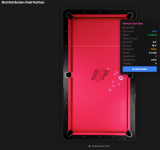
I sent a video in of 10 draw shots to the centre of the table; attached is an image showing the final position and analysis of the 10 draw shots I made in the website. Each circle represents the final position of the cue ball, and hovering over each circle displays the relevant data for that specific shot (see attached image).

The feedback was thorough and extremely detailed, confirming essentially everything I know is wrong with my stroke. Naturally, fixing these problems is the tough part and perhaps this is where in-person coaching might still be favoured over remote coaching / video analysis.

However, I will say that if you're not exactly sure, or have no clue how to identify your mechanical breakdowns, the analysis and data provided by this service is a fantastic starting point. It will isolate key items to work on and results are backed up with data.

Some excerpts from the detailed feedback I received via the website.

Now let’s talk about the cue action. Overall it’s pretty smooth and solid. From your hand touching the table to striking the ball tends to be around the 8 sec mark which is a touch slower compared to top pro’s who are usually about 4-5 secs. If this works for you though that’s fine. The only thing is that the longer people stay down on a shot the longer they can overload their brain with information relating to the shot which could cause a bad shot. You didn’t really hit any bad shots per se. It was just your overall position that made the overall analysis look worse that it really was. The objective of this drill though of course is to leave the cue ball dead centre but you were consistently leaving it to the side of that.

One thing I noticed a lot is that you get down on the shot and then spin the cue around in order to get it to the right position I presume? You did this on a few shots early on but then not so much later. In fact I felt the overall smoothness of your shots got better towards the end few balls.

Another thing is that when you are about to strike the cue ball (just before the tip hits it) you have a bit of excess body movement, look at your left shoulder on all of the shots. It moves to the left. It could be that you're subconsciously trying to drive more power / spin into the shot which is causing this. It’s definitely something to try and isolate though and remove going forward.

This session is a brilliant example of why this drill is way more than “did the ball drop?”. First up, credit where it’s due: you went 10/10 potted, which instantly tells us your base aim and delivery are solid. Across the set your cue delivery stayed consistent too, with average straightness ~81.5 and average pot accuracy ~81.7 — that’s a strong platform to build from, and it’s exactly why the pot never really looked in danger.Where the AI starts to separate levels is the cue-ball “finish” side of the shot. Your average overall score came out at ~68.3, but that’s not because the potting was weak — it’s because this scoring model is heavily weighted toward landing the cue ball dead-centre after the pot. Your average position score was ~6.6, which basically means: the pot is there, the stroke is there… but the cue ball is consistently missing the exact positional target that the drill is demanding.The most useful part of this dataset is the pattern, not the misses. Your cue ball isn’t randomly landing all over — it’s clustering in a repeatable “bias shape”. On average you’re finishing around (38.6, 44.3) versus a dead-centre target of (25, 50) — roughly 13–14 units to the right and about 6 units low. That’s actually great news, because consistent bias is fixable bias: it points to a small alignment/contact calibration offset rather than anything unstable or “wrong” with your action.Speed-wise you weren’t smashing it — your strike was very playable: ~9.9 mph average (about 9.1–11.2 mph range). Yet the cue ball still travelled a fair amount (~74.3 units average cue distance), which tells us you’re transferring energy cleanly and the table is responding predictably. The next gains here aren’t about “more power” — they’re about precision: contact height, delivery direction, and how efficiently you convert that into controlled return.

Overall, I think this is a fantastic tool and no doubt will only get better with time as more features gets added in. Looking forward to see how it develops further!
 

Attachments

  • Screenshot 2026-01-10 020858.png
    Screenshot 2026-01-10 020858.png
    443.3 KB · Views: 19
Hi Caleb,

Thanks for the kind words and sharing the video. It was good to see you making these shots.

That’s actually exactly how this is designed to be used — and you’ve worded it really well.

Nothing here is trying to replace good coaching or in-person guidance. Where this layer becomes powerful is that it turns improvement into a measurable loop rather than a feeling-based one. Instead of “that felt better”, you can literally see whether your timing, alignment bias, cue-ball efficiency and placement accuracy have shifted — and by how much.

The real workflow is:

Analyse > Adjust > Re-submit > Compare > Lock in gains

That way you’re not just being told what to work on — you’re proving that what you worked on actually changed something meaningful. And once players see their own bias clusters tightening, centre error shrinking, efficiency improving, etc., progress becomes very real very quickly.

In that sense it becomes less like “remote coaching” and more like a performance lab you can keep coming back to — and that’s where it starts to get fun.

I'm still in BETA with the web app but will be hoping to launch it soon as I need to add in some instructional videos explaining a few things etc.

Any shot can be analyzed. So if players have a particular shot they could submit that and the same data can be produced of course. So you'd get the hard data combined with my personal feedback and suggestions along with AI suggestions based on the data.

After launch, any player wishing to sign up will have to pick a base pillar assessment of one of three shots -

Perfect Draw Shot (which is the one you did)
Perfect Stop Shot
Perfect Follow Shot

They submit this shot through the site in a video of 10 shots in one continuous take (not edited).

I then analyse the video and create the data along with the other feedback mentioned above and submit it back to the player. They then work on it and send in another video of the same shot 10 times again. Then in the follow up report the data can be compared and validated.

This then forms the baseline assessment for the player and then they can submit any shots they like (or just do one of the core pillar shots again).

High scoring shots can be shared by the player to the public leaderboard and facebook if desired.

There is also a clans feature where players can create a clan and invite other players into it to compare data.

I forgot to add that I can pretty much cater for all table sizes, including Chinese 8 Ball.
 
Last edited:
Back
Top