Hi All, Happy New Year to everyone!
I've been doing more analysis and this here's some more great data on two Elite players having a try at the Perfect Draw Shot.
I anonymised the data but Player Y is actually Phil Burford, he was ok for me to use his name. You can probably guess who the other player is if you delve hard enough...
In any case this data was fascinating as both players have tables with 3.6" pockets, Phil has a Gold Crown V and the other a Diamond, both 9' of course.
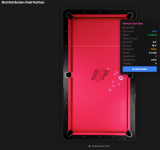
You only have to look at the image to see the final cue ball position similarities between them.
Here's also a quick AI take on all the data if anyone is interested....
Comparative Stroke Analysis — Perfect Draw Drill (Sub-4″ Pockets)
Two high-level players (Fargo ~740–770) independently performed the same 10-shot perfect draw drill under identical geometry and tight-pocket conditions (<4″).
They are referred to here as Player X and Player Y.
The drill requires potting a straight object ball and returning the cue ball to the dead-centre of the table.
Final scores derive from pot success (accuracy), pot quality, and cue-ball position proximity.
Summary Metrics
Player X
Accuracy: 100%
Mean Total score: 87.6
Straightness: 92.5%
Smoothness: 8.9
Speed: 8.1 mph
Tempo: 3.37 s
Waggles: 2
Player Y
Accuracy: 90%
Mean Total score: 78.2
Straightness: 94.0%
Smoothness: 9.0
Speed: 7.9 mph
Tempo: 3.77 s
Waggles: 5
Cue-Ball Return Geometry
Despite clear differences in routine tempo and waggle structure, both players produced cue-ball return positions that cluster within the same central zone of the table.
This overlap indicates similar draw-transfer efficiency and directional stability.
In other words, two mechanically independent strokes converge to nearly identical cue-ball behaviour once alignment and speed control are stable.
Player-Specific Stroke Signatures
The datasets also reveal subtle differences in how each player achieves draw.
Player X
Shorter tempo and minimal waggle count indicate a compact, direct routine.
Cue-ball speeds are marginally higher and return depth slightly greater on average.
This pattern suggests a stroke biased toward committed energy transfer and decisive contact quality.
Draw authority is reached through uninterrupted acceleration rather than routine preparation.
The higher mean score aligns with this: positional proximity improves when draw depth margin increases.
Player Y
Longer tempo and higher waggle count indicate a more deliberate preparatory phase.
Cue-ball speeds are fractionally lower but straightness and smoothness marginally higher.
This profile suggests a stroke prioritising contact precision and alignment stability over maximum draw reach.
Return positions cluster tightly but slightly shallower relative to Player X.
The lower mean score is therefore explained not by instability but by reduced positional depth margin combined with one pot miss.
Routine vs Outcome
The most notable finding is that routine style differs substantially:
Player X tempo: 3.37 s
Player Y tempo: 3.77 s
Player X waggles: 2
Player Y waggles: 5
Yet cue-ball clustering remains strongly similar.
This indicates that once delivery straightness and speed regulation enter elite ranges, routine architecture becomes largely stylistic rather than performance-limiting.
Conclusion
Two independent elite strokes executed the same draw drill on sub-4″ pockets.
The measured data shows:
matched speed selection
elite straightness and smoothness
overlapping cue-ball return clusters
Differences in score arise from pot success and positional depth rather than stroke instability.
The comparison demonstrates convergence of cue-ball behaviour between distinct elite strokes operating under identical constraints.