
Fighting Your Eyes - Alignment.

Colin Colenso

AzB Silver Member
Silver Member
I expect quite a few of you have experienced this same obstacle to alignment that I will discuss here. I hope it leads to some ideas for remedies.

Fact is, I have a constant battle in trusting my eyes...that is, if I think I am aligned to a point, I am actually aligned a little to the right of it.

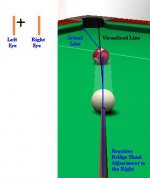
Dominant eye theory does not seem to help much. When I do the finger test, the position that feels most comfortable when pointing, is a little off where my left eye line of sight is. See the diagram below.

So, on most shots, when it looks / feels like my cue is aligned along the black line as shown below, the real aim is actually along the blue line.

For a long time I have fought with my eyes. I know this tendency and try to force myself to see the line through my left eye. But it is just hard work and my eyes don't seem to want to see the line this way.

So I'm trying another way. I just align as my eyes naturally want to do, and then I adjust my bridge about 1-2 mm to the right. It's working like a charm, but I've never heard of anyone doing it this way.

An interesting aside, is that when I am more elevated, such as bridging over a rail, my eyes seem to see the line correctly. And when I elevate even further, such as when bridging over a ball, my eyes actually miscalculate to the other (left side).

Crazy things these eyes are...shoud we fight them to see what we want to see, or just learn their weird tendencies and adjust to them?
 

Attachments

  • fighteyes.JPG
    fighteyes.JPG
    13 KB · Views: 645
I have exactly the same problem as you seem to have, and have found that Joe Tucker's 3rd Eye stroke trainer is getting me on track. I too need to shoot a bit to the right of what my eyes perceive as being the correct line. And it sure does work. In my case, the offset is more than 1-2 mm... maybe something like 5 mm. Crazy.

Flex
 
Flex said:
I have exactly the same problem as you seem to have, and have found that Joe Tucker's 3rd Eye stroke trainer is getting me on track. I too need to shoot a bit to the right of what my eyes perceive as being the correct line. And it sure does work. In my case, the offset is more than 1-2 mm... maybe something like 5 mm. Crazy.

Flex
Flex,
Just to clarify,
What do you mean you have to shoot to the right?

When I think I am lined up, I am actually pointed to the right a little, and so I have to adjust, or shoot more to the left of what looks right.

When I said 1-2mm. I mean the bridge point is off by that much. I shift the bridge to the right, and then re-align my cue tip to the center of the CB. When I look at the aim now, it feels like I'm aligned way to the left, but it is the correct line...yikes!

The way I adjust my bridge is by rotating about the heel of my hand so my index finger (open bridge) is shifted about 5mm to the right. This adjusts my bridge point a couple of mm.

I sure wish my eyes indicated the correct line, but they just don't. I've always had this tendency and it has always taken a lot of practice and adjustments to start making the long shots consistantly. I suspect many people have a similar problem as there are not too many guys around who don't have problems with the long straight shots.
 
Biggest obstacle in fundamentals

Eye alignment, is in my view the single most important feature of stroke fundamentals. I have been working on this for 50 yrs. The difficult part is the different perceptions you receive when you are cutting balls to one side or another, then lining up a straight-in, and finally trying to line up with inside or outside english to a cut to the left or right. With all those variations, it's no wonder it's so hard. Few players can correctly perceive all those variables, that's why we all have difficulties with certain shots. The top players avoid shots that give them a non-confident look. One of these days I will crack the code. Until then, later all.

the Beard
Bank on, brother! Old school pool.
 
freddy the beard said:
Eye alignment, is in my view the single most important feature of stroke fundamentals. I have been working on this for 50 yrs. The difficult part is the different perceptions you receive when you are cutting balls to one side or another, then lining up a straight-in, and finally trying to line up with inside or outside english to a cut to the left or right. With all those variations, it's no wonder it's so hard. Few players can correctly perceive all those variables, that's why we all have difficulties with certain shots. The top players avoid shots that give them a non-confident look. One of these days I will crack the code. Until then, later all.

the Beard
Bank on, brother! Old school pool.

Thanks for the imput 'The Beard'!

Just a couple of general points I want to add for readers.

For the english shots, there is some potential adjustment systems that I have discussed here that work fairly well.

As for judging the cut angle, various systems have been proposed from Houlian variations, to ghost ball, to contact point focus, to the point to point systems. Some swear by some of these, but I find them to be imperfect, and some degree of intuition gained over lots of trial and error seem to me to be a pre-requisite.

But even if these can be developed to work perfectly. If our eyes don't line up to where we want to aim, then we are back to square one. So it is a fundamentally important aspect to conquer.

As I mentioned in the first post, there is a variation in my perceived alignment which changes according to the height of my head above the shot. If I keep my chin about 10" above the cue, the correct line looks correct by my eyes. When I go lower, which presents a better perspective of the line, my eyes see the correct line as actually being left of where the CB will actually go.

I wonder if others have noticed this variation in perception according to the height they view the line of the shot from.
 
I only notice it when I shoot very hard. I always thought it was a inperfection in my stroke, and that it was magnified when I shoot hard. When I break I have to aim almost a quarter ball to the right.
 
Driller said:
I only notice it when I shoot very hard. I always thought it was a inperfection in my stroke, and that it was magnified when I shoot hard. When I break I have to aim almost a quarter ball to the right.
That's probably a different issue.
It could be caused by 2 things.
1. Hitting off center on the CB causing deflection.
or if you are doing this when hitting center CB
2. Sweeping the tip right to left on the stroke (which means the grip hand is moving left to right).
 
I wasn't going to post ever again about my eyes, but Colin, your question has an answer that I just discovered in the last few weeks, so here's my last and best (imho) post on eye problems.

One of my goals for this year (see goal thread) was to find a way for my eyes to work better and stick to that. No more constantly switching contacts, no more lasik, no more flipping back and forth with different prescriptions, mono-vision or any of that. I've screwed with that for over 6 years and have gotten nothing but misery from it. It still amazes me about the power of goal setting, but somehow I recently "accidently" discovered a book review on Amazon that talks about how to psychologically not see spots and floaters, one of my major problems. It was an "ah ha" moment for me. No physical adjustments, just a change of thinking. Who'd thunk it?

So, I simply decided to ignore my eyes and just shoot pool. If my eyes are aligned wrong or if floaters are blocking my vision, or if my eyes are dry, or whatever, I don't consciously care anymore. Why? Because my fundamentals are sound, so I'm just letting my subconscious mind deal with my eyes and am consciously forgetting them.

The results have been wonderful so far. I rarely see my floaters, I don't obsess with poor alignment, or off angle hits or anything. I just keep shooting and forget my eyes, no matter how much trouble they're giving me at the time. And all I'm doing is consciously dismissing the importance of seeing perfectly, and just doing what I can with what I have. Shots that I before complained about are now just shots, like any other shot. Ho hum, who cares, so what?

I don't know if it'll work for you the way it does for me, but what if it does?

Jeff Livingston
 
chefjeff said:
I just keep shooting and forget my eyes, no matter how much trouble they're giving me at the time. And all I'm doing is consciously dismissing the importance of seeing perfectly, and just doing what I can with what I have. Shots that I before complained about are now just shots, like any other shot. Ho hum, who cares, so what? Jeff Livingston
How's that Zen saying go, Jeff? "First mountains were mountains. Then, mountains became more than mountains. Finally, mountains were again just mountains."

Hmmm... In my case, I know cut shots to the left look thicker than they actually are (left eye dominant, right-handed). If I adjust to what my eyes are seeing once I'm down on the shot, I'll overcut the shot. Conversely, shots to the right look to me like I'll overcut when I'm dead on. If I adjust after my bridge hand touches the cloth, I'll cut it fat and miss.

So I've done exactly what Jeff has done (though it seems Jeff's problems are more challenging), since I know that tendency of mine, I just ignore my eyes completely. It's the only way my stroke won't veer off to the side my *eyes* perceive as correct. I'm training my eyes to be passive observers during the shotmaking process. Nothing more.

P.S. I seem not to have problems with straight in shots however. Is that plausible, or am I fooling myself? Thanks.
 
Colin Colenso said:
Flex,
Just to clarify,
What do you mean you have to shoot to the right?

When I think I am lined up, I am actually pointed to the right a little, and so I have to adjust, or shoot more to the left of what looks right.

When I said 1-2mm. I mean the bridge point is off by that much. I shift the bridge to the right, and then re-align my cue tip to the center of the CB. When I look at the aim now, it feels like I'm aligned way to the left, but it is the correct line...yikes!

The way I adjust my bridge is by rotating about the heel of my hand so my index finger (open bridge) is shifted about 5mm to the right. This adjusts my bridge point a couple of mm.

I sure wish my eyes indicated the correct line, but they just don't. I've always had this tendency and it has always taken a lot of practice and adjustments to start making the long shots consistantly. I suspect many people have a similar problem as there are not too many guys around who don't have problems with the long straight shots.


When I line up normally, not using Joe Tucker's 3rd eye, I know from experience that on a shot where the cue ball is 4 diamonds away from the object ball that I need to AIM about 1/4 inch left on the object ball for it to be shot straight on. On a shot where there is no margin for error, say a long straight in shot down the rail on a table with tight pockets, this becomes an imperative.

However, when I shoot those straight in shots while using Joe's device, I've found that my cue tip placement on the cue ball when shooting this shot is actually about 5 mm to the right of what I perceive as being center ball. And when I shoot the shot the cue ball hits the object ball, which goes straight ahead, and the cue ball stops dead without any spin whatsoever.

Having used the 3rd eye probably for 8 hours or so altogether, I'm regrooving my stroke and my aim line and so on. So what looks like straight center ball is very different from what my eyes actually perceive. That's one of the keys to using the 3rd eye, retraining one's eyes to see where center ball really is, and knowing where it is, even when our eyes tell us it isn't so.

One of the things I'm going to have to deal with is relearning cut angles and so on, probably with the exception of certain shots that I have learned to consistently make in a certain way. Once the how to of a specific shot is ingrained, and the feel is there, and so on, the ball goes down, and the cue ball makes it's way (hopefully) to it's home.

Colin, I don't know if you've used Joe's 3rd eye, but if you haven't, you really should give it a go.

So when I say I need to set up and make a 5 mm shift to the right, it means I need to set my aim line angled slightly to the right of what my eyes naturally perceive to be the correct one. The difference is where the tip hits the cue ball.

By the way, since I got the 3rd eye, I've been shooting jacked up shots much better. Joe has a drill for shooting those too, with the trainer. Jacked up shots no longer scare or bother me now.

What I do for these and other shots is imagine where the tongs of the 3rd eye would be to shoot the shot center ball, and imagine which angle I'd need to take and what that would look like if I were using the 3rd eye. To me, it's a visualization thing. And it's helping me a lot.

One thing though, I think the 3rd eye will become a tool that I can't leave home without. It gets me back in line pretty quickly and helps retrain my eyes. Gosh this game can be tough.

As for how this might work with back hand english and so on, I'm not even close to trying to work on that. However, for the straight in shots, I have to say the 3rd eye has helped a lot.

Flex
 
Flex said:
When I line up normally, not using Joe Tucker's 3rd eye, I know from experience that on a shot where the cue ball is 4 diamonds away from the object ball that I need to AIM about 1/4 inch left on the object ball for it to be shot straight on. On a shot where there is no margin for error, say a long straight in shot down the rail on a table with tight pockets, this becomes an imperative.

However, when I shoot those straight in shots while using Joe's device, I've found that my cue tip placement on the cue ball when shooting this shot is actually about 5 mm to the right of what I perceive as being center ball. And when I shoot the shot the cue ball hits the object ball, which goes straight ahead, and the cue ball stops dead without any spin whatsoever.

Having used the 3rd eye probably for 8 hours or so altogether, I'm regrooving my stroke and my aim line and so on. So what looks like straight center ball is very different from what my eyes actually perceive. That's one of the keys to using the 3rd eye, retraining one's eyes to see where center ball really is, and knowing where it is, even when our eyes tell us it isn't so.

One of the things I'm going to have to deal with is relearning cut angles and so on, probably with the exception of certain shots that I have learned to consistently make in a certain way. Once the how to of a specific shot is ingrained, and the feel is there, and so on, the ball goes down, and the cue ball makes it's way (hopefully) to it's home.

Colin, I don't know if you've used Joe's 3rd eye, but if you haven't, you really should give it a go.

So when I say I need to set up and make a 5 mm shift to the right, it means I need to set my aim line angled slightly to the right of what my eyes naturally perceive to be the correct one. The difference is where the tip hits the cue ball.

By the way, since I got the 3rd eye, I've been shooting jacked up shots much better. Joe has a drill for shooting those too, with the trainer. Jacked up shots no longer scare or bother me now.

What I do for these and other shots is imagine where the tongs of the 3rd eye would be to shoot the shot center ball, and imagine which angle I'd need to take and what that would look like if I were using the 3rd eye. To me, it's a visualization thing. And it's helping me a lot.

One thing though, I think the 3rd eye will become a tool that I can't leave home without. It gets me back in line pretty quickly and helps retrain my eyes. Gosh this game can be tough.

As for how this might work with back hand english and so on, I'm not even close to trying to work on that. However, for the straight in shots, I have to say the 3rd eye has helped a lot.

Flex
Much clearer on your meaning now Flex...thanks for clarifying.

I think JT's 3rd eye trainer can be a great tool for many players. I would like to get one for elevated shots and across rail shots, but generally I don't have a problem with aligning center CB in open table play. Testing for unintended english and checking via the top and base of the CB have helped to increase my accuracy here, though it requires constant vigilance to align perfectly center ball.

Of course, improving one's basic alignment fundamentals means re-adjustments on reading some shots that we had learned to make compensations for. Such is the hard task of continual improvement:eek:

Highly accurate and consistand aiming has to be the major goal or platform onto which other compensatory systems like BHE can be added with good effect.

btw: Have you tried aligning from a higher head position to see if your perception of the line changes.

I have been doing this, where I stand very comfortable and with still head with my cue raised to near the top of the CB. I will not hit from this stance, I am just setting my bridge.

I can usually see the line very clearly this way and when I have the bridge in place I set it firmly. Then I move my body and legs and get into my striking position. I don't even have to look back at the OB. I just focus on the CB and hitting in center. I've made some great sequences of relatively challenging shots aligning this way in the last couple of days.

I haven't perfected it, as I still make a few errors, but I'm seeing some purple patches of runs of 10-20 pots, many of them long and of large cut angles. I wasn't seeing these purple patches since I started back practicing. I used to get them on occassion back in the past, when I'd feel as if I can make anything. That is an encouraging sign.:D
 
Doesn't this seem to complicated to execute?

I'm not sure how many on here will agree with me, but I'm a proponent of not thinking about any of this stuff.

When I was first starting to study the game, I noticed that when I watched the better players shoot, it reminded me less of firing a rifle and more of throwing a baseball. What I mean by that comparison is that some players look like they're aligning themselves by sighting down the cue consciously like you would with rifle sights, and adjusting what they need to from there, and other players look like they're "throwing" the cue ball with their cue, thinking of where it goes not as a combination of alignment and stroke, but more abstractly, just looking at the object ball and trusting that their muscles know how to make the cueball go there.

Some players look like they have another level of abstraction, that instead of "throwing" the cueball at the object ball, they're "throwing" the object ball at the hole. Instead of thinking through alignment/sighting, or even thinking through aiming/contact points, they just think about where the balls need to go, and trust their mind and muscles to make it happen. When I watch Efren, or McCready, or Bustamante, I get the impression that they're throwing the balls into the holes, as if they were rolling the object ball with their hand.

I realize this may be bit counter-productive post in a thread about sighting and alignment, but I personally strive to ignore sighting and alignment (because I find them in a way counter-productive), and learn to "throw". I'd be curious to hear arguments against this mental approach.

-Andrew
 
chefjeff said:
I wasn't going to post ever again about my eyes, but Colin, your question has an answer that I just discovered in the last few weeks, so here's my last and best (imho) post on eye problems.

One of my goals for this year (see goal thread) was to find a way for my eyes to work better and stick to that. No more constantly switching contacts, no more lasik, no more flipping back and forth with different prescriptions, mono-vision or any of that. I've screwed with that for over 6 years and have gotten nothing but misery from it. It still amazes me about the power of goal setting, but somehow I recently "accidently" discovered a book review on Amazon that talks about how to psychologically not see spots and floaters, one of my major problems. It was an "ah ha" moment for me. No physical adjustments, just a change of thinking. Who'd thunk it?

So, I simply decided to ignore my eyes and just shoot pool. If my eyes are aligned wrong or if floaters are blocking my vision, or if my eyes are dry, or whatever, I don't consciously care anymore. Why? Because my fundamentals are sound, so I'm just letting my subconscious mind deal with my eyes and am consciously forgetting them.

The results have been wonderful so far. I rarely see my floaters, I don't obsess with poor alignment, or off angle hits or anything. I just keep shooting and forget my eyes, no matter how much trouble they're giving me at the time. And all I'm doing is consciously dismissing the importance of seeing perfectly, and just doing what I can with what I have. Shots that I before complained about are now just shots, like any other shot. Ho hum, who cares, so what?

I don't know if it'll work for you the way it does for me, but what if it does?

Jeff Livingston
Hi Jeff,
Good to hear you've found a better way to deal with your eye problems!

While your example is useful advice (in terms of not focusing on distractions), I think it's a bit different solution I'm looking for here. My eyes still have very good vision and don't bother me at all. It's just the parallax / perception issue that I am curious about working out and getting other's imput as to how they compensate for or cure it.

Thing is, looking down a cue is just not like sighting a gun. I've tried closing one eye but it just looks horrible (the line of shot that is). Now when we look with 2 eyes, even if the dominant eye is over the cue, the brain seems to do funny things in processing this imformation.

So when cuing with my chin down near or on the cue, if I had to say shere it looked like my cue was pointing on a straight in shot, I would say it looked to be pointed a degree or a couple of mm left of where I actually knew I was aligned to. I've learned to estimate and compensate for this ok...one way is not looking too much at the cue, but it sure would be nice for the eye perception of line to be identical to where I know I had to align to.

Interestingly, when my head is higher above the cue, the perceived and actual line meet up. If I go higher still, such as on an elevated shot, the perception crosses to the other side.

I figure this may have something to do with the head angle.

I had a brief chat with Charlie Bryant, (who's writing a book on his system btw), and he was strongly advancing that the head should be level.

This is kind of what I am finding to some degree, that when my head is in a more natural position, I can perceive the line of the cue better.

Our eyes are the path of data imput at the table. The better / smarter we can utilize them the better. I just think there are better ways than just bashing a million balls and learning quirky ways to deal with various shots. I suspect there are systematic ways to approach all these challenges.
 
Andrew Manning said:
I'm not sure how many on here will agree with me, but I'm a proponent of not thinking about any of this stuff.

When I was first starting to study the game, I noticed that when I watched the better players shoot, it reminded me less of firing a rifle and more of throwing a baseball. What I mean by that comparison is that some players look like they're aligning themselves by sighting down the cue consciously like you would with rifle sights, and adjusting what they need to from there, and other players look like they're "throwing" the cue ball with their cue, thinking of where it goes not as a combination of alignment and stroke, but more abstractly, just looking at the object ball and trusting that their muscles know how to make the cueball go there.

Some players look like they have another level of abstraction, that instead of "throwing" the cueball at the object ball, they're "throwing" the object ball at the hole. Instead of thinking through alignment/sighting, or even thinking through aiming/contact points, they just think about where the balls need to go, and trust their mind and muscles to make it happen. When I watch Efren, or McCready, or Bustamante, I get the impression that they're throwing the balls into the holes, as if they were rolling the object ball with their hand.

I realize this may be bit counter-productive post in a thread about sighting and alignment, but I personally strive to ignore sighting and alignment (because I find them in a way counter-productive), and learn to "throw". I'd be curious to hear arguments against this mental approach.

-Andrew
Andrew,
You may be suprised to hear me say this, but I think you are making a very good point regarding the key perceptive aspect in aiming.

My most accurate potting has come when I am clearly visualizing the OB to the pocket. Throwing the OB in as you call it. Almost completely ignoring the CB and cue line.

But what I've found (at least in regards to it working for me) is that to align such that I can see the OB going into the pocket, I must be able sense the CB travel direction accurately.

My method is somewhat different, as I focus very much on the OB to pocket visualization during pre-allignment so that I can set the bridge position. I do this because I believe, that the bridge position basically sets up the shot.

Others like to focus on the OB during the shot and make small adjustments in the stroke. I see this method as second guessing. If we can do it during the movement of the shot, surely we could do it better during the still phase of pre-allignment.

But I share with you the idea of visualizing hitting the OB into the pocket when I select the line and bridge position. Others swear by some different systems of calculation / seeing / finding the angle.
 
Lately I've been worrying less about what I see when I'm down in my stance and more about lining up my "pendulum" as I approach the shot (hope that makes sense). It's done wonders for my accuracy. When I'm down on the shot, it will look wrong, but I know that my arm is lined up in the right direction and the ball will drop. That was a real breakthrough discovery for me.
 
Have you tried aligning the cue along different spots on your chin/face? Put a ball on the middle diamond of the back rail. Put the cue ball a couple inches to the right/left on the other end of the table and try to thin the object ball and barely move it...should be like an 80 degree cut.

Try aligning your cue on your chin, a few mm to the right/left, etc. until you can thin the ball or come close to thinning it. You should find that in certain positions, you hit the ball too full, miss it, etc. Now do the same thing from the opposite side.


Colin Colenso said:
So, on most shots, when it looks / feels like my cue is aligned along the black line as shown below, the real aim is actually along the blue line.

For a long time I have fought with my eyes. I know this tendency and try to force myself to see the line through my left eye. But it is just hard work and my eyes don't seem to want to see the line this way.

So I'm trying another way. I just align as my eyes naturally want to do, and then I adjust my bridge about 1-2 mm to the right. It's working like a charm, but I've never heard of anyone doing it this way.

An interesting aside, is that when I am more elevated, such as bridging over a rail, my eyes seem to see the line correctly. And when I elevate even further, such as when bridging over a ball, my eyes actually miscalculate to the other (left side).

Crazy things these eyes are...shoud we fight them to see what we want to see, or just learn their weird tendencies and adjust to them?
 
im lucky i guess in that what i see is what i see. I bought the tucker tool that fits on your stick to make sure youre aligning properly, and centerball to me is centeraball. I did learn something involving my jumps however. I was noticing whenever i jumped with the dart tech, i was putting wicked left spin on the cue. After a lesson invovling jumping and using an elephant ball to mark where i was hitting, i learned that when im standing up and stroking down on the cue, what looks like centerball to me is actually about atip left of center (hence the spin). Now when I jump i line up a full tip to the right of what looks like center and its dead on for me.
 
Colin Colenso said:
Andrew,
You may be suprised to hear me say this, but I think you are making a very good point regarding the key perceptive aspect in aiming.

My most accurate potting has come when I am clearly visualizing the OB to the pocket. Throwing the OB in as you call it. Almost completely ignoring the CB and cue line.

But what I've found (at least in regards to it working for me) is that to align such that I can see the OB going into the pocket, I must be able sense the CB travel direction accurately.

My method is somewhat different, as I focus very much on the OB to pocket visualization during pre-allignment so that I can set the bridge position. I do this because I believe, that the bridge position basically sets up the shot.

Others like to focus on the OB during the shot and make small adjustments in the stroke. I see this method as second guessing. If we can do it during the movement of the shot, surely we could do it better during the still phase of pre-allignment.

But I share with you the idea of visualizing hitting the OB into the pocket when I select the line and bridge position. Others swear by some different systems of calculation / seeing / finding the angle.

I'm glad to hear you agree with some of my ideas.

I don't think I agree that you can adjust better still than moving. Perhaps some people can, but I think (and I'm not trying to be funny) that's because they're not very good at moving. The best golfers never stop moving during their set up. Many of them advocate alternately lifting each foot off the ground during set up, so they can't stay tied to whatever position you consciously put them in, all while waggling the club head back and forth, so that their movements can "settle" where it feels right.

I think the best way to approximate this in pool, since I agree with you that set up is mostly bridge placement, is to slide my bridge hand into place while simultaneously taking little practice strokes, instead of placing it on the cloth and sticking to that position. Sometimes there are other balls in the way to stop you from sliding, but if you can do it, I think movement is the best way to let your subconscious do what it wants with your setup. Being still and trying to figure out where to go, in my opinion, is much more difficult than moving and letting your subconscious figure out where to settle.

-Andrew
 
Im right handed, Left eye dominate, so I dont align my left eye over the cue, I tried, but it just wasnt confortable, so I use both eyes, and yes it seems at times the shots look wrong. For this reason, if your having trouble pocketing certain shots, set them up, shoot them a 100 times each, everytime you practice untill you have mastered the shot, by shooting the shot over and over again you will imprint your brain with the correct alignment. When you shoot these your form needs to be up to par, if you shoot a 100 the wrong way, you might as well shoot a million, all you'll do generate is bad habbits.

I have found myself on certain shots correting with english to compensate for a misalignment, this is totaly wrong, and I suppose Imyself need to practice what I preach, so that will be my next big practice event..

good topic!


2wld4u
 
Egg McDogit said:
Have you tried aligning the cue along different spots on your chin/face? Put a ball on the middle diamond of the back rail. Put the cue ball a couple inches to the right/left on the other end of the table and try to thin the object ball and barely move it...should be like an 80 degree cut.

Try aligning your cue on your chin, a few mm to the right/left, etc. until you can thin the ball or come close to thinning it. You should find that in certain positions, you hit the ball too full, miss it, etc. Now do the same thing from the opposite side.
Yes, tried all that stuff. Middle eyes, turn the head in all directions, left and right eye.

Left eye works best. But it's still a little off, unless I raise my head a little higher.

It's interesting....can adapt to it....but interested to see how others deal with similar eye alignment perceptions.
 
Back
Top