Help identify Brunswick “Personal” cue - unusual construction and long veneered points

11Cues

New member
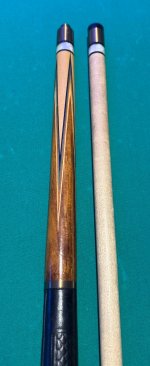
I’m hoping someone recognizes this Brunswick “Personal” cue or knows who manufactured this series for Brunswick.

It has several features that struck me as being above the average production cue:

  • Long, sharp four-point forearm with black/green/natural veneers.
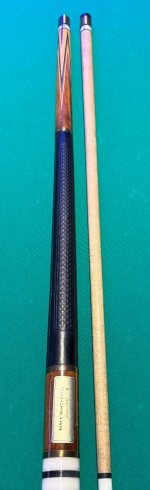
  • Original embossed black leather wrap.
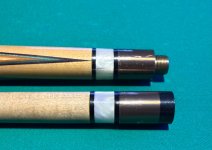
  • Brass joint with unusual construction.
  • Both the butt and shaft are stamped “788.”
  • Brunswick “Personal” plaque and a second engraved nameplate reading “Betty Bray.”

The cue appears to be largely original.

I’m primarily interested in identifying the manufacturer and approximate production period. Does anyone recognize this model or know who built these cues for Brunswick?
 

Attachments

  • IMG_8156.jpeg
    IMG_8156.jpeg
    179.5 KB · Views: 76
  • IMG_8157.jpeg
    IMG_8157.jpeg
    259.4 KB · Views: 73
  • IMG_8166.png
    IMG_8166.png
    1 MB · Views: 74
  • IMG_8159.jpeg
    IMG_8159.jpeg
    260.9 KB · Views: 74
  • IMG_8169.jpeg
    IMG_8169.jpeg
    247.1 KB · Views: 72
  • IMG_8167.jpeg
    IMG_8167.jpeg
    439.8 KB · Views: 74
The stamped number indicates Adam. They numbered them so the shafts didn't get mixed up in shipping.

Though similar to the Schmelke joint, I don't think they interchange.

Brunswick has a large online archive of their old catalogs, you can find the cue there.

I have one just like that in my collection.
 
Thanks, Garczar and Chopdoc, I really appreciate the help.

The explanation of the matching stamped numbers makes perfect sense, and it’s great to know that was an Adam production practice rather than just a random assembly mark. That, along with the joint construction, certainly points me in the right direction.

I’ll start digging through the Brunswick catalogs to see if I can pin down the exact model and catalog year. Thanks again for sharing your knowledge.

I’ll report back if I’m able to locate it in the Brunswick archive.
 
Thanks again to everyone who took the time to help, especially Cuebuddy, Garczar, and Chopdoc.

Cuebuddy’s Schmelke reference, Garczar’s immediate identification of Adam, and Chopdoc’s explanation of the matching stamped numbers gave me enough direction to continue researching and start digging through some older information.

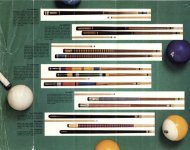
I was able to locate the original 1969 Brunswick catalog page for “The Personal,” and it appears to be an exact match to this cue—from the four veneered rosewood points and tooled leather wrap to the name plate and overall construction.

I also came across this older AZB thread discussing these cues and the Schmelke/Adam manufacturing transition. It was a fascinating read and really helped tie everything together:

https://forums.azbilliards.com/threads/help-dating-this-brunswick-titlist-cue.59469/

Between the catalog page, the historical discussion, and the information shared here, the story behind this cue makes a lot more sense now. I really appreciate everyone pointing me in the right direction. 👍
 

Attachments

  • IMG_8214.jpeg
    IMG_8214.jpeg
    305.1 KB · Views: 23
I have a couple of these, one with matching number, the other not. So i guess they were made in different places?
That’s exactly what I found while researching this one. From what I’ve been able to gather, the unnumbered cues appear to have been built entirely by Schmelke, while the matching-number examples had the butt and shaft stamped so they could be reunited after the shafts were sent out for final finishing, apparently by Adam. At least that’s the explanation I found in the older AZB thread I linked above, and it seems to line up with what Chopdoc shared regarding the purpose of the matching numbers.

Interestingly, while comparing other examples of “The Personal,” I’ve also noticed what appear to be some construction variations. At least one example has different veneer colors, points that terminate farther from the joint, and no white collar rings at the joint. I don’t know yet whether those differences represent production changes or simply variations within the model, but I thought they were interesting observations.
 
Back
Top