How does a pool player get a Fargo Rating (if he or she cares to have one)?

Here you go

Oh, I spelled his now wrong, lol. I feel pretty stupid. I just can't spell hardly anything right. Thanks for that.

Just out of curiosity, how do the pro's get a Fargo rating? I assume that it is from the CSI matches that play in, but is it only CSI sanctioned events at this time? One question I still have is, when does a players Fargo rating expire, after he or she has not competed in the bca or or other leagues that send info to Fargo , or has not competed in CSI events? Thanks.
 
The system itself is totally complete. However, as with anything else relying on data, the more data you have to draw from, the more accurate the conclusions will be that you come to from using that data. A not so good analogy would be if a new player moved into town and started playing at your pool room. If you only saw that player shoot one shot, you can probably get a very rough idea how they play but it won't be very exact at all. If you see them play a whole game you have a better idea but still not very precise. Seeing them play a whole set or even a whole night gets you an even better idea, but for a variety of reasons they could be really off or on that night and you still might have them pegged a little wrong. Same thing if you watched them play for the week. Maybe they just started playing again that week after years of a layoff, or they have had the flu all week and are not at their best, or maybe they have just been really in stroke playing above their head that week and that weeks play still isn't a perfect representation of their true average skill level. But after you have seen them play hundreds or thousands of games over the course of months or years you have them pegged pretty well because that additional data let you get more and more accurate with your assessment of their skill level. And so it is with FargoRate or anything else, more data always equals more accuracy.

Now limited data doesn't always mean horrible accuracy and FargoRate actually works pretty darn well right from the start even with very limited data because of the way it cross references players against each other. Kind of like how with sex and STDs they say you aren't just sleeping with that one person, but with every person they have slept with in the last ten years, and every person each of those people has slept with in the last ten years, etc. Well to drastically over simplify things FargoRate can in a similar way compare you to everyone else through just the people you have played against by using a very accurate and complicated version of "well if Adam usually beats Bob by this much, and Bob usually beats Carl by this much, then Adam will likely be beating Carl by this much" except that instead of just the three players there are usually hundreds or thousands of players in the equation and it becomes very accurate when you cross reference them in this way. But the more data you have (the more games you have played, and the more people you have played against), the better and more accurate the conclusions you can draw from that data, always, even if it was pretty good already with only limited data.

When FargoRate was made public for worldwide use (it had been used on a local/regional level for years), the initial problem you will have with a system like this is that it doesn't start off with as much data as would be ideal. Many people have played few or sometimes no matches where the results of those matches where give to FargoRate for inclusion in their data set. Mike Page did the best he could to get data from previous tournaments and leagues going back as far as ten years (the system uses play from the last ten years with more recent play carrying more weight and having more effect on one's rating that older play) so that it could start off with as much data as possible, but one of the difficulties was that not many tournaments or leagues keep records of all the individual matches, and especially not with the final scores also which FargoRate also makes use of and requires--not just who won or lost. The BCA national singles events is one where this data has been saved over the years, and they were kind enough to provide that information to FargoRate for inclusion, and Mike was able to scrounge up other results from some other tournaments and tours and league sources as well, but because past results including the final scores weren't saved by most people, especially outside of the pro events, the data that FargoRate started with was not as comprehensive as you would ideally like it to be. Now that FargoRate is public and worldwide however, and tournaments, and tours, and leagues start contributing their match statistics to FargoRate as they occur, more and more people will be included, and the already good accuracy gets better and better exponentially and quickly.

Thanks for the great post. I now understand what Fargo rate is and how it works after reading the site FAQ page and watching the vids, and reading your very good post. That also answers my last question on when a players Fargo rate expires (sounds like they would need to stop competing in events that send info to Fargo rate for 10 years, before they would no longer have a Fargo rating). Very interesting read. Thanks for your post.
 
I mainly play BCA 9 ball which uses ball count so that explains why most players I know don't have a rating.

Sent from my SM-G900V using Tapatalk
 
Just out of curiosity since I work in the field- what database system are you using to store the data? Are you using a full fledged rdbms or are you going with one of the big data ones like Mongo?

This is not my area--I just kinda sweeps up around here--but I think the answer is C) all of the above. We use SQL Server for the bulk of our stuff--a full-fledged RDBMS. But we also use a plethora of NoSQL databases for search optimization and player rating retrieval....
 
I don't want to speak for Mike but to me it almost seems like you are thinking of FargoRate as another league handicapping system in the same vein as the APA and it is not a league handicapping system at all (although it can and should be used for that). It is a worldwide rating/ranking system that accurately rates and compares all pool players who play 8, 9, or 10 ball against all other pool players in the entire world who play 8, 9, or 10 ball no matter the league or even if not in a league, and because it accurately rates people, one of its many uses is that it can also accurately handicap matches when desired.

No league or league rating/handicap system does anything remotely similar. If you are an APA 6 in 8-ball for example, there is no way to compare that to someone in say a TAP league. And for that matter, an APA 6 in Idaho is probably a totally different skill level than an APA 6 in Ohio, so you can't even accurately compare APA rankings from people that are not in the same area. Not to mention that APA ratings aren't usually that accurate to begin with even for a specific player in a specific city.

The USAPL is a pool league that decided to adopt the FargoRate rating system for handicapping matches because it does it more accurately than anything else out there, and because it does it on a worldwide level where if you are rated an X in one city or country, you have the exact same skill as an X in another city or country. But again, FargoRate is not a league itself, or simply just a handicapping system. It is a rating and ranking system that accurately compares anyone in the world who plays 8, 9, or 10 ball and therefore it can also be used to accurately handicap 8, 9, or 10 ball matches in a league or anywhere else when desired.

You are really great at explaining how the Fargo rating system works. Thank you very much. I completely understand the system now, and I agree that it is a great system for ranking pool players.

I think that it is great that the creator of Fargo silently waited 5 to 6 years (?) To collect data from 8, 9, and 10 ball matches before going public with the system. Thanks for taking so much time to explane all of this to me.
 
I was not aware of the extent of this although I suspected that it took place to some extent. To be clear, I do not speak for Mike and do not have any inside information. My attempts to help with explanations about FargoRate are based on my own knowledge and understanding from the information that is public and in some cases are just my presumptions.

You were really great at explaining, and it sounds like a great rating system I think.

By the way you explained it, I did think that maybe you may have been friends with the creator, or been involved closely with the system in some way. Thanks.
 
Most of the explanations you are looking for can be found here, particularly under "About FargoRate" towards the bottom of the page:
http://www.fargorate.com/

If after reading that you want even more insight and details Mike Page (the creator of FargoRate) has provided much more detailed additional information in the many threads on here regarding FargoRate. The FargoRate system has been done exceptionally well--as good as it is possible to do in fact. Anyone who takes the time to learn about it and understand it will come away extremely impressed.

Ya think???
 
This is not my area--I just kinda sweeps up around here--but I think the answer is C) all of the above. We use SQL Server for the bulk of our stuff--a full-fledged RDBMS. But we also use a plethora of NoSQL databases for search optimization and player rating retrieval....

Mike, I've asked this several times but have not red a conclusive answer and I'd guess you'd be the man to ask lol. So; if a player, any player does not want to participate in the Fargo system - name listed, ranking, results etc are they free to completely opt out of it or is their participation forced just by participating in a league or tourney or whatever? I kinda have a feeling what your answer is going to be, but I really really hope not.
 
Player Location

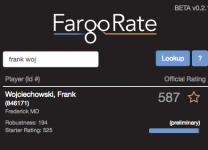
I noticed I do not have a player location listed. How does one get that corrected.

Frank Wojciechowski 846171 Frederick, Maryland

Thanks
 
Last edited:
I could be wrong but I would think it would help if you emailed him about the cases where you knew or suspected the same person was listed multiple times (and make sure you are clear about how positive you are about it and why). There are several that I am aware of that are listed more than once with several different name misspellings, or under different nicknames, or under their various maiden and married names that I plan to email him about soon. I wouldn't think it could hurt but then again maybe he truly has all the sources of of these errors figured out and doesn't need to be inundated by a ton of emails about it. Mike, would this be of any help?

I can see how this could be an issue, because there are so many people out there with the same 1st and last names. It reminds me of an issue that I see with facebook (or other similar site). I look up an old friend, and I get like 50 matches (for a person with that same exact name). I imagine that looking up a player on Fargo rate can have a similar issue (and the issue might get even worse in the future, with more new players being added to the Fargo rate system).
 
There have been no discussions with APA.

While user-generated data is an attractive approach to, in a sense, crowd-sourcing data collection, we have chosen to avoid it.

Data integrity is an important issue to us. And while we will never have every match score be right, we want bad data to be a minor statistical issue that is a fact of life--like shoplifting is for Walmart.

One of the things that helps insure this is peer review. So basically, for the matches that go into the system for you, we want your peers to seem them, including possibly peers that don't like you and don't trust you. So we want the matches to be viewable online. This way we won't have a phantom league or an imaginary tournament. We actually feel pretty good about this issue. But it is our business to develop policies that if anything err on the cynical side...

I agree that you should get your data from trusted 3rd party sources (3rd party as in the people who run the leagues or tournaments). That is good that you are avoiding to allow players to send in their own scores.
 
Mike, I've asked this several times but have not red a conclusive answer and I'd guess you'd be the man to ask lol. So; if a player, any player does not want to participate in the Fargo system - name listed, ranking, results etc are they free to completely opt out of it or is their participation forced just by participating in a league or tourney or whatever? I kinda have a feeling what your answer is going to be, but I really really hope not.

I imagine that by playing in the league, or the tournament, then you may not have the option to opt out of being listed in the Fargo rate system. It is just something you will have to deal with (if they collect enough data on your matches in order to give you an accurate Fargo rating).

I do like that they also show how many games (?) you played next to your rating, so that was a very smart thing to do I think. For example, I see that Alex Pagulayan has a Robustness of 2944, and I think I remember the video explaining that that means that he has played 2,944 games to get his current rating (of 792). It seems like a good system to me.
 
Thanks for the great post. I now understand what Fargo rate is and how it works after reading the site FAQ page and watching the vids, and reading your very good post. That also answers my last question on when a players Fargo rate expires (sounds like they would need to stop competing in events that send info to Fargo rate for 10 years, before they would no longer have a Fargo rating). Very interesting read. Thanks for your post.

Correct. One thing I did not include in the quoted post but that Mike later clarified was that he did not just rely on whatever match results he could get from the past, but he actually sat on the release of FargoRate system for six years while he and others collected current match results from whichever tournaments and leagues they could during those six years so that he would have an extensive data set to start with from day one.

FargoRate will get even better and more comprehensive in the future as even more data is collected. This relies on the people that run the tours and tournaments and leagues to submit their data to Mike for inclusion. I'm guessing here but some might not be doing this simply because they are not even aware yet that FargoRate exists. Some might simply be too lazy even though it wouldn't take that much effort. Some might figure since they aren't currently using FargoRate to handicap matches in their tournament or league (their tournament or league might not even be a handicapped one for that matter) then why contribute since they think it doesn't benefit them directly since they aren't currently using it for handicapping.

The thing is though that a system that accurately rates and ranks all the players world wide is good for all the players and good for the game. It is up to us to educate the league and tournament directors about FargoRate and what it does whenever they are unaware of it, and when they already are knowledgeable about it, to motivate them to provide all their match results to FargoRate by letting them know that it is important to us since it is good for all the players and good for the game.
 
I noticed I do not have a player location listed. How does one get that corrected.

Frank Wojciechowski 846171 Frederick, Maryland

Thanks

I think it is a good idea to show the location (or the last known location) of where the player is from, so that the player does not get confused with another player who might have the same name (which I can see happening, because many last names are very common). You would not want a tournament director to think that you have a 660 rating if you actually have a 520 rating (for example, if there were 2 players with the same name who had a 660 rating and a 520 rating). Then you could show your ID to prove which of the players you are (if the Fargo rate system were to show the location of the player).
 
I imagine that by playing in the league, or the tournament, then you may not have the option to opt out of being listed in the Fargo rate system. It is just something you will have to deal with (if they collect enough data on your matches in order to give you an accurate Fargo rating).

I do like that they also show how many games (?) you played next to your rating, so that was a very smart thing to do I think. For example, I see that Alex Pagulayan has a Robustness of 2944, and I think I remember the video explaining that that means that he has played 2,944 games to get his current rating (of 792). It seems like a good system to me.

Look J, it really does not effect me one way or the other - actually if anything it benefits me with no down side. I don't play league and don't anticipate I will any time soon as I hate it. I don't do tournaments ( probably been 5+ years since I played in one and when I do its rare ). I just do not think it is right to force someone to participate if they truly do not want to ( regardless of reason ), and this may sound a little silly but I do believe that kind of information is private to a degree ( yes I understand someone could follow you around and write down everything but yall know what I'm saying ) and should remain that way UNLESS said player WANTS to put himself out there like that.
 
Mike, I've asked this several times but have not red a conclusive answer and I'd guess you'd be the man to ask lol. So; if a player, any player does not want to participate in the Fargo system - name listed, ranking, results etc are they free to completely opt out of it or is their participation forced just by participating in a league or tourney or whatever? I kinda have a feeling what your answer is going to be, but I really really hope not.

In the few cases where we have imported private data--like for instance a tournament director that gave us a spreadsheet of scores that are not otherwise public--we would remove a person's private games on request. But the near universal situation is the player has already shared this information with the world. For instance if you play in and go two and out in the Turning Stone Classic, then that information is already out there for anybody to see. And we will share your match history only with you.
 
I could be wrong but I would think it would help if you emailed him about the cases where you knew or suspected the same person was listed multiple times (and make sure you are clear about how positive you are about it and why). There are several that I am aware of that are listed more than once with several different name misspellings, or under different nicknames, or under their various maiden and married names that I plan to email him about soon. I wouldn't think it could hurt but then again maybe he truly has all the sources of of these errors figured out and doesn't need to be inundated by a ton of emails about it. Mike, would this be of any help?

SNITCHES GET STITCHES bro!!! Lol
 
Correct. One thing I did not include in the quoted post but that Mike later clarified was that he did not just rely on whatever match results he could get from the past, but he actually sat on the release of FargoRate system for six years while he and others collected current match results from whichever tournaments and leagues they could during those six years so that he would have an extensive data set to start with from day one.

FargoRate will get even better and more comprehensive in the future as even more data is collected. This relies on the people that run the tours and tournaments and leagues to submit their data to Mike for inclusion. I'm guessing here but some might not be doing this simply because they are not even aware yet that FargoRate exists. Some might simply be too lazy even though it wouldn't take that much effort. Some might figure since they aren't currently using FargoRate to handicap matches in their tournament or league (their tournament or league might not even be a handicapped one for that matter) then why contribute since they think it doesn't benefit them directly since they aren't currently using it for handicapping.

The thing is though that a system that accurately rates and ranks all the players world wide is good for all the players and good for the game. It is up to us to educate the league and tournament directors about FargoRate and what it does whenever they are unaware of it, and when they already are knowledgeable about it, to motivate them to provide all their match results to FargoRate by letting them know that it is important to us since it is good for all the players and good for the game.

Yeah, I remember that Mike explained that he waited 6 years (in order to collect as much data as he could) before making the Fargo rate system public. I imagine that it must have been a lot of work to analyze all of that data during those 6 years. He must really love the sport of pool, to have done so much work to create this great system. I think it all sounds really great, and it sounds like a very fair ranking system. After reading the creator's bio, I imagine that he came up with a really great system. His partners bio also looks really impressive. Seems like a really great team to me, after reading their bio's on the fargo rate site. Thanks again for your replies. I have no more questions.
 
Last edited:
I noticed I do not have a player location listed. How does one get that corrected.

Frank Wojciechowski 846171 Frederick, Maryland

Thanks

It's that simple...

Now we won't get you confused with all the other Frank Wojciechoski's
 

Attachments

  • Screen Shot 2016-04-26 at 11.42.37 PM.png
    Screen Shot 2016-04-26 at 11.42.37 PM.png
    30.9 KB · Views: 332
Look J, it really does not effect me one way or the other - actually if anything it benefits me with no down side. I don't play league and don't anticipate I will any time soon as I hate it. I don't do tournaments ( probably been 5+ years since I played in one and when I do its rare ). I just do not think it is right to force someone to participate if they truly do not want to ( regardless of reason ), and this may sound a little silly but I do believe that kind of information is private to a degree ( yes I understand someone could follow you around and write down everything but yall know what I'm saying ) and should remain that way UNLESS said player WANTS to put himself out there like that.

Well, if you do not play league or tournaments (and you have not played in the USAPL or any other league that might decide to send data to Fargo rate, within the last 10 years), then I do not think there is any chance of you ever having a Fargo rating. It sounded to me like Mike Page has no plans or receiving and using data from non trusted (non officially trusted sources), so no need to worry about any data from gambling matches being used to get a Fargo rating.

Any time you play in a public (non private) event, you are basically giving your permission to have all of the info from that public event posted online. I do not know, but it is just the way I see it.

Many things just can't be kept private (like if I were to win the lottery, I would have no choice but to have my picture taken by the public media and my full name be shown for anyone who watches the news). Sorry for going off topic, but I really do wish that many things could be private (many things that are public domain, and should not be any of any other persons business, in my opinion).
 
Last edited:
Back
Top