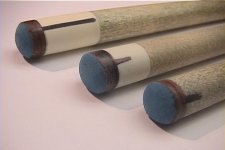
Marking The Ferrule

I have nothing against people who do it, but I don't mark my ferrule. I like a clean ferrule when I shoot and I'm not a big fan of marking my equipment.

I don't play on 4-inch pockets (4 1/2 is my minimum) and I use an LD shaft, so I'm not that concerned with slight variances in shaft deflection or tip consistency. I'm confident that there is enough margin for error as long as I execute properly.

If I twist my wrist by mistake during a shot, I know it right away because I can feel it, and I can also observe the position of my knuckles after I've followed through.

My bridge length constantly changes, so, marking my cue for optimum pivot point doesn't do me any good.
 
Last edited:
Who was it who took a marker and filled in their whole ferrule with red color for the road? Must have driven his opponents nuts!
 
Who was it who took a marker and filled in their whole ferrule with red color for the road? Must have driven his opponents nuts!
Lassiter had a red ferrule which he claimed he needed to be able to see where the end of his cue was. I think it was red fiber and not painted, though.
 
I was taught that you used the line to mark the spine of the shaft so you would always have it pointing up and therefore the deflection would be consistent... I could see it exposing some stroke flaws but the orientation was the main reason behind it......
 
Has anyone tried 4 lines every quarter section of the ferrule? Just wondering if the extra lines help or are more of a distraction. I'm guessing distraction, but maybe it could ensure the same head position on every shot? ( making sure you can see the top and 2 side lines).
I'm going to try the single line first on a spare shaft, will see if it works for me.
Thanks for the info.
 
Another reason I like to have my ferrule marked is that I know what part of the tip will be hitting the cue ball. Then I can make sure that particular part of the tip is well-chalked if I'm going to spin the ball.
 
meucci red and black dot shafts should be mentioned here. marked to disignate the spline direction and shoot consistently
 
meucci red and black dot shafts should be mentioned here. marked to disignate the spline direction and shoot consistently

That's because they are made from flat laminates turned round. They have a greater tendancy to flex along one plane. That can be valuable if you know how to take advatage of it.
 
Differences between Black-/Red-Dot shafts concerning orientation of that dot

meucci red and black dot shafts should be mentioned here. marked to disignate the spline direction and shoot consistently

Actually, that's only true of the Red Dot shaft. The Red Dot shaft is a plain maple shaft (no laminations) that is tested, measured, and marked specifically for deflection-consistency orientation reasons. That is, if you orient the red dot marking "up," the left and right deflection is tested and certified to be exactly the same.

The Black Dot shaft, on the other hand, while a flat-laminate construction, oddly enough that black dot mark is only a marketing identification, not a deflection-consistency orientation reason. Supposedly, according to Meucci's marketing, the orientation of the black dot does not matter, as the laminates are oriented and glued in a way that supposedly nullifies any deflection, irrespective of the orientation of that black dot mark.

http://meuccicues.com/shafts.html

"The Meucci Black Dot Bullseye Performance Cue Shaft is the most consistent, hi tech, performance cue shaft in the world. The Black Dot is made from 39 flat Northern Hard Rock Maple laminations. Radial Consistency is equal to Natural Hard Maple or any of the “Pie” laminated shafts currently on the market. Every Black Dot Shaft plays exactly the same whether you have 2, 3, 4, or more shafts with your cue. Unmatched by any other shaft"​

Notice the use of the term "radial consistency" when referring to the Black Dot product (which means the orientation of the black dot mark doesn't matter -- it's radially consistent regardless).

Compare that to the Red Dot, which is the only shaft that actually mentions the orientation of the red dot mark:

"The Red Dot shaft guarantees you perfect positioning for consistent and predictable results when shooting with high, low, left or right english or any combination thereof when the red dot faces up. In fact, we have so reduced effective cue ball deflection, that we can now boldly guarantee that your new Meucci Red Dot Shaft will reduce effective deflection by an average of at least 20% over the best of any competitor’s standard brand of the same diameter or your money back!"​

It's odd, I know, that a flat-laminated shaft would be radially consistent.

-Sean
 
Another reason I like to have my ferrule marked is that I know what part of the tip will be hitting the cue ball. Then I can make sure that particular part of the tip is well-chalked if I'm going to spin the ball.

Ensuring the entire tip is properly chalked keeps it simple and will accomplish the same thing. Chalk's cheap, so why not chalk the whole tip?
 
Ensuring the entire tip is properly chalked keeps it simple and will accomplish the same thing. Chalk's cheap, so why not chalk the whole tip?

I have a feeling Bob's pulling our leg -- in his inimitable way. ;)

-Sean
 
Dave Kikel patented a shaft that has a contrasting dark colored piece of wood running the entire length of the shaft. The patent was from the 80's, if you google it you'll see it.
 
I think I am going to mark the ferrule on one of my cheap Cuetec Cues and see how that works out.

I hope thats okay with Travis, Allison, and Earl.

Mike
 
Ensuring the entire tip is properly chalked keeps it simple and will accomplish the same thing. Chalk's cheap, so why not chalk the whole tip?
If I'm spinning the ball, I look at the tip. If it's already chalked well, there is no need to chalk it further. It is rare that anyone chalks the whole tip. One swipe will not do it.
 
I've been doing it on and off for about 30 years.
Here's a picture from a BD column I just stumbled across...
SIGHTS.JPG
 
Back
Top