Methods of Applying English

Another point I want to mention on aligning for English with a parallel shift.

On shots with longer separation, say 3 to 6 feet, if the shot is played with drag (slow and low) and english the swerve can effectively cancel out the squirt deflection.

The same shot at higher speeds will squirt more and swerve less, and hence require an adjustment if aim, or alignment via the BHE method.
 
Colin Colenso said:
Another point I want to mention on aligning for English with a parallel shift.

On shots with longer separation, say 3 to 6 feet, if the shot is played with drag (slow and low) and english the swerve can effectively cancel out the squirt deflection.

The same shot at higher speeds will squirt more and swerve less, and hence require an adjustment if aim, or alignment via the BHE method.


Very accurate, but rather advanced. For example, this can be used to kill the cue ball when making a cut up the rail to the corner. Object ball close to but not on the rail.

You folks didn't tell me you wanted to give the good stuff away!:rolleyes:
 
Cornerman said:
Did someone else other than the internet forums describe it such a fashion?

Parallel aimining is exacty what it sounds like, right or wrong. The cue stick is parallel and is stroked parallel to what would be a center ball stroke. If it wasn't parallel, then it wouldn't be called parallel. It would be pivoted :)

Parallel Aiming, as Bob Jewett See It

Many instructors of two or three decades ago believed that the cueball would still go straight.

Fred

I have asked you this when we met in Valley Forge because it has bothered me for quite some time. I am now finally back to doing it by pivot.

A lot of players here in Canada coming from a snooker background will say parallel works, as long as you know how much to shift. At least that is what they told me.

This is what I was told(I am not saying I agree with it all all, I am just telling you how I understand it.):

1)Move my right leg, my grip hand, and my bridge hand all in a parallel fashion, to a line according to how much the cue ball will squirt, before getting down on the shot,

2)walk into the shot as if I was shooting a straight in shot, except that I am now aiming at a spot off center of the cue ball,

3) and then just shot straight.

How much to shift depends on distance and speed.

The theory behind this, as I understand it, is that the player wants to be able to use the same straight stroke on all his shots. A lot of snooker players believe it is more accurate if you only use one stroke in a game.

I have watched these guys shot, and I think they do not really shift parallel. May be they think they do, but they do not. They are facing the table at a different angle, eventhough may be they are using the same straight cueing action, i.e. they are not using backhand english or turning their wrists, or forearm. I am not sure if I am being clear. By the same straight cueing action, I mean they want to always deliver their cues along the same line, at the same distance away from their bodies. That is why they also move their feet.

With the slow drag shot with english(swerve), they raise the butt end of their cues, and they choke up on the shot, so may be they are facing the shot square, the cue is far from being level.

Just my observation.

Richard

 
Colin Colenso said:
I've suggested for a while that the mechanism affecting this is the degree of interlocking (grip), and how this effects relative forces at the tip-CB contact interface.

We see relative friction is reduced between 2 balls on high speed collision...hence less throw. I expect the relative component of friction between the tip and CB is also reduced at higher speeds.

By relative, I mean the amount of friction actually increases in both these collisions, though not in the same ratio as the elastic rebound through the center of the two masses. Basically this means their is partial slip, and this becomes more noticeable at higher speeds...at least how I can fathom it.
Colin,
I don't know if you saw a related thread on the Billiard Digest forum a while ago. The Australian high speed video linked to at Dr. Dave's site has an extreme closeup of a draw shot. Although there is not enough ball surface irregularity to directly see if it's moving in lock step with the tip, one of the posters (Cushioncrawler) noticed that the tip does start moving downward after contact, but before the ball starts moving forward. With the reservation that the tip did seem to be chalked excessively, it does offer some evidence for your mechanism.

Jim
 
Jal said:
Colin,
I don't know if you saw a related thread on the Billiard Digest forum a while ago. The Australian high speed video linked to at Dr. Dave's site has an extreme closeup of a draw shot. Although there is not enough ball surface irregularity to directly see if it's moving in lock step with the tip, one of the posters (Cushioncrawler) noticed that the tip does start moving downward after contact, but before the ball starts moving forward. With the reservation that the tip did seem to be chalked excessively, it does offer some evidence for your mechanism.

Jim
Hi Jim,
I missed this post last time. Thanks to Sonia bumping the thread I saw it:)

I never saw the video you refered to....I'll see if I can find it over there.

Colin
[edit] I found that video. It's actually Austrian. I've put it on Youtube for easy viewing:
http://www.youtube.com/watch?v=pZqkaJDaz2A
 
Last edited:
Colin Colenso said:
... We see relative friction is reduced between 2 balls on high speed collision...hence less throw. I expect the relative component of friction between the tip and CB is also reduced at higher speeds.
...
The friction between balls is sliding friction. The friction between tip and ball is static (non-slipping) friction so far as I can tell and so far as anyone has demonstrated, unless there is a miscue. The two situations are unrelated.
 
Jal said:
Colin,
I don't know if you saw a related thread on the Billiard Digest forum a while ago. The Australian high speed video linked to at Dr. Dave's site has an extreme closeup of a draw shot. Although there is not enough ball surface irregularity to directly see if it's moving in lock step with the tip, one of the posters (Cushioncrawler) noticed that the tip does start moving downward after contact, but before the ball starts moving forward. With the reservation that the tip did seem to be chalked excessively, it does offer some evidence for your mechanism.

Jim
The high-speed video was by Robert Leitner and Andreas Efler in Austria. It is for sale as a DVD.

If the tip does not slip on the cue ball on a draw shot, it must be moving down during contact with the cue ball. That is because the cue ball is rotating while the tip is on the ball. Efler's tip is a rather thick Moori. When I first saw the video I thought it was done specially for effect (large amounts of tip deformation) but it is the thickness Efler normally uses. Which brings up the related point that tip deformation might give you the effect you are looking for without any tip-ball slipping.
 
Bob Jewett said:
The friction between balls is sliding friction. The friction between tip and ball is static (non-slipping) friction so far as I can tell and so far as anyone has demonstrated, unless there is a miscue. The two situations are unrelated.

From what I can tell, it seems close to static, but I believe there is some slippage occuring. There's no real proof for either side .... is there?

Except that, the observation that harder hitting with english increases squirt in my own testing, which lends weight to the possibility of slight slippage as a cause.
 
There is a lot of work currently going on to investigate the nature of friction at the nano level.

The classical model of a pure state between either static or kinetic / sliding friction is not very useful at that level.

Here is an interesting article on some of the recent findings and developments.
http://physicsweb.org/articles/world/18/2/9
 
Colin Colenso said:
...
Except that, the observation that harder hitting with english increases squirt in my own testing, ...
How elevated is your stick?
 
Bob Jewett said:
The high-speed video was by Robert Leitner and Andreas Efler in Austria. It is for sale as a DVD.

If the tip does not slip on the cue ball on a draw shot, it must be moving down during contact with the cue ball. That is because the cue ball is rotating while the tip is on the ball. Efler's tip is a rather thick Moori. When I first saw the video I thought it was done specially for effect (large amounts of tip deformation) but it is the thickness Efler normally uses. Which brings up the related point that tip deformation might give you the effect you are looking for without any tip-ball slipping.

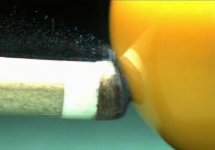
The tip clearly deforms and chalk is seen flying as the attached picture shows. This indicates that there is movement going on with the materials involved in transfering forces at the collision interface. The question is how significant are these non-static forces?

The thick tip and caked on chalk exagerate the effect, but that is for our benefit in observation.
 

Attachments

  • tipcbcollision.JPG
    tipcbcollision.JPG
    11.4 KB · Views: 150
Bob Jewett said:
How elevated is your stick?
I am very careful to take swerve into account.

For example, a shot played with CB and OB 3 feet apart with heavy english, 1st shot at 50% strength (where any swerve would be insignificant) and the 2nd shot at around 90% show considerable differences in squirt. The 90% strength shot squirts a lot more.

I also have taken into account the variation in throw with speed. Both throw and swerve make it more difficult to isolate squirt as a variable, but I am very convinced that squirt increases with speed as well as tip-offset.

btw: I found it better to test this with Inside English on moderate cut shots around 10-20 degrees. The variation in throw with IE from moderate to high speeds is significantly less than using OE. Hence helping to isolate that variable.
 
Last edited:
Hi Colin,

Very interesting article on friction. Thanks. And sorry for the misdirection regarding the video. I'm glad you finally figured out that that idiot may have confused Australia with Austria. :)

Colin Colenso said:
From what I can tell, it seems close to static, but I believe there is some slippage occuring. There's no real proof for either side .... is there?
I also think it's slipping. As far as I know, only two things can account for the shaft moving downward, as can be measured between frames 2 & 3 in Dr. Dave's pdf: slippage or ball rotation. If it's ball rotation, I think you should be able to detect some movement of the ball forward as well, which I don't think you can. This was Cushioncrawler's point.

Colin Colenso said:
Except that, the observation that harder hitting with english increases squirt in my own testing, which lends weight to the possibility of slight slippage as a cause.
At least a part of it, or maybe all of it, could be due to the tip rotating around the ball farther, giving you a greater effective offset?

Jim
 
Bob Jewett said:
... Which brings up the related point that tip deformation might give you the effect you are looking for without any tip-ball slipping.
Can you explain this?

Jim
 
Jal said:
Can you explain this?

Jim
I mean that if the tip is deforming but the surface of the tip on the ball is not slipping it may be the same result (time evolution of forces and velocities) as the tip retaining its shape but slightly slipping.
 
Jal said:
Hi Colin,

Very interesting article on friction. Thanks. And sorry for the misdirection regarding the video. I'm glad you finally figured out that that idiot may have confused Australia with Austria. :)

I also think it's slipping. As far as I know, only two things can account for the shaft moving downward, as can be measured between frames 2 & 3 in Dr. Dave's pdf: slippage or ball rotation. If it's ball rotation, I think you should be able to detect some movement of the ball forward as well, which I don't think you can. This was Cushioncrawler's point.

At least a part of it, or maybe all of it, could be due to the tip rotating around the ball farther, giving you a greater effective offset?

Jim
Good points Jal,

Trying to frama-by-frame that video best I could and with a little guestimation, it looks to me like the cue deflects downward about 4mm while in contact with the CB (significant alteration of the offset) while the CB moves forward about 5mm.

This would seem to be a longer contact phase than seen in some other high speed videos (of course this video seems to capture more frames per second though).

Without being able to actually measure the amount of CB rotation during this contact phase, it's hard to establish if there is any significant amount of slippage.

The significant deformation of both the tip and the end of the shaft during the contact phase makes me suspect that the rotation induced deflection force is not the only force here acting downward from the line of the cue's initial movement.

I still don't know how to explain this in physics terms though, other than with the speculation of the significant influence of millions of micro-slip collision being involved. I did a little reading of the effects of the stick-slip friction phenomenon which is common in moving static like collisions. Such as the brake pads on the wheel rims, or the dragging of a block across a surface with an elastic spring.

I suspect the static model concept works well as an approximation for most tip-CB collisions, but at the nano-level it certainly can't be entirely true. At higher speeds some other things are going on that have significant effects.

btw: Another piece of possible evidence for the pie is that stiffer shafts tend to squirt less (in my experience). Something that would tend to contradict the rotation induced deflection model but add weight to the idea that a cue deforming to increase overall offset is playing a role here.

Hope some of that waffle makes sense:D

Colin
 
Colin Colenso said:
... it's hard to establish if there is any significant amount of slippage.

The significant deformation of both the tip and the end of the shaft during the contact phase ...
I think that if there is slipping of the surface of the tip on the ball there will be some amount of visible abrasion by the chalk being rubbed across the ball. How about polishing the ball and then checking it under a microscope after the shot?

As for shaft deformation, where do you see this?
 
I don't understand any of these terms(what is back-hand english?) but here is how I use english: I adjust compensate with the aim.
 
Bob Jewett said:
I think that if there is slipping of the surface of the tip on the ball there will be some amount of visible abrasion by the chalk being rubbed across the ball. How about polishing the ball and then checking it under a microscope after the shot?

As for shaft deformation, where do you see this?
Microscopic inspection sounds like a good idea. Might reveal something.

The shaft deformation I refered to is the bending downward of the shaft.

During the contact phase it appeared to me that the tip moved down about 4mm.

One thing to note, is that during a ball to ball collision, it would also be very hard to observe slipping...right? So trying to observe slippage in the range of 1 or 2% as could be happening between the tip and CB will be even harder to detect.
 
Back
Top