Object ball on low deflection cue

Here's a simple explanation I added to the what causes squirt? page:

With an off-center hit, while the tip is in contact with the CB, the CB starts to move forward and turn. The ball turn pushes the tip away sideways causing the end mass of the shaft to move. Mass doesn't like to move, so it pushes back during contact (because for every action, there is an equal and opposite reaction). That's why the CB deflects (squirts) off line.

I hope that helps,
Dave

That explanation is why I assumed lower endmass meant that the shaft pushes back less and wants to move more.
But if it is pushing back less, that means it is being pushed less.

Regards,
Dave
 
Last edited:
I guess since every cue shaft has flexibility, making the tip end lighter is an automatic way to create less CB squirt. That's why shaft end mass is the main factor, and not shaft stiffness. Even the revo has enough flexibility so that its super light end mass is what makes the difference in minimizing cb squirt.
Bingo.

Also, remember that the tip contact time is incredibly brief (about 0.001 s), so the amount the shaft flexes is very small while the tip is in contact with the ball. Most of the flex occurs after contact, due to the sideways momentum of the endmass (resulting from the off-center tip-ball collision).

Regards,
Dave
 
Last edited:
But if it is pushing back less, that means it is being pushed less.


Regards,

Dave


I guess I’m just trying to see where acceleration, inertia and force vectors factor in when endmass is reduced.

If I have my feel tuned to make the cue ball travel X distance, I need a certain amount of force to transfer into it. If less mass is involved in the collision, am I not just compensating by adding more acceleration to ensure the cueball still travels X distance? Isn’t the overall force generated in delivering a stroke similar with a LD shaft vs normal when compensated to achieve the same positional outcome?

Ultimately isn’t the key thing to ensure the vector of that force is less lateral? It still seems the lighter endmass just means the tip is more likely to roll with the curve of the cue ball because it now has less mass to overcome cueball inertia. Does relative inertia between cue and shaft play no role in how much lateral force is transferred? The tip rolling on the curve of the cueball slightly during that .001s of impact makes the direction of the force alter and converge with aiming line through the duration of impact. In all spin shots the tip is ricocheting (changing direction) off the curve of the ball some regardless of stiffness. No?

It seems like there’s only two ways that adjusting mass can truly reduce the lateral force being applied (when acceleration is compensated and added into lower mass delivery). Either the energy is transferred as spin rather than squirt. Or, some of the lateral force is bled out into the change in direction of the tip during the .001s of impact.


Sent from my iPhone using Tapatalk Pro
 
I guess I’m just trying to see where acceleration, inertia and force vectors factor in when endmass is reduced.

If I have my feel tuned to make the cue ball travel X distance, I need a certain amount of force to transfer into it. If less mass is involved in the collision, am I not just compensating by adding more acceleration to ensure the cueball still travels X distance? Isn’t the overall force generated in delivering a stroke similar with a LD shaft vs normal when compensated to achieve the same positional outcome?

Ultimately isn’t the key thing to ensure the vector of that force is less lateral? It still seems the lighter endmass just means the tip is more likely to roll with the curve of the cue ball because it now has less mass to overcome cueball inertia. Does relative inertia between cue and shaft play no role in how much lateral force is transferred? The tip rolling on the curve of the cueball slightly during that .001s of impact makes the direction of the force alter and converge with aiming line through the duration of impact. In all spin shots the tip is ricocheting (changing direction) off the curve of the ball some regardless of stiffness. No?

It seems like there’s only two ways that adjusting mass can truly reduce the lateral force being applied (when acceleration is compensated and added into lower mass delivery). Either the energy is transferred as spin rather than squirt. Or, some of the lateral force is bled out into the change in direction of the tip during the .001s of impact.

If you really want to understand the physics, it might help (assuming you have some background in physics) to look at:

TP A.31 - The physics of squirt

With collisions, it is better to think in terms of impulse and momentum transfer, not force and acceleration.

Also, you need to be careful to distinguish between the forward force (and impulse) required to deliver forward momentum to the cue and CB, and the sideways force (and impulse) resulting in endmass momentum and CB deflection. These are two different forces. The forward force and cue momentum is a result of what you develop and feel during your forward stroke into the ball. The sideways force (during the 0.001s of tip impact only) is a result of the interaction between the CB and endmass. This equal and opposite sideways force is what causes CB deflection and sideways momentum of the end mass, which in turn causes cue flex and vibration (which you feel after the hit).

The ratio of endmass to CB mass most definitely affects the amount of squirt (see the analysis and equations for the details).

At the level of physics detail you are attempting to delve into, the best answers to your questions are in the detailed analysis.

Regards,
Dave
 
Last edited:
If you really want to understand the physics, it might help (assuming you have some background in physics) to look at:

TP A.31 - The physics of squirt

With collisions, it is better to think in terms of impulse and momentum transfer, not force and acceleration.

Also, you need to be careful to distinguish between the forward force (and impulse) required to deliver forward momentum to the cue and CB, and the sideways force (and impulse) resulting in endmass momentum and CB deflection. These are two different forces. The forward force and cue momentum is a result of what you develop and feel during your forward stroke into the ball. The sideways force (during the 0.001s of tip impact only) is a result of the interaction between the CB and endmass. This equal and opposite sideways force is what causes CB deflection and sideways momentum of the end mass, which in turn causes the cue flex and vibration (which you feel after the hit).

The ratio of endmass to CB mass most definitely affects the amount of squirt (see the analysis and equations for the details).

At the level of physics detail you are attempting to delve into, the best answers to your questions are in the detailed analysis.

Regards,
Dave


My physics education is only about high school level but I try to think in those terms even if the formulas lose me quick. I was viewing the forward impulse and sideways impulse as a single force being continuously redirected and distributed. For some reason you describing them as two separate forces to be considered distinctly is what gives me that “aha moment” in terms of understanding what you’re saying.


Sent from my iPhone using Tapatalk Pro
 
My physics education is only about high school level but I try to think in those terms even if the formulas lose me quick. I was viewing the forward impulse and sideways impulse as a single force being continuously redirected and distributed. For some reason you describing them as two separate forces to be considered distinctly is what gives me that “aha moment” in terms of understanding what you’re saying.
I'm glad that helped. I aim to swerve. :grin-square:

Regards,
Dave
 
My physics education is only about high school level but I try to think in those terms even if the formulas lose me quick. I was viewing the forward impulse and sideways impulse as a single force being continuously redirected and distributed. For some reason you describing them as two separate forces to be considered distinctly is what gives me that “aha moment” in terms of understanding what you’re saying.


Sent from my iPhone using Tapatalk Pro

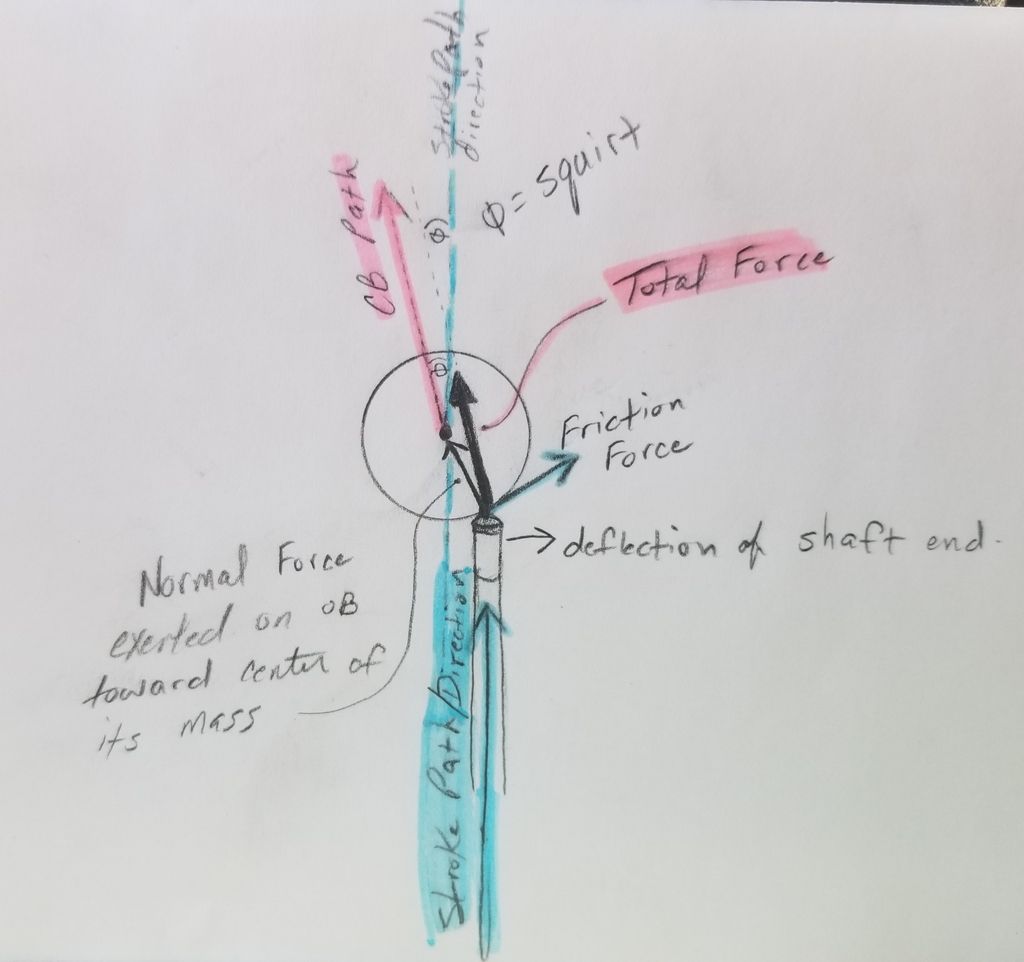
Here's a sketch of the forces when using a standard non-LD shaft. Notice how the "Total Force" is angled away from the stroke direction. This is CB squirt. With a lighter shaft end mass the friction force between the cb and the tip would be much less, so the tip would deflect more easily and the total force line would move closer in the direction of the stroke, like using a revo. More end mass would increase the tip's force/influence on the cb and the total resulting force would move farther away from the stroke line, squirting the ball even more than shown here. I'm no physicist either, but this is what makes sense to me in a simplified way.

https://m.imgur.com/gallery/m9okTHk
 
Last edited:
Here's a sketch of the forces when using a standard non-LD shaft. Notice how the "Total Force" is angled away from the stroke direction. This is CB squirt. With a lighter shaft end mass the friction force between the cb and the tip would be much less, so the tip would deflect more easily and the total force line would move closer in the direction of the stroke, like using a revo. More end mass would increase the tip's force/influence on the cb and the total resulting force would move farther away from the stroke line, squirting the ball even more than shown here. I'm no physicist either, but this is what makes sense to me in a simplified way.

20180508_112943_zpspvycnn5b.jpg
Re the part in blue: If shots with different cues produce the same net amount of force in the same net direction, what indicates different amounts of friction?

pj
chgo
 
Re the part in blue: If shots with different cues produce the same net amount of force in the same net direction, what indicates different amounts of friction?

pj
chgo

Hmmm.....we know from experience that some cues deflect more or less than others, creating different amounts of squirt, which means the net amount of force and direction is not always the same. I'm not sure, but I'd say this indicates varying shaft end masses and/or stiffness. It seems that when the tip strikes the ball there is a battle between masses, cb mass v/s shaft end mass.

There are two forces working against the cb in two different directions -- the force exerted by the mass of the entire cue stick at whatever direction and velocity, and the force of the shaft's end mass pushing the ball at a sideward angle. The goal is to make these two forces total a net force that propels the cb in a desired direction, like that great diagram you posted showing 3 different shafts all producing the same resulting force.

Maybe the friction between tip and ball determines which force is more prevalent. But the friction should only last until the speed of the rotating cb matches the speed of the tip, which is just a fraction of a second, then the tip is no longer influencing the ball because it has been deflected away. More end mass would cause more friction between the ball and tip, which would mean the sideward force would affect the cb more and cause more squirt. But with practically zero friction at the point of contact (like striking the cb with no tip on the ferrule) the net force would have to be directed more sideways than along the stroke direction, causing maximum cb squirt. In this frictionless scenario end mass won't matter. So with a tip, the friction basically plays a part when the end mass is countered perfectly by the cb mass, resulting in cb path along the stroke direction.

The right combination of tip friction and a light flexible end mass allows the tip to roll side spin onto the ball at the same time it's deflecting away from the larger cb mass. This is what the LD shaft allows to happen. And the larger force, the directional force from the full weight and velocity of the cue stick takes precedence in the final cb direction, the net/total force.

Damn.....didn't realize I was going so long. Sorry....just tossing thoughts out.
 
Last edited:
Back
Top