OK, I just figured-out that this is a continuation of your previous thread.
http://forums.azbilliards.com/showthread.php?t=144325
Except in this thread you didn't mention that your intent is to move the bal. pt.
IMO, it would have made more sense to continue your previous thread so everyone reading could stay on topic and have the benefit of knowing everything that has already been stated.
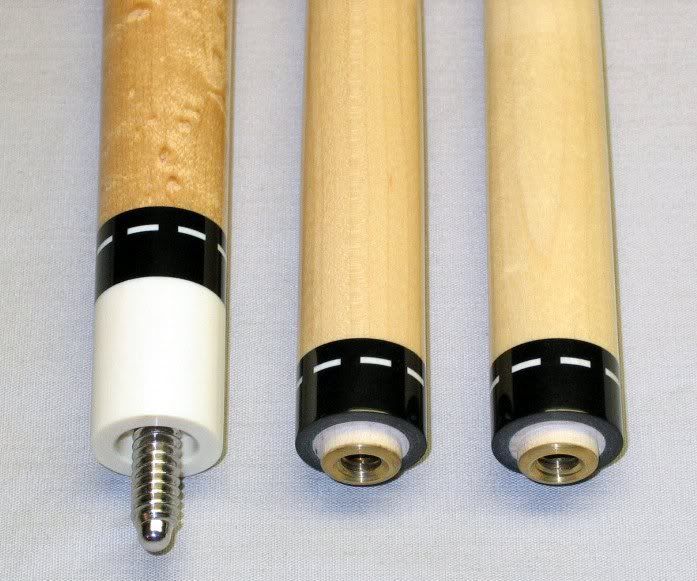
When you opened with 'the use of ivory for the joint', in this thread, I interpreted that to mean your goal was cosmetic. Ivory may or may not accomplish what you want. There are no guarantees with ivory. It's unstable, susceptible to cracking and can vary in wght.
But if ivory is what you want and you don't mind the cost or the other drawbacks, it should move your bal.pt.
I don't know who told you that a phenolic joint produces a soft hit but that's not true. Phenolic yields a firm/crisp hit and at the same time allows the wght. at the joint to be better managed. I see no sense in incorporating a pilot here. A flat-face with the woods that you have in this cue will provide all the 'hit' that a player could want.
I'm going to suggest that you have the stainless joint collar replaced with a 3/8" phenolic and your problem will be solved.
Your bal.pt. will be moved further back and you'll let the woods in the cue determine the hit rather than a steel joint.
It's my opinion that a steel joint does very little to enhance the hit and in many cases, it actually distorts it.
It's apparent to me that the woods chosen for your cue, "full-splice rosewood into tulipwood forearm", were chosen for a reason; a dense, firm natural hit. The stainless joint does not belong in this equation.
One thing that may be confusing for some is how you are measuring your bal.pt., eg, from the joint face down-ward. Most determine bal.pt. from the butt, up.
I truly hope that you find what you seek. Rosewood is heavy. You may end-up having that bored to lighten as well.