Pocket Size and other factors

turaniko

AzB Silver Member
Silver Member
I play on a table that doesn't have the smallest size of pockets. It is only about 4.5 inches at the corners and about 5 inches at the sides.

Sometimes I play on tables which have smaller pockets (down to 3.5 inches corners and sides) and especially on the corner pocket shots, even I hit the side rail first I make the ball but not on the table I regularly play where the pockets are bigger.

The table I regularly play has one 1/8" of facing on every pocket. I don't know if this is because of that or it is my head :)

Does anyone know anything about this? I am tired of the rattle snake. Uh.. yea I am a bit of a ball banger. :)
 
Take a picture of one of the "tough" pockets, and one from another table from comparison. Both looking straight down into the center of the pocket. Post the pics here. You'll get your answer.
 
I play on a table that doesn't have the smallest size of pockets. It is only about 4.5 inches at the corners and about 5 inches at the sides.

Sometimes I play on tables which have smaller pockets (down to 3.5 inches corners and sides) and especially on the corner pocket shots, even I hit the side rail first I make the ball but not on the table I regularly play where the pockets are bigger.

The table I regularly play has one 1/8" of facing on every pocket. I don't know if this is because of that or it is my head :)

Does anyone know anything about this? I am tired of the rattle snake. Uh.. yea I am a bit of a ball banger. :)

Just guessing here....since you didn't mention what kind of pool table you're talking about, but is it an Olhausen?
 
No it is a brunswick century. It is a 9 foot table. It had larger pockets. I had the rails replaced and added 1/8" facings on the pockets.
 
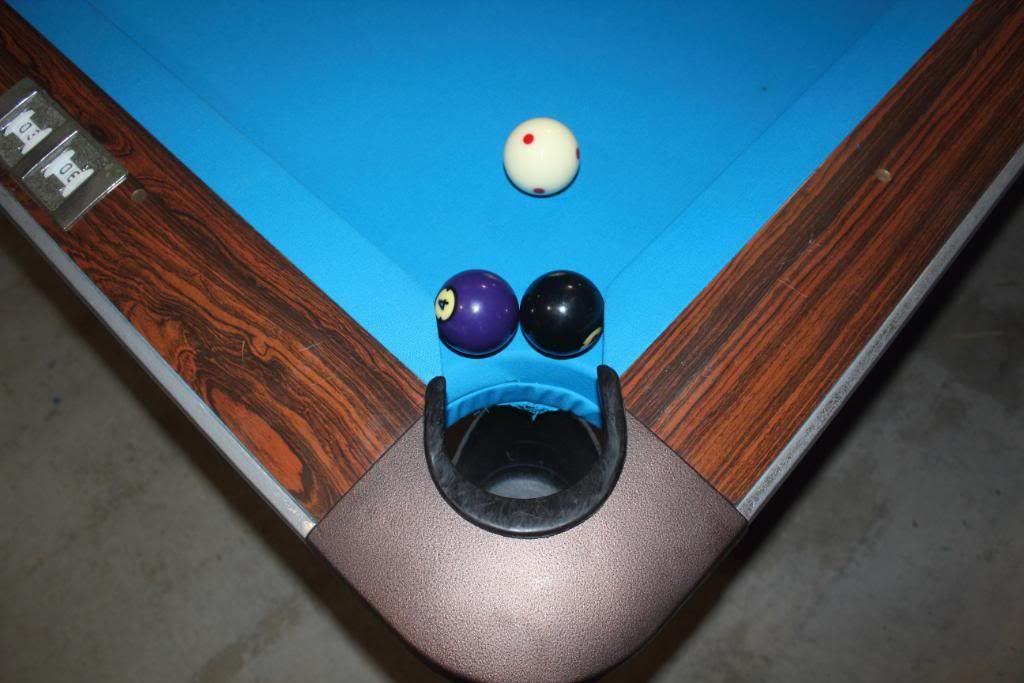
Here is the pocket in question. Please click on the link. It is probably in my head and I need to quit banging balls and learning finesse.

http://i1270.photobucket.com/albums/jj620/ebayturaniko/2012-01-16_22-01-26_764.jpg

The shelf looks very deep in that picture. I'd be interested if you could post a pic with a ball as deep as possible in the pocket and against the facing. But it appears that well under 1/2 the ball would be visible if you looked down the rail. I believe Diamonds (also a deep shelf table) are made so about 40% of the ball is visible down the rail. This looks maybe even less than that, but it's hard to tell without a ball for reference.
 
Last edited:
This is the picture with a 9 ball in the shelf of the pocket. Makes me feel disgusted because this happened to me before in some games I played in the past.

http://i1270.photobucket.com/albums/jj620/ebayturaniko/2012-01-17_01-18-36_785.jpg

Yes, but as I said before, it would be more helpful to show the ball up against the facing as far in as possible, not in the middle of the pocket, so you can see how much of the ball would be visible down the rail with the ball against the facing. BTW, with that ball there the pocket looks bigger than 4.5". In that pic it also looks like the facings on either side of the pocket are not cut the same. But maybe it's just the picture.
 
Take a look at this picture

http://i1270.photobucket.com/albums/jj620/ebayturaniko/2012-01-17_01-55-14_954.jpg

I measure it at 4.5 tip to tip but it may be the camera angle.. or i am measuring it wrong..

That depth looks about right for a deep shelf table, a little under half a ball. As for pocket measurement, from the looks of that ball it appears another ball could come close to fitting next to it in the throat of the pocket. If you put two balls next to each other at the points (so a line drawn from point to point would pass through the center of the balls), do they take up the entire width or is there a little extra room left over?

Here's a pic of a well set up 4.5" pocket (measured at the mouth and not the throat), done by Donny of SD Billiards (Donny did the rails but did not assemble the table so that's not his finish work):

IMG_49352012.jpg


Compare the angles of the facings to your table. It's hard to tell from the pic but it may be that the facings on the table you are talking about are more splayed out - in other words more "V" shaped than "U" shaped.

This will cause a ball hit firmly along the rail that hits the facing to want to rebound across the front of the hole and into the other facing rather than go in. This is more so with deep shelf slate and especially if coupled with soft cushions, like Olhausen's accufast. When the ball hits the facing it compresses and "opens up" even more, so the ball rebounds across the front of the hole and not down into the pocket. Even more so if it hits the rail on the way to the hole because it is then hitting the facing at an angle going away from the hole rather than straight into the facing And of course, when the shelf is deep it will occur more often.

Amazing what I've learned on AZB. :grin-square:
 
Last edited:
Roger Long wrote a really informative and practical article on here...

http://www.azbilliards.com/rogerlong/roger2.php
I think his formula doesn't capture the difficulty of a pocket. For example, a pocket with a 5" opening and 4" throat and a pocket where both are 4.47" are rated as equally difficult, no matter the shelf depth. It seems to me that is not accurate.

I think one main issue comes from the fact that the ratio of opening to throat is important for OBs close to a rail, but not of much importance for OBs from the middle of the table. And I think the same is true for shelf depth.

Clearly the most difficult pocket is one where the opening barely allows a ball to pass (2.25" for standard pool balls). In this case, it will be very difficult to pot a ball on the rail if the shelf depth is 0. If the shelf depth is greater than 0, it should not be possible.

Similarly, the most difficult throat width is also the width of the object ball.

The most difficult shelf depth would be infinity, but that's not practical, so I'll go at it from the other way and set the easiest possible shelf depth to 0.

From there, I'll try to engage my mathematician son in developing a formula that we think is more useful. The range of 40-45 degrees is the one of interest I suppose. At 45 degrees, opening width = throat width, and all, or almost all, balls from any angle that contact inside the pocket opening will be accepted, no matter the shelf depth or ball speed.
 
MSB?? I think.. They are K66. Have you heard of them? They respond pretty good.

If that's the cushions that were installed, your table mechanic didn't know what he was doing, which also explains why the pocket miter angles are so wide, and inconsistant to both sides. The wider the pocket miters, combined with a deeper slate shelf leaves more room for the balls to set on instead of dropping into the pocket. When the pocket miters are not cut in such a way that they direct the balls into the back of the pocket, but instead bounce the balls across the pocket into the opposing pocket facing...and having enough slate shelf for the ball to come to rest on...you end up with pockets that don't play right. Are all 4 corner pockets the same width at the point to point opening? When looking at some of the pictures you posted, it even looks like the pocket facings are starting out at the inside edge of the end of the sub-rail, meaning that the sub-rail and cushion are short by design, and being corrected by the pocket facings being thicker.

Glen
 
Back
Top