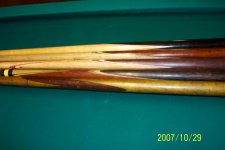
Preview of the Brunswick Collector

TATE said:
I sure hope you kept that cue, Jack! I still do not have one for an example, but I can keep my hopes up. They have been scarace for many years now, but you never know...maybe if a good deal comes up...Jack, if you still have it, I would appreciate some pictures.

Chris

Hi Chris,

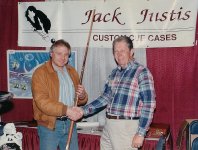
I sold it to the guy in the photo. I think I have his Phone # somewhere if your interested.
 

Attachments

  • model360.jpg
    model360.jpg
    94.7 KB · Views: 180
Jack Justis said:
Hi Chris,

I sold it to the guy in the photo. I think I have his Phone # somewhere if your interested.

That's a great photo - I would really like to have pictures of that particular cue, so please do PM me with his number or e-mail address.

Chris
 
manwon said:
I totally Agree with this the below statement Chris:

ps. I learned something interesting from the 1908 catalog. Some of the shafts that are ebony or purpleheart spliced on the ends are actually repair jobs. When a shaft got worn out or warped, Brunswick offered the service of splicing a new end onto it. For a one piece cue, that's not a bad idea.


I have also done some research on this subject. While Herman Rambow started working for Brunswick as a mail boy sometime in the 1890's it was not long before he had switched to the cue making department of Brunswick. Sometime before 1910 Herman started a cue repair department for Brunswick which became a very profitable department. In this department they would repair cues that were broken for their customers at half the price of a new cue.

Chris, I have found many examples of cues that were sent back to Brunswick for repair, and I am also certain that imported cues were also repaired, which after repair were given a Brunswick label. Now it is common knowledge the older plain cues (Pre or early 1900) without veneering on the points commonly had wedges machined into the bottom of the cues. Throughout the last five years I have begun to notice cues with Brunswick labels from the 20's and 30's with single or even multiple wedges on their bottoms. Another factor are the number punches used for weight identification, on the very early cues these are normally found in the cues wedge at the bottom of the cue. Also on cues made in the 1920's the weight stamp numbers are very neat in most cases and uniform, on the older cues they were hand stamped without care to alignment or even the size of the stamps used. Last of all, I have also found that the weight stamps were not changed after repairs. I have found cues that up too two oz less than the stamped weight.

I hope this helps, and I will start putting together some photo's for you!

Have a good night Chris!

Craig,


Here's a tie in to the 1908 Catalog page. This is just a few pages. The entire catalog is 120 pages. You'll probably see some of your cues. This was just right before they used decals I believe, although they already had the round Brunswick logo (shown on the cover). Please let me know how this format works in your browser.

By the way, the "sales pitch" on the "Cues" page is hilarious, especially the "sucker" part and "broom handles". How about "we don't make mop sticks!". You could use the same pitch today!

http://www.palmercollector.com/Brunswick1908.html

Chris
 
Last edited:
What you are doing is amazing and truly a great thing!

Many-many 'thank you's are on the way to you as it will be very-very helpful! Thank you very much for all and I wish you the best of luck in your new adventure!
 
Amazing. Thank you for sharing.

Chris,

I would love to meet both you and Craig and to be in a room with the two of you discussing all this in person. Amazing stuff.
 
TATE said:
Craig,


Here's a tie in to the 1908 Catalog page. This is just a few pages. The entire catalog is 120 pages. You'll probably see some of your cues. This was just right before they used decals I believe, although they already had the round Brunswick logo (shown on the cover). Please let me know how this format works in your browser.

By the way, the "sales pitch" on the "Cues" page is hilarious, especially the "sucker" part and "broom handles". How about "we don't make mop sticks!". You could use the same pitch today!

http://www.palmercollector.com/Brunswick1908.html

Chris

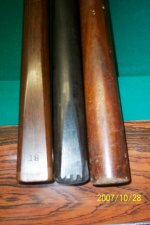
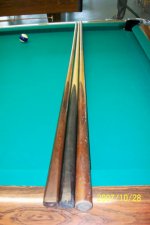
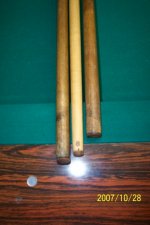
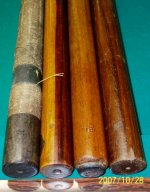
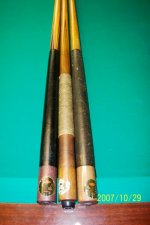
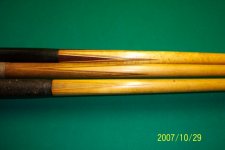
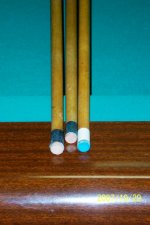
Chris here are pictures of Brunswick cues that were made in the 1890's or earlier. Note, these cues were made with no ferrules, the tips were glued directly on the end of the shaft. All three are single Butterfly spliced butts no veneer's. Two of the three have wedges in the bottom with the weight stamped in them, the other cue has no wedge in the bottom. Two of the cues appear to be Rosewood, and one is Ebony. all these cues are a standard 56 1/2 to 57 inches in length, and approximately 14 1/2 to 15 mm at the tip end. These are some of the earliest type Brunswick cues produced in this country, most cues before this style were imported from Europe.


Earlyest butts.jpg

Early cues.jpg

no ferrule.jpg

Note: The picture of the cue on the Left in the first photo has a Hexagon shaped butt. The photo below shows the contour.

Hexigon butt.jpg
 
Last edited:
TATE said:
Craig,

Thanks for the photos. This will be helpful in attempting to ID the early cues.

Here's where I'm at so far on the site:

http://www.palmercollector.com/Brunswick/BruswickCollectorHomePage.html

So far it's just catalogs. Please let me know what you think so far.

Chris

I really like it Chris, just like with the Palmers there is no better way to preserve something than to catalog it as reference for public use.
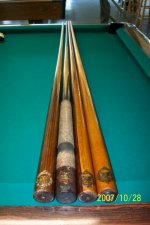
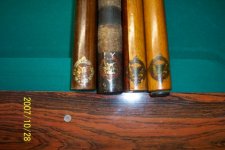
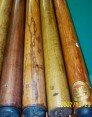
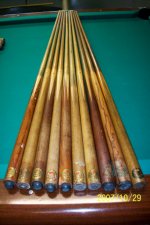
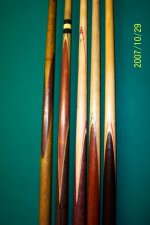
Here are some more photo's. These photo's are of cues most likely from your 1908 Catalog. These cues have a their weight in the wedge and Ivory Ferrules or Ivory Points as Brunswick called them, along with rubber bumpers.

Wedge butts.jpg

Wedge butts1.jpg

Wedge butts2.jpg

There will be more cues to follow, have a good night Chris!!!!!
 
Hey Chris, these cues are from the 1915 Catalog, I suspect. However the cue on the left has an earlier lable, and I am uncertain when they first started using it. These cues do not have wedges in their butts, however, the weight marking are still on the bottom of the butts. These cues also featured Ivory Points or ferrules, and rubber bumpers.

1915use1.jpg

1915use2.jpg

1915use3.jpg
 
Craig,

You have some nice cues there. Do you plan to restore any of them? Two of my favorite cues are some 26 1/2 cues I had restored, one ebony and one rosewood. They were perfectly straight to begin with and Scot Sherbine sanded them clean, put new leather wraps on, but otherwise left everything else (the decals, ferulles, etc.) alone. They play really good too!

Chris
 
TATE said:
Craig,

You have some nice cues there. Do you plan to restore any of them? Two of my favorite cues are some 26 1/2 cues I had restored, one ebony and one rosewood. They were perfectly straight to begin with and Scot Sherbine sanded them clean, put new leather wraps on, but otherwise left everything else (the decals, ferulles, etc.) alone. They play really good too!

Chris

Tate, the cues pictured will be restored. Here are some additional photo's.
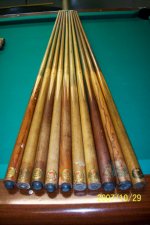
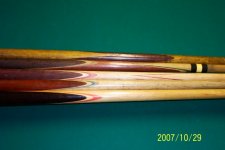
Chris the cues below are some of the Brunswick 26 1/2 cues I have. The cue on the left has been partly restored by runscott, and it has a Birdseye Maple shaft from the point to the ferrule.

26butt.jpg

26cues.jpg

26forearm.jpg

26ferrule.jpg
 
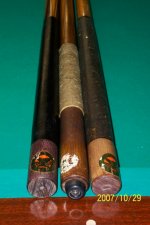
Here are some photo's of later model Brunswick cues with intact lables.

later cues 1.jpg

later cues 2.jpg

later cues 3.jpg

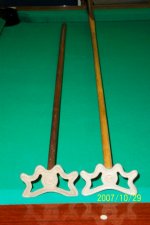
Below are some bridges that were produced by Brunswick during the 1920's or 1930's. The Bridge with the Butterfly splice was made as a bridge and not cut down later.

bridge1.jpg

bridge back.jpg
 
Some additional cues with later lables, that I suspect were actually old models that had been repaired.

Later lable old.jpg

The cues above are also below on the far right!!

later cues 1.jpg

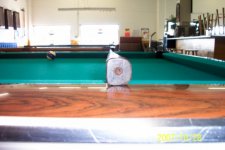
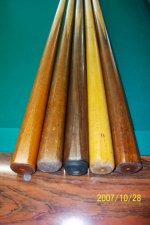
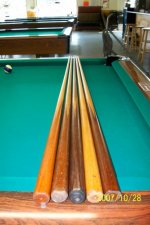
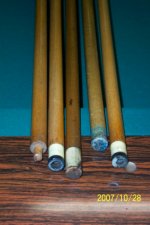
The cues below have not been identified yet, they could Brunswick or any other maker.

Unknown.jpg

unknown2.jpg

unknown3.jpg

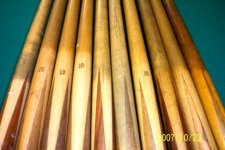
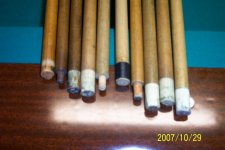
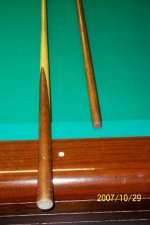
Chris in additon to these I some Titlist cues, and about another 150 one peice cues some with leather, some with linen, and some with no wraps. Many of these I have not even looked at yet so I really have no idea what else I will find, however, I will keep you posted. Chris I can send unsized photo's for your site if you want them.

Have a good day!!!!! I really love this stuff:)
 
Last edited:
You have some great examples there. Yes, I will like pictures, at least sized at 1000 pixels width. It will be fun to see if we can figure out the years and so forth from the catalogs. I already see a couple they showed in the 1908 catalog.

Chris
 
Back
Top