Rempe 'Hook and Throw'?

Colin Colenso

AzB Silver Member
Silver Member
Hey Guys,

I had a video over 10 years ago with Jim Rempe extolling the virtues of (I think he called it) hook and throw.

From memory, I think a hook was to pull the cue left across the cue ball and to throw was to push the cue to the right. (This is for a right hander).

What is interesting, is that hooking or throwing (I think we need another word that throw here, it is way overused) is very common among players as a naturally developed phenomenon.

I used to assume it was becuase they did this to correct for alligning too thick on the object ball. ie: To point at the contact point rather than at the centre of the ghost ball.

But now I wonder if this is also an intuitive method to compensate for deflection. I will draw a diagram later to show how this would work.

First let me know if you know anything about Rempe's theory.

Cheers
 
Colin Colenso said:
Hey Guys,

I had a video over 10 years ago with Jim Rempe extolling the virtues of (I think he called it) hook and throw.

From memory, I think a hook was to pull the cue left across the cue ball and to throw was to push the cue to the right. (This is for a right hander).

What is interesting, is that hooking or throwing (I think we need another word that throw here, it is way overused) is very common among players as a naturally developed phenomenon.

I used to assume it was becuase they did this to correct for alligning too thick on the object ball. ie: To point at the contact point rather than at the centre of the ghost ball.

But now I wonder if this is also an intuitive method to compensate for deflection. I will draw a diagram later to show how this would work.

First let me know if you know anything about Rempe's theory.

Cheers

I've heard about it for some time ago. Don't know, I've learned to shoot straight and wouldn't change to shooting "across" the cueball. Admitted, if I want to shoot maximum English with slow speed, I've noticed that shooting across the cueball gives more spin. But I only use it when the object ball is near the pocket, I find it hard to aim if I don't shoot straight.
 
Colin Colenso said:
Hey Guys,

I had a video over 10 years ago with Jim Rempe extolling the virtues of (I think he called it) hook and throw.

I thhnk this is just another form of backhand english or aim-and-pivot or aim-and-swoop. The last is the same as aim-and-pivot except the stick is brought across the ball at the last momemt. If it's aim-and-swoop, I can think of no better way to ruin your fundamentals.

Why not address the cue ball where you intend to hit it and then hit it there?
 
I agree, we all want to simplify an already complicated game as much as possible. Adding spin/throw etc... if not neccessary, will make precise contact less predictable. We have to make sure we are using it in correct applications. But thats for Jim Rempe to know and us to find out.
 
Bob Jewett said:
I thhnk this is just another form of backhand english or aim-and-pivot or aim-and-swoop. The last is the same as aim-and-pivot except the stick is brought across the ball at the last momemt. If it's aim-and-swoop, I can think of no better way to ruin your fundamentals.

Why not address the cue ball where you intend to hit it and then hit it there?
Hi Bob,

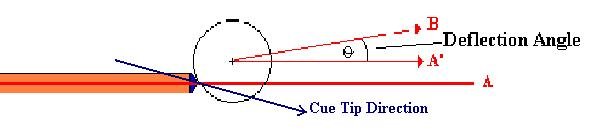
See attached pic.

I know swooping across (throwing or hooking) seems to complicate allignment, but I see a lot of top players doing this. Even in snooker where accuracy is extremely important. Often their swoop is slight, but it is a common habit.

It needen't involve backhand english (hitting in a different position to the original allignment) but this is usually the case.

Backhand English doesn't change the deflection, so much as it creates a new aiming point to compensate for it.

However, swooping as you call it (I prefer this term to throw or hook), will have the cue tip traveling in a different direction than the centre line through the cue. (As shown in the diagram below).

This will impart spin and also produce linear forces which may negate deflection forces.

It seems a player could theoretically learn to swoop to just the right degree for various amounts of side, and effectively overcome deflection. Obviously the less the cue deflects in the first place, the less swoop would be needed.

There will always be some degree of cue ball defelction, so a player has to learn to adapt to that. If they learn to adapt their swooping instead, they merely change to a new variable to adjust to.

I'm not sure I would advise this method as a coach. But not sure I would want to train it out of someone who already does it with success.

I'd like to hear some guys opinions on whether they are swooping or whether they have observed the pros swooping.
 

Attachments

  • Deflect Angle with throw.jpg
    Deflect Angle with throw.jpg
    11.8 KB · Views: 275
Colin Colenso said:
I know swooping across (throwing or hooking) seems to complicate allignment, but I see a lot of top players doing this. Even in snooker where accuracy is extremely important. Often their swoop is slight, but it is a common habit. ...
There are also a lot of top players who have absolutely straight through delivery.

There are others who don't exactly have a straight delivery, but do have some curve in their strokes. An example is Irving Crane, who many would take as a example of good fundamentals. He had a little left-to-right tip movement on most shots, but this seemed to be independent of the side of spin, if any, he was using. In contrast, for aim-and-swoop, the tip must move right-to-left for left english and left-to-right for right english

Among carom players, one of the main proponents of "wiping english onto the ball" as it is sometimes called was Bill Hawkins, who held the high run record for US competion for many years (19?). I think there is no current top player who uses the technique; they all seem to come through the ball like pistons, not cracking whips.
 
The video that your are refering to is either Pool School or Power Pool. They were two videos in a 3 video promotional set offered by Meucci Originals. In my opinion, they were the finest instructional videos ever offered. Pool School and Power Pool featured Jim Rempe and Loree Jon Jones, and the third video included all of the Meucci sponsored Pros of the late 80s, David Howard, Earl Strickland, the late Louis Roberts, Sammy Jones and of course Loree Jon Jones and Jim Rempe.

The methods that you are refering to, as displayed by Jim Rempe, are 'Tuck' and 'Throw'. Tuck refers to using maximum inside english on the cue ball by way of actually wiping the cue tip acrossed the cue ball to impart more spin, and throw uses the same method, but puts maximum outside english on the cue ball.

Here's the trick with these strokes. The cue ball will react differently with either one of these strokes applied to it. When you apply normal english, left or right to the cue ball, a straight through stroke if you will, the cue ball will DEFLECT. Depending on what type of cue you are using and the amount of deflection that cue puts on the cue ball, the path of the cue ball will actually change as it moves towards it's target. For example, if you use right hand english with a 'straight through' stroke, the cue ball will travel to the left of straight ahead and vice versa with left hand english, the ball will travel to the right of straight ahead, and this is basically known as deflection. Using the tuck and throw strokes, the cue ball actually reacts almost the exact opposite of the straight through stroke. The wiping action almost puts a masse on the cue ball. If you were to use right hand english with a throw stroke, the cue ball would actually travel to the right as it approaches it's intended target. Naturally, the same is true if you used left hand english with the wiping action, the cue ball would actually travel to the left as it approached it's target.

As mentioned in a post a few months ago, Buddy Hall is one of the few pros who consistently use tuck and throw. For the most part, these strokes are essential to your arsenal, but should be left for a 'need to use basis'. Most shots on the table do not require the extreme english that tuck and throw impart to the cue ball. However, in the instances that call for this type of stroke, knowing how to execute it is essential.
 
ACDEALER said: "The wiping action almost puts a masse on the cue ball. If you were to use right hand english with a throw stroke, the cue ball would actually travel to the right as it approaches it's intended target. Naturally, the same is true if you used left hand english with the wiping action, the cue ball would actually travel to the left as it approached it's target. "

There is no almost about it, it is masse or swerve caused by hitting down on the ball. As dic=scussed many times in the past, you can hardly ever get a level stroke due to the rails. Buddy hall talks about this in one of his videos. I used to shoot like this and was always ver inconsistent. I have seen the light and now try to shoot straight through the ball, although I think I still do the swoop thing on occasion, but not on purpose.
 
Thanks ACCDealer,
It had Loree Jon Jones, and I believe it was power pool that I saw, though I may have seen the whole set. Memory fades:( And yes, tuck is the word, not hook.

I do prefer the term Wiping English, event better than Swoop.

And Frank, I also have gone more for straight cueing, but save up a good wipe when I really want to get some sidespin. So long as the pot is not too hard.

Bob, good info, cheers!
 
Back
Top