
Ring Press?

^ OK.
I do them on the cue with slow-setting epoxy. I measure each piece on four sides to make sure they are dead flat. Place a waxed Delrin as a spacer then a delrin tube with pressure behind it.
Some extra steps are done with chains and pattern rings. Those I am not in the liberty to discuss. It was passed on to me and I've figured other extra steps in doing them.
I won't ask Dave B. how he does his either. Not that he is going to give them away anyway. Maybe 20-year supply of root beer and a swear under the bible ought to do it.
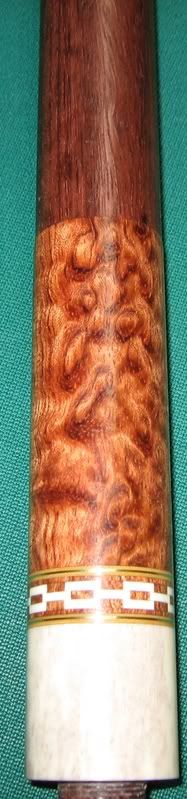
cool2.jpg
 
BarenbruggeCues said:
Dave........Generally I am very helpful. Ask me what pin I like best....what tip I think is better.......if I use fiber pads under my tips......what type of bumper I like best.....what feels better in my hands, linen or leather.....
how do I put my ferrules on.....what bit makes the best cuts....so on and so forth..........I think I am pretty damn helpful. I mentioned on more than one occasion how lucky the cue builders are to have some place like this to come and exchange ideas. There were very few people who would show or even talk to you about how to install a tip or a ferrule just as short as around 10 years ago. It was voodoo to have a conversation about forearms and handles and ring work and wraps and how to set your lathe up to cut tapers.
Even my close friends[I do have a couple, I think] and just friends in general know how tight lipped I am about my ring work. There was NO one to show me or tell me how to do it. I literally have hours and hours of time and piles of scrap expensive wood into my rings. I don't do inlays in my cues and my rings are a signature of my style of work and this is one thing I don't feel I would like to openly discuss.
They are not rocket science and if someone else wishes to use this style or some of the designs I have used in the past my hat is off to them and I consider it a compliment to my work. There are every few, if any, things that have not been copied or expanded on in the cue building world so I expect one day I'll see this also.
Since I don't know you personally I don't mean to act or sound harsh but the rolling eyes, smiling face is hard to distinguish between taking a soft jab in the ribs or a thanks for being a smart A.
Which ever one in may be intended for I'm not sure but it pushed my button to clarify myself on this subject.
I like to joke around and have a good time as much or more than the next person and it at times get me into situations that I wish I weren't in.
All I am saying is I hope the people that are just jumping into the cue building world appreciate all the help that everyone does give on this board because it would have been a God sent 10 years ago.

Remember......Some of us do this fulltime for our only livelihood!

Just some of my thoughts on exchanging ideas, and ringwork.........
Come on, you use them laserpens to align them rings. :D
I have a guess how you do them.
My suspicion is, not too many are going to go thru that pain to do them anyway. :)
 
JoeyInCali said:
^ OK.
I do them on the cue with slow-setting epoxy. I measure each piece on four sides to make sure they are dead flat. Place a waxed Delrin as a spacer then a delrin tube with pressure behind it.
Some extra steps are done with chains and pattern rings. Those I am not in the liberty to discuss. It was passed on to me and I've figured other extra steps in doing them.
I won't ask Dave B. how he does his either. Not that he is going to give them away anyway. Maybe 20-year supply of root beer and a swear under the bible ought to do it.
cool2.jpg


A & W, Barqs or Muggs? :D

I have a secret too and I'm not telling you either. As far as DB doing ring work, Dave and I discussed how he does it about 5 or 6 years ago. It's no secret and quite easy but labor intensive. The way he explained it to me was exceedingly dangerous using the equipment he mentioned. I tried it and no thank you but it does work well not to mention that it saves a ton of material (billets). :eek: Since then I prefer to do it my way; much safer for me.

C'mon Joey, let's hear it. Afterall, I think you garnered a sufficient amount of knowledge and information from this board. How about contributing back some of your wisdom. Spill the beans so-to-speak.

BTW... very clean looking work in the photo. :p
 
Last edited:
Thnx.
I suspected Dave's work is very labor intensive. But, not dangerous.
Dave does the best rings and they separate his cues from the rest.
Since I don't do this for a living, I'm glad the good guy gets all the props and honey in the ring department.
Joey~Wondering if Dave can see without a comparator these days~ :)
 
JoeyInCali said:
Thnx.
I suspected Dave's work is very labor intensive. But, not dangerous.
Dave does the best rings and they separate his cues from the rest.
Since I don't do this for a living, I'm glad the good guy gets all the props and honey in the ring department.
Joey~Wondering if Dave can see without a comparator these days~ :)


Trust me, his method of doing rings, is IMHO - dangerous. Leave it at that. Unless he's told you exactly how he does it, you can't imagine. And, I seriously doubt that there is anyone else out there doing them the way he does them.
 
I'm a bit surprised nobody here mentions threading their collars and other components on. This greatly facilitates gluing rings on joint, shaft, and buttcap area--especially the kind that are not indexed. The threaded component holds the rings firmly in place. Well mixed 5 or 30 minute epoxy works fine. Indexed rings, depending on complexity, are a bit different, and as Joey sez, I am not at liberty to comment on that. :eek: BTW, It helps if you have a big swig of root beer prior to installing any rings--belching is optional.

Martin


PetreeCues said:
Hey all,

I have my own method (probably much harder than it has to be) of pressing many rings together before I put them on a cue. I have never known much at all about how other cue makers do ring assembly. I am wondering if I do it as good as it can be done, or if there is something better out there.

Let's say you are building a cue that has many rings at the joint or butt. Like maybe 4 or more pieces. Do you put the cue in your chuck and install each piece one by one, or do you build the ring set seperately by pressing them together somehow, and then install them as one piece on the cue?

Either way, elaborate on how you assemble them, if you will. I think how they are installed can be a big factor in the hit of a cue, especially rings at the joint, and so I am curious to know how different cue makers assemble rings.

Thanks!
 
Nobody showed me how to do any part of Qbuilding. I started 20 years ago, & I'm glad to share, so I guess if you want to ask for help, just e-mail ME. I will give you what I know, from my limited experiences. It may or may not be what others do, but I won't dance around & almost tell you something. Look, this is really NOT brain surgury. The facts, as I see it is that the better the equipment you have, the easier this Qbuilding is. If I can trial & error my way to this point, you can too. I'm as dumb as a box of rocks, but I stumbled on to few things, that I am willing to share. I have my heros in this field & I don't pretand to be anywhere near their equal, BUT I may be able to shead a little light your way. NO OFFENCE to anyone who feels thay don't want to share, I'm just getting to the end of my life & I feel it would be a sin to take what I have learned, to the grave. Most of you who are serious about Qbuilding, will far surpass my meager accomplishments, but just maybe there is some little thing, that I can pass on. Feel free to ASK...JER
 
You're a generous soul Jerry...I greatly enjoy your contributions and humor here.

Martin


BLACKHEARTCUES said:
Nobody showed me how to do any part of Qbuilding. I started 20 years ago, & I'm glad to share, so I guess if you want to ask for help, just e-mail ME. I will give you what I know, from my limited experiences. It may or may not be what others do, but I won't dance around & almost tell you something. Look, this is really NOT brain surgury. The facts, as I see it is that the better the equipment you have, the easier this Qbuilding is. If I can trial & error my way to this point, you can too. I'm as dumb as a box of rocks, but I stumbled on to few things, that I am willing to share. I have my heros in this field & I don't pretand to be anywhere near their equal, BUT I may be able to shead a little light your way. NO OFFENCE to anyone who feels thay don't want to share, I'm just getting to the end of my life & I feel it would be a sin to take what I have learned, to the grave. Most of you who are serious about Qbuilding, will far surpass my meager accomplishments, but just maybe there is some little thing, that I can pass on. Feel free to ASK...JER
 
jazznpool said:
I'm a bit surprised nobody here mentions threading their collars and other components on. This greatly facilitates gluing rings on joint, shaft, and buttcap area--especially the kind that are not indexed. The threaded component holds the rings firmly in place. Well mixed 5 or 30 minute epoxy works fine. Indexed rings, depending on complexity, are a bit different, and as Joey sez, I am not at liberty to comment on that. :eek: BTW, It helps if you have a big swig of root beer prior to installing any rings--belching is optional.

Martin
Threading will also make soft rings expand.
Btw, you know how to make veneers?
What dye and mix are needed?
Tattoo ink and acetone?
 
Dave- I hope you took no offense. I knew this would be a sensitive subject due to the types of rings that you assemble. VERY NICE!!:)

Everyone else,
Though I don't personally stack a lot of rings, if I were to start, I have envisioned a type of 2-piece jig that would screw together...maybe made of delrin... that you would tighen by hand. I would make several of course. Maybe even turn a piece of wood for the rings to slip over for better strength during assembly. You could place your FLAT outer ring first, stack and align others using CYNO?, and then finsh up with a THICK outer ring (for facing purposes later) Once everything is glued and clamped, seal the assembly with epoxy, and as Dave said, "let it soak for 72 hours"! :D

IMO. Any additional theories?

HAPPY NEW YEAR EVERYONE!

Chris
 
Poulos Cues said:
Dave- I hope you took no offense. I knew this would be a sensitive subject due to the types of rings that you assemble. VERY NICE!!:)

Everyone else,
Though I don't personally stack a lot of rings, if I were to start, I have envisioned a type of 2-piece jig that would screw together...maybe made of delrin... that you would tighen by hand. I would make several of course. Maybe even turn a piece of wood for the rings to slip over for better strength during assembly. You could place your FLAT outer ring first, stack and align others using CYNO?, and then finsh up with a THICK outer ring (for facing purposes later) Once everything is glued and clamped, seal the assembly with epoxy, and as Dave said, "let it soak for 72 hours"! :D

IMO. Any additional theories?

HAPPY NEW YEAR EVERYONE!

Chris


By "CYNO" you mean Super Glue Gel, I wouldn't use it on rings. Early on, I assembled my rings using Super Glue Gel & after a few years, white cracks in the finish started to appear, between the rings. Evidently the Super Glue gave way & when the rings weren't being held together, it cracked all of the way to the surface, through the finish...JER
 
Poulos Cues said:
Dave- I hope you took no offense. I knew this would be a sensitive subject due to the types of rings that you assemble. VERY NICE!!:)

Everyone else,
Though I don't personally stack a lot of rings, if I were to start, I have envisioned a type of 2-piece jig that would screw together...maybe made of delrin... that you would tighen by hand. I would make several of course. Maybe even turn a piece of wood for the rings to slip over for better strength during assembly. You could place your FLAT outer ring first, stack and align others using CYNO?, and then finsh up with a THICK outer ring (for facing purposes later) Once everything is glued and clamped, seal the assembly with epoxy, and as Dave said, "let it soak for 72 hours"! :D

IMO. Any additional theories?

HAPPY NEW YEAR EVERYONE!

Chris

Hi Chris
Do yourself a favor, don't use super glue anywhere in the construction of the cue. The only place really acceptable to use it, is to glue the tip.

Mr. B.
Please forgive some of them, they know not what they say.
 
Guys,
Call me odd , but I use screws and washers. I cut the tenon on the cue , get it to desired size while having all my rings precut and faced. Then I pre drill a 1 inch small hole and leave the last ring , or buttplate about 30 thou over size , then I use the screw with a rachet 1/4 head on it and use the washer to press , and screw it down til snug. Then as the glue presses , I add several turns to ensure no glue gaps and is super tight. Then when dry , take the screw off , and turn to size.This helps by not tieing any of my machines up and really gets em tight with the ratchet.
Just my way!
Thanx ,
Jim
 
J&D CUSTOMS said:
Guys,
Call me odd , but I use screws and washers. I cut the tenon on the cue , get it to desired size while having all my rings precut and faced. Then I pre drill a 1 inch small hole and leave the last ring , or buttplate about 30 thou over size , then I use the screw with a rachet 1/4 head on it and use the washer to press , and screw it down til snug. Then as the glue presses , I add several turns to ensure no glue gaps and is super tight. Then when dry , take the screw off , and turn to size.This helps by not tieing any of my machines up and really gets em tight with the ratchet.
Just my way!
Thanx ,
Jim
I like that idea...Very good info...But I have not had good luck gluing rings off the cue in a fixture, just my personal experience.
 
Super glue gel should not be used in any part of the manufacturing process on a cue. However, high grade cyano's can be used with great success. And, the precision of the parts has a lot to do with the bond. Inferior craftsmanship cannot be held together with super glue. You need tight tolerances to insure a good bond. You cannot use the glue to make up for loose tolerances. Actually, you need tight tolerances with the use of any glue. Additionally, the brand of cyano has a lot to do with the quality of the job as well.
 
Ring press...

I was talking about a high-grade CYANO in my previous statement...like HOT STUFF or someting else of the type. The jig would be a sort of enlarged version of delrin joint protectors with a longer locating shoulder on the "male" part and maybe a longer bored id for the "female".

I do use the gel for tips.

Thanks.
Chris
 
Last edited:
i too use the screw / washer method. i prefer doing the same step to 4 or 5 pieces at a time. this includes doing the glue up work. with this method of clamping i do not tie up my lathes (i let the epoxy set up for at least 24 hours). also i don't have to worry about cleaning epoxy off of the lathes. the screw i use has a hex head and an aggressive wood type thread. i did use an all purpose or drywall type screw until i twisted one in half and had fits getting it out so i could finish the cue.
 
Back
Top