
shaft cleaning

Dave38

theemperorhasnoclotheson
Silver Member
Hello, I have a shaft that I'm redoing for a customer, and it was the dirtiest one I've seen yet. My problem is, even using the magic eraser, repeatedly, there is still a yellowed look to the wood. Where I sanded, (peeled) the old topcoat off, it's that nice clean wood look. Is there a trick to making the whole shaft that way without sanding down to china? Any help much appreciated. If you don't want to divulge this info, I understand. Thanks all,
Dave
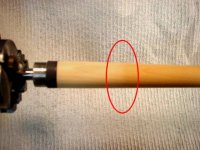
shaft.jpg
 
Dave38 said:
Hello, I have a shaft that I'm redoing for a customer, and it was the dirtiest one I've seen yet. My problem is, even using the magic eraser, repeatedly, there is still a yellowed look to the wood. Where I sanded, (peeled) the old topcoat off, it's that nice clean wood look. Is there a trick to making the whole shaft that way without sanding down to china? Any help much appreciated. If you don't want to divulge this info, I understand. Thanks all,
Dave

View attachment 64094

Most people clean their shafts with water or alcohol. I use neither as why would I want to put water onto a bare shaft that I just spent over a year drying out. As far as alcohol, it is a pretty good disinfectant and the next time I intend using my shaft to operate on some ones Spleen I may use it. For cleaning shafts and raising dents I use ammonia. It cleans well, works great for a liquid on a Magic Eraser and once dry leaves the wood a little whiter. I always use it for raising dents for a number of reasons. It cleans the area around the dent, it is thinner than water so that it soaks in quicker and deeper than water and it boils at a lower temperature than water so it will steam up the dent quicker with less chance of damage to the shaft. As far as trying to get the shafts color to match where there once was finish but now has been removed it's not going to happen. The finish has soaked into the wood, hardened and protected it. You may get it close but I doubt ever perfect

Last week when people were talking about installing a ferrule on a non round shaft it was mentioned that wet sanding would cure the problem as it would swell the wood. This was one of the silliest recommendations for a cue repair I've ever heard of. It might work for a day or two so that the shaft is out of your shop but once the water dries the shaft is going back to it's original size but actually a little smaller as the wood will sand more than the ferrule and by adding the moisture you are tempting fate as it may be enough moisture to make the end of the shaft move even more than it already has.

By the way, this paragraph wasn't directed to you personally.

Dick
 
Last edited:
Cuedog said:
Which ammonia do you use Dick? Thanks.

Gene

I just looked and the jug I now have is Meijer's brand sudsy Ammonia. A 1/2 gal. jug is a 1.00 or so in the laundry detergent section. A jug lasts a long time and I keep an old Windex spray bottle full of it. When there is a dent in the shaft I spray some on the area while the shaft is spinning around 2000 rpm and then run a piece of leather over the area. Usually the dent is gone in less than 10 seconds.

Dick
 
rhncue said:
Last week when people were talking about installing a ferrule on a non round shaft it was mentioned that wet sanding would cure the problem as it would swell the wood. This was one of the silliest recommendations for a cue repair I've ever heard of. It might work for a day or two so that the shaft is out of your shop but once the water dries the shaft is going back to it's original size but actually a little smaller as the wood will sand more than the ferrule and by adding the moisture you are tempting fate as it may be enough moisture to make the end of the shaft move even more than it already has. Dick

Thank you for pointing that out. I was going to mention it but it slipped my mind. That's what happens when you get old. :)

One should not wet sand any bare wood. In fact I make sure the wood is completely covered in finish because I don't want to break through the finish and stain the wood.

Good Cuemaking,
 
Thanks Dick, I will try the ammonia, I just have to get some. And I agree with you about the wet sanding, definatley a bad Idea in my opinion.
Dave
 
Dave38 said:
Thanks Dick, I will try the ammonia, I just have to get some. And I agree with you about the wet sanding, definatley a bad Idea in my opinion.
Dave
Along with WD40.:eek:
I've used mineral spirits b/c denatured alcohol and thinner are too nasty for me.
I will try ammonia. Thanks Dick.
 
Cuedog said:
The common household ammonia has water in it.

Gene

You may be right as I'm no chemist but there is no mention of any water in the list of ingredients: Ammonium Hydroxide solution, Anionic Surfactant, Quality control agents, fragrance and colorant.

Dick
 
most ammonia any of us can be is going to be 80% or more water and maybe 10-20% actual ammonia.the household brands are even weaker than that.

if you have pure anhydrous ammonia at your house you are probably on the DEA watch list.
 
rhncue said:
You may be right as I'm no chemist but there is no mention of any water in the list of ingredients: Ammonium Hydroxide solution, Anionic Surfactant, Quality control agents, fragrance and colorant.

Dick

ammonium hydroxide solution is ammonium in water.
 
I can build a still, and distill the ammonia, then whola... we're all set:D :D
 
Arnot Wadsworth said:
Thank you for pointing that out. I was going to mention it but it slipped my mind. That's what happens when you get old. :)

One should not wet sand any bare wood. In fact I make sure the wood is completely covered in finish because I don't want to break through the finish and stain the wood.

Good Cuemaking,


That's funny You guys say that, because I was thinking the same thing Myself, but was trying not to be too critical, being I had already comented on the other thing in that thread. I always try to get that transision area perfect. Even heating some ferrule materials up from sanding and burnishing will make them expand, and then later they will shrink as they cool. Sometimes you even get lucky, and when they shrink, they even out perfect requiring no extra work. Expansion is usually only temporary. Sometimes You have to watch out for that, so You don't over work the area too soon. Different ferrule materials act differently It seems like, and some are worse about It then others. I kind of thought of the wet sanding of the wood in the same light, that It would shrink, but then I don't use that method, and so don't have all the facts, just theory, so that's another reason I didn't comment.


The yellowing issue mentioned in this thread- Most shafts you can clean, and It only seems like sealer that is yellowed, but I have had some antique shafts that seem like they are like that all the way through. More like It's the wood It'self. Has anyone ran accross that, and do you know the deal with It? The sanding dust will be more yellow then white. Sanding and/or cleaning do no good, except to remove dirt and grime on top. The yellow seems to be in the shaft It'self.


Greg
 
Back
Top