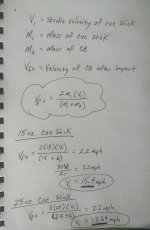
Should your break cue weigh less than your playing cue?

For those interested, lots of calculations and interesting related conclusions can be found on the optimal cue weight resource page (especially in the linked TP A.30 document).

Enjoy,
Dave

You are the man! :smile:. Excellent info available there. My calculations are not as detailed as your resource page. I just used a basic elastic collision equation, ignoring friction, tip absorption, etc... I believe it follows along the same findings that can be found in your work. If I'm wrong in using this equation please let me know, as
I kind of assumed momentum and kinetic energy would be conserved.

Thanks,
Brian
 
For those interested, lots of calculations and interesting related conclusions can be found on the optimal cue weight resource page (especially in the linked TP A.30 document).
Excellent info available there. My calculations are not as detailed as your resource page. I just used a basic elastic collision equation, ignoring friction, tip absorption, etc... I believe it follows along the same findings that can be found in your work. If I'm wrong in using this equation please let me know, as I kind of assumed momentum and kinetic energy would be conserved.
Your equation is the same as Equation 7 in TP A.30 (with a center-ball hit, where x=0), so your work is valid.

Good job,
Dave
 
Your equation is the same as Equation 7 in TP A.30 (with a center-ball hit, where x=0), so your work is valid.

Good job,
Dave


Thanks. After reviewing the link I don't believe there is any physics aspect left out or not covered in your material/resources. Good stuff for curious minds.
 
Your equation is the same as Equation 7 in TP A.30 (with a center-ball hit, where x=0), so your work is valid.
Thanks. After reviewing the link I don't believe there is any physics aspect left out or not covered in your material/resources. Good stuff for curious minds.
Thanks. The analysis obviously took a long time to complete (I did it many years ago when I was younger and dumb enough to know how long it would take), but all of the conclusions that came out of it made it worthwhile.

Catch you later,
Dave
 
The speed that figures into the force equation is a direct result of the mass of the cue stick crashing into the mass of the CB. If stroke speeds are equal, a 24oz cue stick (weighing 4 times the 6oz weight of the CB) would produce more CB acceleration than a 15oz cue that only weighs 2.5 times more than the CB. More acceleration equals more force.

More speed and less speed is the only thing the cue ball can have. Peak acceleration would be as soon as the ball leaves the tip then the cue ball slows down from there. I dont think the cue ball has any idea how heavy the that strikes it is, only how fast the cue is traveling.
I should have used velocity in place of speed, at any rate for the ball to have more "force" but not velocity/speed would be for it to increase in weight on the way to the rack.
 
Last edited:
More speed and less speed is the only thing the cue ball can have. Peak acceleration would be as soon as the ball leaves the tip then the cue ball slows down from there. I dont think the cue ball has any idea how heavy the that strikes it is, only how fast the cue is traveling.
I should have used velocity in place of speed, at any rate for the ball to have more "force" but not velocity/speed would be for it to increase in weight on the way to the rack.

I'd say the CB knows exactly how heavy the object/cue is that strikes it, due to the fact that it takes part of the collision force with it in the form of acceleration. The more forceful the tip to cue impact is, the more acceleration the CB gets, causing a faster break speed into the rack.

The first f=ma force (cue tip collision with CB) can only be increased with more mass (heavier cue stick) or more acceleration (faster stroke). Either of these predicts a greater CB acceleration, which increases the second force, f=ma, when the CB collides with the rack. The mass of the CB of course remains constant, but its acceleration increases as the force acting upon it increases. This causes a greater collision force at the rack. It really doesn't matter that the CB immediately begins to decelerate after being struck by the cue. The amount of time vs distance is so trivial that it probably doesn't factor in much at all.
 
This is awesome dude!!!!!!!!

At last....someone did the calculations.

Thanks a lot for your work and the time you spent on this.
beautiful! :)
 

Attachments

  • attachment.jpg
    attachment.jpg
    199.6 KB · Views: 214
I believe Dr Dave's info on,
What is the optimal weight for a cue?, is the most useful and informative word on this topic.

I particularly like his baseball analogy: Choosing a break cue can be looked at like choosing a bat... "A lighter bat can be swung faster, but a heavier bat has more mass. Some players can generate more ball speed (and distance) with a heavier bat (e.g., Babe Ruth), and some do better with a much lighter bat (e.g., Barry Bonds)."

It's a matter of feel and personal reference. It's nice to have friends with a variety of cues you can try out. I used a buddy's Predator BK2 for a week and loved it. I just didn't like the price of buying my own! :eek:
 
Last edited:
Back
Top