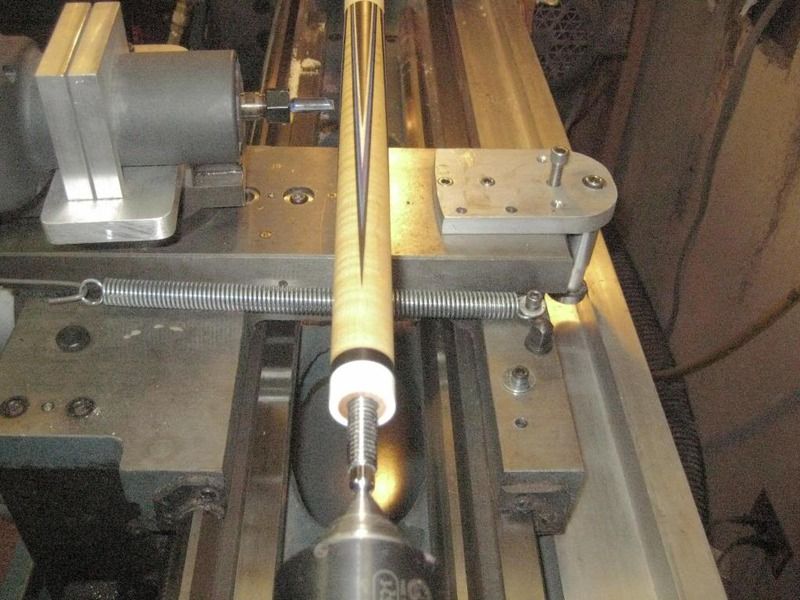
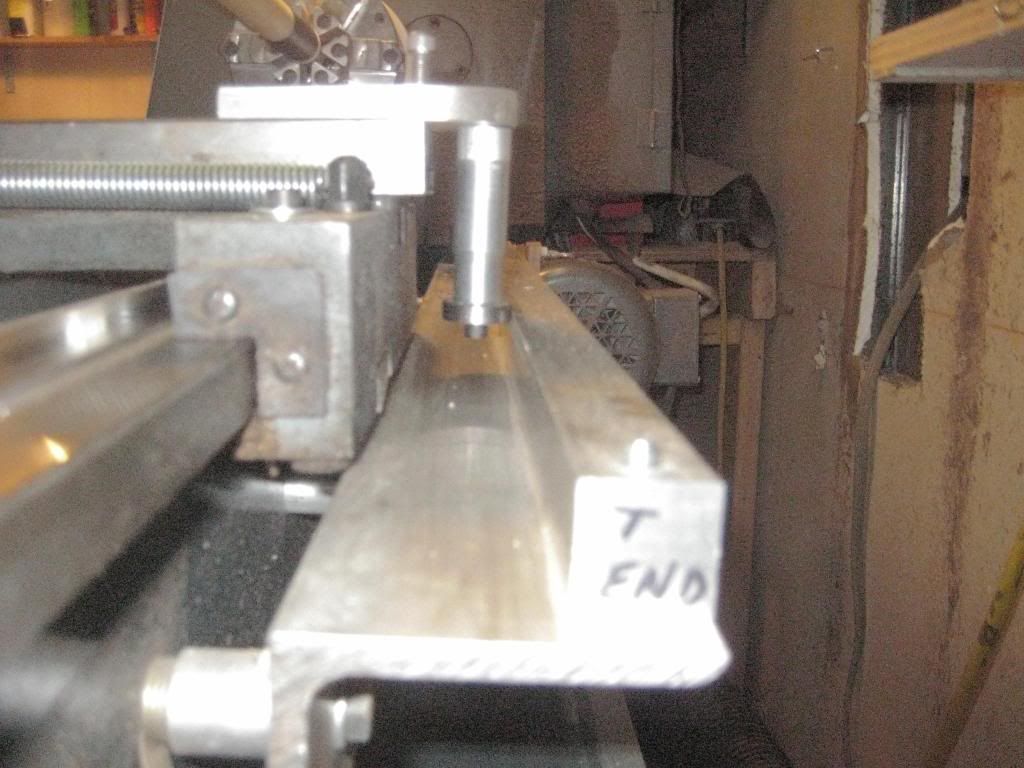
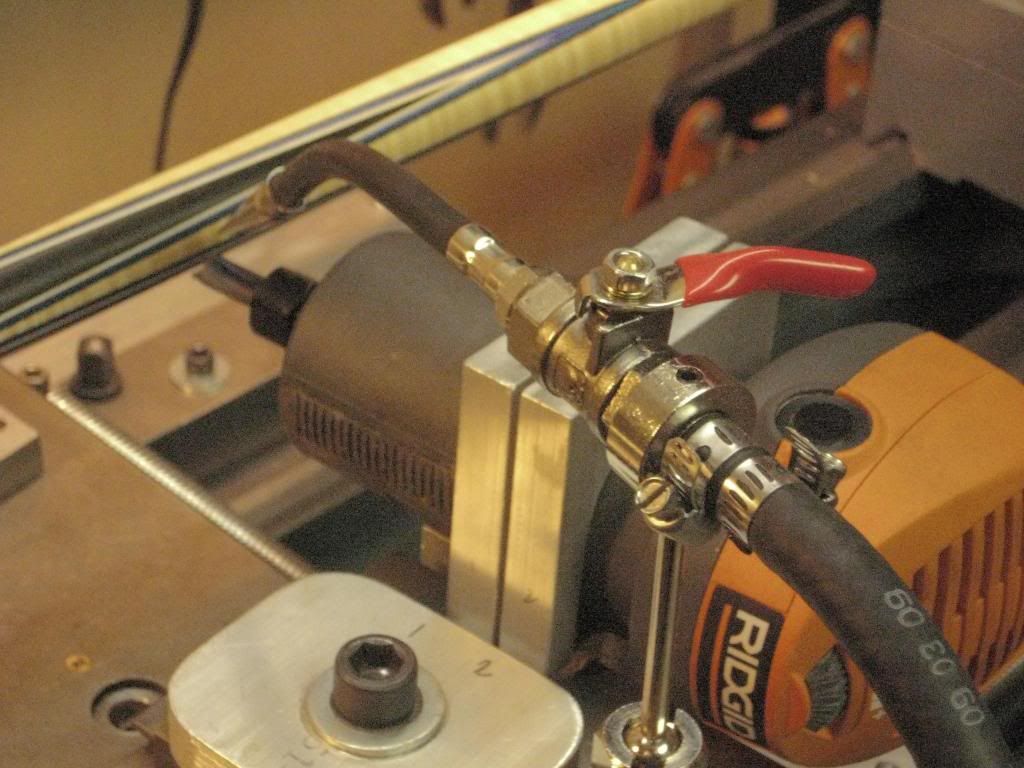
Taper attachments for sale for Engine Lathes, complete, ready to ship!

Wow, this thread went south real quick, and it's a shame. It was clear when I saw this item that it was very similar to another, extremely well built product, fine. But I would agree that it's built (and priced) like a Ford rather than the Benz as the OP stated. I also agree with everything the OP has said about all of the guys "building and designing" the Taig based lathes. The situation is VERY similar, so let's not create a double standard. Quite frankly, having multiple suppliers for a product is good in almost every way for the customers.

People have been beaten up over Taig based lathes in several threads. And you are absolutely correct about choices being beneficial to "customers". But it is obvious that your point of view is that of a consumer. Perhaps if it was your design being knocked off you would feel differently.

To all of the opponents: We hear you, point taken. Tom can fight his own design theft battles if he chooses to do so. He could probably even patent the thing if he chose to do so. That was, and still is, up to him. This man's product is offered with different (less) options and frills, is at a different price point, and he has offered to do some customizing to it if requested to fit your lathe. Choices, and competition, are good for all of us. This industry is so small, that I don't think it benefits us to chase away all of the new suppliers.

In this situation there are three important parties; the original designer, the OP, and a potential customer. Each party sets their own line in the sand about when design theft is OK and when it crosses the line. Part of the problem with design theft in this industry is that it is so small. If only 10 units are to be sold in a year of this product competition in this example does significant harm to the original designer. Take this to a it's natural end and it is my belief that design theft does more harm than good.

Will the arguably better original design still be produced with the new competition? Will the original designer still offer new innovations or will they be kept to himself? Will a third or fourth option appear that dillutes the market to the point that all stop making the product available?
 
Part of the problem with design theft in this industry is that it is so small. If only 10 units are to be sold in a year of this product competition in this example does significant harm to the original designer. Take this to a it's natural end and it is my belief that design theft does more harm than good.

I agree with your points on this as well. Which brings up my question: What rights does anyone have in protecting their Intellectual Property if they didn't get it patented? Is there any recourse or is it just the way it is?

Regards,
Frank
 
Wow, this thread went south real quick, and it's a shame. It was clear when I saw this item that it was very similar to another, extremely well built product, fine. But I would agree that it's built (and priced) like a Ford rather than the Benz as the OP stated. I also agree with everything the OP has said about all of the guys "building and designing" the Taig based lathes. The situation is VERY similar, so let's not create a double standard. Quite frankly, having multiple suppliers for a product is good in almost every way for the customers.

To all of the opponents: We hear you, point taken. Tom can fight his own design theft battles if he chooses to do so. He could probably even patent the thing if he chose to do so. That was, and still is, up to him. This man's product is offered with different (less) options and frills, is at a different price point, and he has offered to do some customizing to it if requested to fit your lathe. Choices, and competition, are good for all of us. This industry is so small, that I don't think it benefits us to chase away all of the new suppliers.

To the OP: Less is more. You are a new member here who is creating his reputation with every post. Please remember that you are talking to your potential customers here . . . if you want to be a business man, then act like one.

I totally agree. Competition among machine builders or accessory designers is what keeps equipment design from becoming stagnant and helps to bring prices down for consumers. It may be detrimental to the original designer BUT I notice that the original builders are not the ones complaining here. They are business men and, although may not liking it, knew going in that they would sooner or later run into competition from other builders especially on such easy equipment to construct from mostly already made parts. The ones who are doing all of the complaining are the actual benefactors from this competition. Talk about shooting yourself in the foot! I just don't understand "gentlemen cue makers".

Dick
 
i totally agree. Competition among machine builders or accessory designers is what keeps equipment design from becoming stagnant and helps to bring prices down for consumers. It may be detrimental to the original designer but i notice that the original builders are not the ones complaining here. They are business men and, although may not liking it, knew going in that they would sooner or later run into competition from other builders especially on such easy equipment to construct from mostly already made parts. The ones who are doing all of the complaining are the actual benefactors from this competition. Talk about shooting yourself in the foot! I just don't understand "gentlemen cue makers".

Dick

+1........
 
The OP could have diffused all the issues by being a gentleman. It is obviously a copy, made to be cheaper. Ok.. If I don't like something for whatever reason I won't buy it. That said, he got really upset and eventuall started name calling for producinng EXACTLY what he claimed it was...a copy.

I don't understand his reaon for being rude and the "hahahahahah, I sold 2" it just kinda immature.
 
The OP could have diffused all the issues by being a gentleman. It is obviously a copy, made to be cheaper. Ok.. If I don't like something for whatever reason I won't buy it. That said, he got really upset and eventuall started name calling for producinng EXACTLY what he claimed it was...a copy.

I don't understand his reaon for being rude and the "hahahahahah, I sold 2" it just kinda immature.

Sometimes there is a lot more than just the product itself.
 
Hi,

I think the most important thing here is ("ready to ship").

I as point of observation, I would not want to build it for that price. It is however a great deal for someone in the need for a taper set up.

Rick G
 
Taper attachments have been around for a long time, and the basic way they work has not changed. For anyone thinking of building their own here is a link to a design ... do not worry that the article is nearly 50 years old ... I'm older than that and still work fine :thumbup:

http://www.strippingknives.com/tools/taper.htm

Dave
 
The OP could have diffused all the issues by being a gentleman. It is obviously a copy, made to be cheaper. Ok.. If I don't like something for whatever reason I won't buy it. That said, he got really upset and eventuall started name calling for producinng EXACTLY what he claimed it was...a copy.

I don't understand his reaon for being rude and the "hahahahahah, I sold 2" it just kinda immature.

This is what I don't get at all. It takes the comment of a "respected member of our community" for people to back off and quit knocking anything and everything. It's not hard to see that its a similar bar. If I am going to use extruded aluminum 8020 to produce something like this, there are only so many ways that it can be done.

What I would like to point out is that someone was questioning my bars ability to be set up for a parabolic taper. Actually, using a flexible material is a LOT easier to set up a compound curve, or what you guys are referring to as a parabolic taper. As far as I can tell, parabolic taper is more of a buzz word that an actual feat that's accomplished on a cue.

Delrin or any type of flexible material is the ONLY way you will manually set up a compound curve to any degree of accuracy. You can sinch down 1 point to be used as a fulcrum in the middle of the bar (or from the point at which the pro taper ends usually) with one of the bolts, pin the other end to act as the effort while maintaining lateral movement as you exert a load somewhere along the middle of the two to create a curve. The bar can still move laterally and flex in the middle from any number of points to create the curve. You then sinch down along the curved area with those bolts and it holds its shape along that curve. Once you have the initial curve set from where the pro taper ends to where it starts its compound curve back to match the taper of the butt (the parabolic taper, or so we like to think). Then you repeat the process in the other direction to create the compound curve to come back and match the taper of the butt. It's almost impossible for a curve or parabolic taper to be set up with a low flex segmented piece of aluminum. I'm sorry, but it just cant be done. You can not consider a series of straight lines a curve, or a compound curve taper/parabolic taper.
 
This is what I don't get at all. It takes the comment of a "respected member of our community" for people to back off and quit knocking anything and everything. It's not hard to see that its a similar bar. If I am going to use extruded aluminum 8020 to produce something like this, there are only so many ways that it can be done.

What I would like to point out is that someone was questioning my bars ability to be set up for a parabolic taper. Actually, using a flexible material is a LOT easier to set up a compound curve, or what you guys are referring to as a parabolic taper. As far as I can tell, parabolic taper is more of a buzz word that an actual feat that's accomplished on a cue.

Delrin or any type of flexible material is the ONLY way you will manually set up a compound curve to any degree of accuracy. You can sinch down 1 point to be used as a fulcrum in the middle of the bar (or from the point at which the pro taper ends usually) with one of the bolts, pin the other end to act as the effort while maintaining lateral movement as you exert a load somewhere along the middle of the two to create a curve. The bar can still move laterally and flex in the middle from any number of points to create the curve. You then sinch down along the curved area with those bolts and it holds its shape along that curve. Once you have the initial curve set from where the pro taper ends to where it starts its compound curve back to match the taper of the butt (the parabolic taper, or so we like to think). Then you repeat the process in the other direction to create the compound curve to come back and match the taper of the butt. It's almost impossible for a curve or parabolic taper to be set up with a low flex segmented piece of aluminum. I'm sorry, but it just cant be done. You can not consider a series of straight lines a curve, or a compound curve taper/parabolic taper.

Hi,

I agree with your thoughts and hope you sell at lot of your set ups. There are always going to be people who want to flame or stick their nose into other people's business here. Best thing to do is ignore them or be polite.

Both my shaft and butt saw machines have parabolic and compound tapers respectively. If someone wants one all they have to do is plot their design geometry on a Cad program then have the CNC mill the bar and attach it to your rig with a pivot point on one side.

With nine adjustments on your unit you can create curves to a shaft taper and I am sure you can create some nice playing shafts. Anyone who thinks they can produce a complex Parabolic taper geometry with an adjustable bar does not understand the process. When plotted on an axis the parabolic taper is a series of small arcs (parabolic sub-groups) that join to create an overall arc over a distance. My shaft taper has over 300 sub groups or plotted points. When the bar is milled these plotted points are quantized to form a repeatable contour pattern.

The trick is to get the RMS finish of your process to a point where as little sanding is needed to get a geometry that is repeatable. This geometry will never be exactly the same as the plotted contour on the computer screen. We are dealing with wood!

"Beware of the Parabolic Taper Police, they lurk here in the forum"

Good Luck to you,

Rick G
 
Last edited:
Taper attachments have been around for a long time, and the basic way they work has not changed. For anyone thinking of building their own here is a link to a design ... do not worry that the article is nearly 50 years old ... I'm older than that and still work fine :thumbup:

http://www.strippingknives.com/tools/taper.htm

Dave

That is a home made version of the Myford taper turning attachment.
The copy attachment used springs and a roller cam to make profiles.
There was a procedure to compensate for tool radius to roller radius when making the pattern or template.
Ofcourse in latter years they came up with hydraulic copy turn attachments with different styli for the ruffing and finish tools to match.

Back in the early 1900's they made lathes with twin beds. The rear bed pivoted, and you set the taper on it. That way, the jobs of different lengths could be set up between centers and then the tapers turned on the various shafts and corresponding pulleys.
Not much is really new.

Now, cnc makes all of that stuff obsolete.
 
I'm not the parabolic police, far from it but a compound taper and a parabolic taper are two totally different entities.


<~~just tryin' to keep it real, yo!
 
Delrin or any type of flexible material is the ONLY way you will manually set up a compound curve to any degree of accuracy. QUOTE]

This is my setup and i would argue that it quite accurate.
http://forums.azbilliards.com/showthread.php?p=2272542#post2272542

Hi,

Everyone has their own bend to the brim.

Rick G

Straight Taper Bar on Lathe

298.jpg

297.jpg

294.jpg

295.jpg

312.jpg
 
Last edited:
Delrin or any type of flexible material is the ONLY way you will manually set up a compound curve to any degree of accuracy. QUOTE]

This is my setup and i would argue that it quite accurate.
http://forums.azbilliards.com/showthread.php?p=2272542#post2272542

I'm talking about being able to bend it with a smooth curve when
the material is 1/4" thick and and 1.5 inches wide, or there about. Especially if you're only bending 14-16 inches of the bar. With 1/4 inch thick aluminum segmented, it not going to bend to a smooth curve. Of course you could always cut the curve any number of ways. But for the person that doesn't have, or have access to those machines. plastics are a good bet!
 
Of course you could always cut the curve any number of ways. But for the person that doesn't have, or have access to those machines. plastics are a good bet!

Do not underestimate hand work. It is very possible to work metal bars to exacting tolerances by hand using only hand tools.

Dave
 
Sale this week only!!!!!

Monday May 16th through Friday May 20th......Lets have a sale this week on my Taper Bar set-up! $600.00 + FREE SHIPPING!!!! with 3 bars included in the price! I have 3 set-ups ready to ship today!

Give me a call, or shoot me an email!

815-218-2712 phone
avgrafix@hotmail.com
 
Back
Top