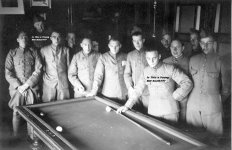
Hi Everyone; This is an article that was written about the finest man I've ever had the extreme pleasure to call my BEST friend. His name was Ernie Presto, not only my friend but my mentor of 3 cushion billiards in my early years.
The article appeared in the 1992 Billiards Digest June issue of George Fels column,"Tips and Shafts". The article was entitled, "The Encyclopedia". Named so, for the unforgetable memory that Erine had to recall any event in 3 cushion billiards, or other sports for that matter.
TIPS & SHAFTS
by George Fels
The Encyclopedia
HE WAS MUCH like the bubbling vat in the "The Sorcerer's Apprentice" of Disney's famed Fantasia: ask Ernie Presto anything about billiards — anything — and he was impossible to turn off. Systems or stories, playing or players, Ernie would immediately immerse himself so deeply as to get
lost and take you right with him, engrossed in his swirling molten lava
of love.
What else could possibly motivate him to make it a point of taking on
every single national champion over 60 years? To offer open access to that encyclopedic knowledge to everyone from intimates to virtual strangers? To turn his entire life over to a game which could repay him only
spiritually?
(And at that, his bottomless love was wretchedly repaid once, in the
form of the only cue-games playing injury I ever heard of. Players keel over
at the table now and then, and that's sad enough, but how often does
anybody get hurt due to mere playing dynamics? Decades ago, when cue
shafts inlaid from the ferrule down were authentic status symbols, Ernie
addressed a shot with his ball on the end cushion. His delivery somehow
failed to clear the rail; the expensive inlays exploded upon impact, and Ernie's follow-through drove the splintered shaft deeply into the back
of his bridge hand, through not just flesh but delicate muscles and nerves.
The result was permanent palsy in that hand — yet he was back at the tables even bef ore the cast came off, his game only somewhat impaired, his spirit damaged not in the least.)
Ernie did not trust everything to his warehouse-sized memory, although he
demonstrated often enough that he almost certainly could have. Instead he logged the results of every single game — exhibitions, tournaments, pastime — by opponent and score; if pressed, he most likely would have been able to call out the highlights too. No doubt his proudest single endeavor was a two-hole loss to Willie Hoppe, but with typical modesty, he preferred to broadcast that he was 0-24 lifetime versus that immortal. He considered it a deep honor and privilege to come to the table with champions of his beloved game; outcome and actual score were puny trivia by comparison.
Included in his memorabilia is a receipt of payment for 20 lessons from
another legend, Jake Schaefer, Jr. (for the eyebrow-liaising price of $100, this back in 1945), and Ernie Presto no doubt studied less formally with other greats. Besides Schaefer, Welker Cochran and Augie Kieckhefer were
Chicago habituees at one time or another, and besides there was that
ongoing parade of other U.S. champions from whom to glean. What Ernie
brought to their parties, in addition to his endless devotion and
in-' satiable quest for knowledge, was his profession of civil engineer, which couldn t have hurt his mastery of angles in the slightest.
Ernie Presto helped construct some of America's more famous highways, notably the Al-Can in Alaska, when he wasn't making inroads into billiards.
As Ernie aged, the times rose up here and there to test his love. First
there was the downward spiral of his beloved Bensinger's; when that room
left Chicago's downtown district, it permanently relinquished any claim it
had on majesty. The noble hall that once reserved an entire separate floor
for billiards relocated on the north side of the city with eight or nine tables intact out of what had once been thirtyplus. That wasn't bad; good players were still reasonably abundant, and tournament play, at both city and regional levels, survived too. But billiards and pool were no longer sectioned off from one another, thus Ernie had to endure the gradual infestation of tough young kids, drunks, and slobs. When Bensinger's finally folded its dirty tent in the mid-70s, Ernie and the other diehards migrated northwest to an unpretentious room with six slow carom tables. Those tables played longer than Ernie's Al-Can Highway, but the players' loyalty was astounding: the same men in place at the same time, seven days a week. You literally couldn't get a table, and until a falling-out with management, it appeared Ernie Presto had his sneakpreview of heaven.
If there ever breathed a woman who had the potential to compete for that
kind of love, Ernie never found her. He had many siblings, he had his work, and he had his game; that was plenty. The only element he lacked for
total fulfillment was a student to whom he could truly pass the torch;
and he even found that, in his last decade-plus, in Chicago's volatile Bill
Smith. The young man was working on his own system of categorizing
shots according to spin', speed, and stroke selection, and at last Ernie had
found a rich concerto of ability and ambition to which his own voluminous
knowledge could play a valid counterpoint. For his part, Smith played a
dual role as brilliant protege (he went on from that cosmic lift-off to set most of the American Billiard Association's playing records) and a surrogate for the son the elder man never had, wept unashamedly at his mentor's passing, and delivered a dazzling eulogy that did both men honor.
A few years before he died, Ernie Presto was interviewed by a local hack
(a term I surely hate to use for a writing colleague, but the young woman earned it in spades) who could find no better story angle than to portray
him and his friends thoroughly falsely as petty, bickering, back-biting old codgers. One nice old guy got a look at himself in print and promptly had a stroke and died; Ernie suffered only slightly less, mostly ostracized by his peers, often sitting alone in his new haunts, an empty-by-day room, his
siblings long gone, no one to compete with or, perhaps even better, relate
stories to. I had the privilege of the man's acquaintance for the better part of 40 years, yet never once asked him to play; I tend toward a purist view of things, and it seemed to me his love for the game deserved my respect, not my intrusion.
They were shaking their heads and saying "It's a matter of days," for
months before a diabetic coma finally took him; he had long since proved
that no mortal force was going to set him down. It might have been serendipity, but Ernie Presto was aptly named. There was indeed something about the man that was earnest and magical at the same time.
84 Billiards Digest • June 1992
HE is surely missed in my life.
Bill Smith "Mr3Cushion"
The article appeared in the 1992 Billiards Digest June issue of George Fels column,"Tips and Shafts". The article was entitled, "The Encyclopedia". Named so, for the unforgetable memory that Erine had to recall any event in 3 cushion billiards, or other sports for that matter.
TIPS & SHAFTS
by George Fels
The Encyclopedia
HE WAS MUCH like the bubbling vat in the "The Sorcerer's Apprentice" of Disney's famed Fantasia: ask Ernie Presto anything about billiards — anything — and he was impossible to turn off. Systems or stories, playing or players, Ernie would immediately immerse himself so deeply as to get
lost and take you right with him, engrossed in his swirling molten lava
of love.
What else could possibly motivate him to make it a point of taking on
every single national champion over 60 years? To offer open access to that encyclopedic knowledge to everyone from intimates to virtual strangers? To turn his entire life over to a game which could repay him only
spiritually?
(And at that, his bottomless love was wretchedly repaid once, in the
form of the only cue-games playing injury I ever heard of. Players keel over
at the table now and then, and that's sad enough, but how often does
anybody get hurt due to mere playing dynamics? Decades ago, when cue
shafts inlaid from the ferrule down were authentic status symbols, Ernie
addressed a shot with his ball on the end cushion. His delivery somehow
failed to clear the rail; the expensive inlays exploded upon impact, and Ernie's follow-through drove the splintered shaft deeply into the back
of his bridge hand, through not just flesh but delicate muscles and nerves.
The result was permanent palsy in that hand — yet he was back at the tables even bef ore the cast came off, his game only somewhat impaired, his spirit damaged not in the least.)
Ernie did not trust everything to his warehouse-sized memory, although he
demonstrated often enough that he almost certainly could have. Instead he logged the results of every single game — exhibitions, tournaments, pastime — by opponent and score; if pressed, he most likely would have been able to call out the highlights too. No doubt his proudest single endeavor was a two-hole loss to Willie Hoppe, but with typical modesty, he preferred to broadcast that he was 0-24 lifetime versus that immortal. He considered it a deep honor and privilege to come to the table with champions of his beloved game; outcome and actual score were puny trivia by comparison.
Included in his memorabilia is a receipt of payment for 20 lessons from
another legend, Jake Schaefer, Jr. (for the eyebrow-liaising price of $100, this back in 1945), and Ernie Presto no doubt studied less formally with other greats. Besides Schaefer, Welker Cochran and Augie Kieckhefer were
Chicago habituees at one time or another, and besides there was that
ongoing parade of other U.S. champions from whom to glean. What Ernie
brought to their parties, in addition to his endless devotion and
in-' satiable quest for knowledge, was his profession of civil engineer, which couldn t have hurt his mastery of angles in the slightest.
Ernie Presto helped construct some of America's more famous highways, notably the Al-Can in Alaska, when he wasn't making inroads into billiards.
As Ernie aged, the times rose up here and there to test his love. First
there was the downward spiral of his beloved Bensinger's; when that room
left Chicago's downtown district, it permanently relinquished any claim it
had on majesty. The noble hall that once reserved an entire separate floor
for billiards relocated on the north side of the city with eight or nine tables intact out of what had once been thirtyplus. That wasn't bad; good players were still reasonably abundant, and tournament play, at both city and regional levels, survived too. But billiards and pool were no longer sectioned off from one another, thus Ernie had to endure the gradual infestation of tough young kids, drunks, and slobs. When Bensinger's finally folded its dirty tent in the mid-70s, Ernie and the other diehards migrated northwest to an unpretentious room with six slow carom tables. Those tables played longer than Ernie's Al-Can Highway, but the players' loyalty was astounding: the same men in place at the same time, seven days a week. You literally couldn't get a table, and until a falling-out with management, it appeared Ernie Presto had his sneakpreview of heaven.
If there ever breathed a woman who had the potential to compete for that
kind of love, Ernie never found her. He had many siblings, he had his work, and he had his game; that was plenty. The only element he lacked for
total fulfillment was a student to whom he could truly pass the torch;
and he even found that, in his last decade-plus, in Chicago's volatile Bill
Smith. The young man was working on his own system of categorizing
shots according to spin', speed, and stroke selection, and at last Ernie had
found a rich concerto of ability and ambition to which his own voluminous
knowledge could play a valid counterpoint. For his part, Smith played a
dual role as brilliant protege (he went on from that cosmic lift-off to set most of the American Billiard Association's playing records) and a surrogate for the son the elder man never had, wept unashamedly at his mentor's passing, and delivered a dazzling eulogy that did both men honor.
A few years before he died, Ernie Presto was interviewed by a local hack
(a term I surely hate to use for a writing colleague, but the young woman earned it in spades) who could find no better story angle than to portray
him and his friends thoroughly falsely as petty, bickering, back-biting old codgers. One nice old guy got a look at himself in print and promptly had a stroke and died; Ernie suffered only slightly less, mostly ostracized by his peers, often sitting alone in his new haunts, an empty-by-day room, his
siblings long gone, no one to compete with or, perhaps even better, relate
stories to. I had the privilege of the man's acquaintance for the better part of 40 years, yet never once asked him to play; I tend toward a purist view of things, and it seemed to me his love for the game deserved my respect, not my intrusion.
They were shaking their heads and saying "It's a matter of days," for
months before a diabetic coma finally took him; he had long since proved
that no mortal force was going to set him down. It might have been serendipity, but Ernie Presto was aptly named. There was indeed something about the man that was earnest and magical at the same time.
84 Billiards Digest • June 1992
HE is surely missed in my life.
Bill Smith "Mr3Cushion"
Last edited: