The Problem With Shane's 3 Fouls Against Alex

Is the player after a foul allowed to make make balls or does that wipe out the foul


1

Not sure I understand your question, but I'll try to answer.

With a standard (1-point penalty) foul, play passes to the opponent. The player who fouled is "on one foul." When that player returns to the table for his next inning (regardless of what the opponent has just done), if his first shot is legal he is no longer on a foul. If he fouls again on that first shot, he is then "on two fouls." If he fouls again on the first shot of his next inning, the serious-foul rule (three consecutive fouls) kicks in and he loses an additional 15 points (total of 18 for the three fouls) and he has to break a full rack of balls under the opening-break requirements.
 
As nine o nine said, it is a total of 18.

From the WPA (world-standardized) rules: "A point is subtracted for the third foul as usual, and then the additional fifteen-point penalty is subtracted and the offending player’s consecutive foul count is reset to zero."

Yes, as I have always understood it a penalty of a total of 18 points are lost. One for each foul ( 3 points total ), then a 15 ball penalty on the third consecutive foul ( totaling 18 points. As to the rest of it; call it shifty, cheating, or whatever yall may want to, but I DO CONSIDER it my opponents responsibility to inform me ( as per the rules ) when I am in fact on 2 fouls ( 14.1, one pocket, or 9 ball ) AND it is their responsibility to deduct the additional 15 points ( 14.1 ) and with one pocket or 9 ball if my opponent does not call it , we'll sorry but your luck - they should have taken the game more seriously and paid better attention and called me out and taken the game. This had been a debate on here as long as I've been here and I am Def on the side that the responsibility lies with the opponent. I DO NOT IN ANY WAY SEE MYSELF AS " A CHEATER " for not doing what clearly is my opponents responsibility ( which is clearly defined in EVERY set of rules anyone has ever read ), and I WILL continue the game, run out, and take the trophy ( actually way more likely the CHICKEN and I will sleep just fine - EVERY TIME!!!! For those of you that disagree, and ( are holier than thou ) well once again sorry bout your luck and YOU SHOULD PAY BETTER ATTENTION ! LOLOLOL. Truth be told; for me personally, this has only came up a handful of times my entire pool playing career. On the few times it has, usually opponent remembers at the end of the game or at least a few innings later. On each and every occasion once they ( my opponent ) brought it up, I reminded them of the actual rules and they said something to the effect of " that's F'd up bro........ but your right - your game bro..... " and that was the end of it and play continued. The end.
 
Last edited:
Not sure I understand your question, but I'll try to answer.

With a standard (1-point penalty) foul, play passes to the opponent. The player who fouled is "on one foul." When that player returns to the table for his next inning (regardless of what the opponent has just done), if his first shot is legal he is no longer on a foul. If he fouls again on that first shot, he is then "on two fouls." If he fouls again on the first shot of his next inning, the serious-foul rule (three consecutive fouls) kicks in and he loses an additional 15 points (total of 18 for the three fouls) and he has to break a full rack of balls under the opening-break requirements.

Actually, there's a little more to the 15 point penalty. The penalty is either 10% of the game score or 15 points, which ever the greater is meaning if they were playing to 200 points....the penalty would be 20 points plus 3 foul points for a total of -23;)
 
Actually, there's a little more to the 15 point penalty. The penalty is either 10% of the game score or 15 points, which ever the greater is meaning if they were playing to 200 points....the penalty would be 20 points plus 3 foul points for a total of -23;)

I don't think I've ever heard of this. Can you provide a link for this rule? I've only ever read it's 15 points.

Thanks.
 
Actually, there's a little more to the 15 point penalty. The penalty is either 10% of the game score or 15 points, which ever the greater is meaning if they were playing to 200 points....the penalty would be 20 points plus 3 foul points for a total of -23;)

There may be leagues or tournaments out there that use
this rule, but it is most certainly not in the WPA rule book.

gr. Dave
 
Actually, there's a little more to the 15 point penalty. The penalty is either 10% of the game score or 15 points, which ever the greater is meaning if they were playing to 200 points....the penalty would be 20 points plus 3 foul points for a total of -23;)

It used to be that way, Glen, but not any more (unless it has remained in effect under some set of rules unknown to me).

Under current WPA (world-standardized) rules, in effect for many years now, the additional three-consecutive-fouls penalty is 15 points regardless of the number of points required to win the game.

[I think the old way makes sense!]
 
It used to be that way, Glen, but not any more (unless it has remained in effect under some set of rules unknown to me).

Under current WPA (world-standardized) rules, in effect for many years now, the additional three-consecutive-fouls penalty is 15 points regardless of the number of points required to win the game.

[I think the old way makes sense!]

Yeah, I knew everyone quit going by the rules and changed them a while back, but nevertheless, the rule did exist.
 
I'm not familiar with the 10% rule either...I've neither gotten to 200 nor ever played for 200. For me it's moot RKC. I'm lucky to get to 50. Mitch
 
Actually, there's a little more to the 15 point penalty. The penalty is either 10% of the game score or 15 points, which ever the greater is meaning if they were playing to 200 points....the penalty would be 20 points plus 3 foul points for a total of -23;)

It used to be that way, Glen, but not any more (unless it has remained in effect under some set of rules unknown to me).

Under current WPA (world-standardized) rules, in effect for many years now, the additional three-consecutive-fouls penalty is 15 points regardless of the number of points required to win the game.

[I think the old way makes sense!]

I'm not familiar with the 10% rule either...I've neither gotten to 200 nor ever played for 200. For me it's moot RKC. I'm lucky to get to 50. Mitch

I'm not so sure that 10% rule was universal...some of the oldtimers played matches to 1.000....if someone had a 118 foul, I think I would've heard about it.
 
A little history

Three foul penalties at 14.1 continuous:

1913-1918 -- the rule was that all the points (balls) remaining on the table would be awarded to the non-fouler and the balls would be racked with the non-fouler breaking.

1921 -- official 14.1 tournament rules changed to a penalty of 15 but the non-fouler was still shooting at a full rack with no two-ball requirement:
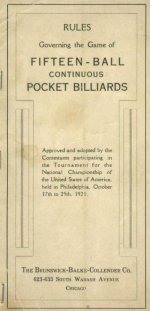
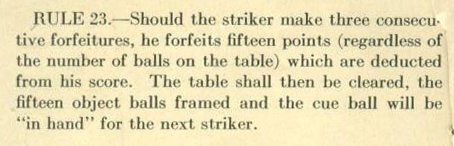
14.one rules 001.jpg

14.one rules 002.jpg

1925-1935 (BBCCo "Royal Game" rule book) -- the rule remained as in 1921 with 15 points and the non-fouler shooting at a full rack but with no two-ball requirement.

1937-1942 (BBCCo "Royal Game" rule book, edited without notice) -- the 3-foul clause (part of Rule 23) was removed entirely, so presumably there was no extra penalty for three consecutive fouls.

1945 BAA (to become the BCA) rule book -- the modern form of the rule first appeared with a 15 point penalty and a forced re-break by the fouler

1974 -- the 1945 rule continues

1977 -- the rule is changed to non-fouler's option: 25 points and a rebreak or take ball in hand anywhere on the table.
(This change can only be described as temporary insanity.)
1978 -- continues

1980 -- back to the 1945 rule: 15 points and a forced rebreak

1982 -- the rule is changed to 20% of the length of the game and a rebreak with an option to take ball in hand (anywhere on the table? -- not specified) instead of the point penalty

1993 -- the rule is changed back to the 1945-1974 rule of 15 points and a forced rebreak
1999 -- as in 1993
2000 -- the non-breaker is given the option of accepting the balls in position rather than have a rebreak. I am listed as being on the Rules Committee at the time, but I do not remember accepting any such rule change.
2006 -- the in-position option continues
2008 -- the major WPA rewrite deletes the "in position" option for the incoming player. A 15-point penalty with a rebreak is required as was the case from 1945-1974, 1980, and from 1993-1999.

 
Last edited:
Three foul penalties at 14.1 continuous: ...

Thanks for doing that, Bob. Looks like you are a collector of rule books! So the %-of-game-length penalty was in effect only from 1982-1993, and it was 20%. I thought I remembered it being 10% at some point, but apparently not.

Do you like the current rule, or would you prefer something different?
 
Last edited:
Thanks for doing that, Bob. Looks like you are a rules-book collector! So the %-of-game-length penalty was in effect only from 1982-1993, and it was 20%. I thought I remembered it being 10% at some point, but apparently not.

Do you like the current rule, or would you prefer something different?

I think the present rule is fine. It is the rule I saw the top players of the 1970s/1980s play under and it is the rule I learned from the first BCA rule book I read (which was probably 1963 or 1965).
 
In the old days, when straight pool was played in suits, tuxedos, and hotel ballrooms, the first thing a competitor would do when he got in a predicament was look at the scoreboard to see whether his opponent was on a foul. That movement of the head was inevitable.
 
Of course all rules must be followed. I have been gambling at pool ( and about everything else ) since I was 11 and I will be 70 in a month and still doing it. One of the first lessons
a player must learn and abide by it the rest of his life is that he is responsible to protect
himself regardless even if the rules in some situations protect him. Once you develop this
habit it becomes second nature to always keep your mind in the game and you'll know exactly where you stand at all times. Nobody will protect your interests at the table like you
will. There are many ways to get screwed if you're not paying attention. And it doesn't
cost anything.
 
If I had a vote, I'd go for the 10% in the next revision. I think it particularly makes sense in lower level leagues where they play shorter games. I've played in a handicapped partners league where the team receiving the handicap only played to 30. That would make the three fouls way too punitive.
 
Back
Top