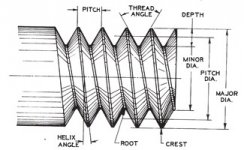
Thread sizes

KRJ

Support UKRAINE
Silver Member
I have a Willie Hoppe Pro that was refinished by "local" cue maker, over an hour drive each way for me. He put his joint on it as well. Came out great.

But, now i"m trying to replace a shaft, and I can't figure out what size the new shaft needs to be drilled out with? Another local cue maker ( few miles away) did not have the "tap" to fit this size? He had about every other size in the world but this one, so must be an "off" size.

Ask the original cue maker several times and i'm told it's a modified 3/8-10 pin ?? Ok, modified how much, etc ??

Finally, I said I've tried everything and nothing is working. He then says standard 3/8-10 is fine ?? What, I thought it was modified. But it matters not, because standard is not fine, and it won't work.

So, then he says he uses a standard and drills 5/16, and others might only drill 19/64 ??

What the heck does this mean? I'm willing to buy the tap that is right and GIVE it to my local cue maker so he has it when I need it down the road, but I don't know what to order or tell him how to make a new shaft (OB partial) fit ?

Thoughts ? CAn anyone make heads or tails of this ??
 
I have a Willie Hoppe Pro that was refinished by "local" cue maker, over an hour drive each way for me. He put his joint on it as well. Came out great.

But, now i"m trying to replace a shaft, and I can't figure out what size the new shaft needs to be drilled out with? Another local cue maker ( few miles away) did not have the "tap" to fit this size? He had about every other size in the world but this one, so must be an "off" size.

Ask the original cue maker several times and i'm told it's a modified 3/8-10 pin ?? Ok, modified how much, etc ??

Finally, I said I've tried everything and nothing is working. He then says standard 3/8-10 is fine ?? What, I thought it was modified. But it matters not, because standard is not fine, and it won't work.

So, then he says he uses a standard and drills 5/16, and others might only drill 19/64 ??


What the heck does this mean? I'm willing to buy the tap that is right and GIVE it to my local cue maker so he has it when I need it down the road, but I don't know what to order or tell him how to make a new shaft (OB partial) fit ?

Thoughts ? CAn anyone make heads or tails of this ??
What the maker is saying is that he uses a standard pitch. The pitch of the threads is 10 threads per inch. The part he is describing as being 5/16" is the root diameter of the thread. This size changes depending on the how the pin was made. So basically the hole size you drill before you run your tap in is 5/16" of an inch. The "modified " is just a term they use to describe that style of pin.
 
3/8 10 modified pin will may fit (tight ) wood joint 3/8 10 shaft. But not a Phenolic as with predator shaft as it will not give. As the previous posted stated.
Major = threads per inch are the same
Minor = larger diameter in the modified pin....think like they don't cut the threads as deep into the stock metal rod..

So a 3/8-10 modified shaft will fit a standard 3/8 -10 pin.
 
Last edited:
Here's a nice explanation.

From the article

Regarding questions about the backwards compatibility - when I used the std 3/8-10 pin, I bored my shafts to .302" diameter before running a tap into it. This was a smaller hole than most used. I liked it because the pin had a tighter fit. Again, there's that intimacy I like. The problem arises because the modified pin has a .308" minor diameter & will not fit into an older shaft unless the .302" diameter is enlarged to .308". It takes about 2 minutes to set it up & run a reamer into the existing hole.

http://www.dzcues.com/modified_pin.html
 
Last edited:
so, if my local guys drills it out at 5/16 before he "taps" it with a standard 3/8 -10, I'm good to go ??
 
so, if my local guys drills it out at 5/16 before he "taps" it with a standard 3/8 -10, I'm good to go ??

the modified pin has a .308" minor diameter

5/16 is .3125. That's more than what you need.

With a new shaft tell him to bore it to .308.
 
In my experience, drilling a 5/16" hole before tapping will work on pretty much any 3/8-10 pin.
 
3/8 10 modified pin will may fit (tight ) wood joint 3/8 10 shaft. But not a Phenolic as with predator shaft as it will not give. As the previous posted stated.
Major = threads per inch are the same
Minor = larger diameter in the modified pin....think like they don't cut the threads as deep into the stock metal rod..

So a 3/8-10 modified shaft will fit a standard 3/8 -10 pin.
================================================

How many corrections are needed here?

1) A 3/8" modified pin will NOT fit a regular threaded 3/8" hole.

2) Major = the outside diameter of the threads, in this case, it's 3/8" or .375".

3) Minor = the thinnest part of the threaded area, it's .302" or .308" on the Flat Faced pins, on the regular V formed threads it's around .270" or so.

The minor diameter is the most important, its the size you want to bore after drilling, for some, it's the drill size, whatever.

A Standard 3/8" x 10 Pin WILL fit into the flat faced 3/8" Pin Shaft set up. Will fit does not mean it's right.

A Flat faced Pin will NOT fit into a regular 3/8" Pin Shaft set up because it's minor was drilled the same size as the bottom of the V in your threads. Look at the two pins side by side and within 2 seconds, it will make sense.
 
In my experience, drilling a 5/16" hole before tapping will work on pretty much any 3/8-10 pin.


Will work? If you say so but if you're drilling that large and using the standard 3/8" pins, you are leaving a large void in the threaded area. That standard pin needs a much smaller hole. V form threads need to be drilled or bored closer to the Minor diameter and the Minor is very different on the Flat faced pins vs the V form threads.

Take care, Dave.
 
================================================

How many corrections are needed here?

1) A 3/8" modified pin will NOT fit a regular threaded 3/8" hole.

2) Major = the outside diameter of the threads, in this case, it's 3/8" or .375".

3) Minor = the thinnest part of the threaded area, it's .302" or .308" on the Flat Faced pins, on the regular V formed threads it's around .270" or so.

The minor diameter is the most important, its the size you want to bore after drilling, for some, it's the drill size, whatever.

A Standard 3/8" x 10 Pin WILL fit into the flat faced 3/8" Pin Shaft set up. Will fit does not mean it's right.

A Flat faced Pin will NOT fit into a regular 3/8" Pin Shaft set up because it's minor was drilled the same size as the bottom of the V in your threads. Look at the two pins side by side and within 2 seconds, it will make sense.


Tap tap. Very good points. The minor will vary depending on where the screws were purchased.
Ex.
I buy from Jan. Mfg. The minor is .281. I had 2 taps made according to that spec. 1 for wood and 1 for phenolic. I once bought these screws from Atlas. They have a smaller minor but spinning the screw. I didn't like the way it spun. I also bought some from Schmelke. David had his made with a larger minor to make up for the slop because the standard tap really shouldn't be the standard tap. Next, Tom redesigned his to work with the standard tap offered. Last, would be what Thomas Wayne offers or offered. I don't know if he has changed over the years. His is also different. This is why the question should be asked.
The most popular 3/8x10 used is really McDermott so I chose Jan mfg because they are the closest to what McDermott offers.
 
Hope the OP finds what he needs seems to be the point of his post.
Not a CUE MAKER sorry.
Tried to keep it simple for someone that appeared to be looking
for a simple answer.

Modified ???
Seems mainly it is the minor is a larger diameter. Yes?

As Mike pointed out different modifications out there.
As well as the way the shaft is tapped.

Good luck
 

Attachments

  • IMG_0167.JPG
    IMG_0167.JPG
    32.3 KB · Views: 322
Last edited:
Not a cue maker either but know a little about machine work... In metal work (don't know why wood would be different) you subtract the pitch from the major diameter to find the drill size... easiest way to show is if you look at a machine bolt chart a 3/8" 16TPI bolt you use 3/8 - 1/16=5/16 (this is for a 70% thread fill). So you use a 5/16" drill. If something is an odd size just measure with caliper and subtract the pitch. (threads are 60degrees on each angle so it is inclusive to the minor dia).
 
Will work? If you say so but if you're drilling that large and using the standard 3/8" pins, you are leaving a large void in the threaded area. That standard pin needs a much smaller hole. V form threads need to be drilled or bored closer to the Minor diameter and the Minor is very different on the Flat faced pins vs the V form threads.

Take care, Dave.


Been using that joint since 2000, beginning with standard v-thread. I can't say I have noticed any issues, nor has anybody with one of my cues ever mentioned issues related to shaft threads. I didn't post so we could debate what ifs & theory. I posted info that would exactly help the OP's local builder, which is what he asked for. And I stand by it 100%.
 
I am still questioning why you would have to instruct the cue maker on what size to make the hole. Are you ordering a shaft and the maker is building it with out access to the butt of the cue? If it were me fitting the shaft I would simply measure the root diameter of the pin and machine the bore of the threaded hole accordingly. If I was nervous I would machine up a mock joint from some scrap maple. The way I have found to be the most accurate is to drill the tap drill size slightly under of the root diameter of the pin. tap my hole then using a boring bar, bore out a few .001" at a time until I get the fit I am looking for. If the size of pins root is a nominal size then you can also run a reamer in after tapping your hole. I build my pins with a 0.297" minor so I can use a 19/64 reamer to fit the pin.
 
I am still questioning why you would have to instruct the cue maker on what size to make the hole. Are you ordering a shaft and the maker is building it with out access to the butt of the cue? If it were me fitting the shaft I would simply measure the root diameter of the pin and machine the bore of the threaded hole accordingly. If I was nervous I would machine up a mock joint from some scrap maple. The way I have found to be the most accurate is to drill the tap drill size slightly under of the root diameter of the pin. tap my hole then using a boring bar, bore out a few .001" at a time until I get the fit I am looking for. If the size of pins root is a nominal size then you can also run a reamer in after tapping your hole. I build my pins with a 0.297" minor so I can use a 19/64 reamer to fit the pin.

What's the best way to measure the root diameter of a thread?
 
What's the best way to measure the root diameter of a thread?

Either a shadow graph, or a set of triangular blocks (for 60 deg included thread angles) that sit in the thread like thread wires, but will measure the root of the thread. These are very old school now. They used to also have them in 55 deg and 47.5 deg as well. These were called thread triangle sets. They came like thread wire sets, so there were single triangles, double triangle sets and triple triangle sets. The easiest to use I found is the triple wire or the triple triangles. It looks like the basic double triangles are still available from SPI, not sure if the PeeDee ones are still available. Both of these are essentially the same. Not sure of the brand of the smaller ones I used to use many years agao. We just used O ring grease to hold them in place during the measurement.
Neil
 
Back
Top