Tip Hardness ~ explanation request

stevekur1

The "COMMISH"
Silver Member
Hey Guys,

for quite some time i have been using a Super Soft tip, but recently i tried a cue that had a medium hardness tip on it and i noticed that shots with alot of English i was pocketting better and moving the CB with greater ease. The shaft i had used i had put on my Playing Cue to get a better feel for it.

I am thinking over changing over to a Medium Tip, and was curious if tip hardness has any effect on Deflection.

Thanks In Advance !!

-Steve
 
Last edited:
Hey Guys,

for quite some time i have been using a Super Soft tip, but recently i tried a cue that had a medium hardness tip on it and i noticed that shots with alot of English i was making and moving the CB with greater ease.

I am thinking over changing over to a Medium Tip, and was curious if tip hardness has any effect on Deflection.

Thanks In Advance !!

-Steve

Steve,

I am sorry that I cannot offer more advice on your specific question regarding deflection. I would like to offer that over time I have gradually move to a tip that is increasingly hard. I started with a Le Pro, moved to a Triangle, and now I play with a Black King layered medium (which is pretty hard). I find it easier to draw the cue ball with a harder tip. That is to say, I don't think you are the only one that finds certain things easier with a harder tip.

I think Black King makes a great tip. Give'em a try if you are looking into something new.

kollegedave
 
Idk how much a tip would really effect deflection. A softer tip compresses more which may influence slighty but normally deflection changes due to the shaft/cue you are using. You have to take in consideration that you changed your whole setup when you tried the med/hard tip. Maybe the cue you tried just fits you style of play better. Im interested in what other people say. Well see.
 
It all depends on how well the tip holds chalk.
Chalk creates friction between the cue ball and tip.

I'm sure if a soft tip and a hard tip held chalk equally the same, there would be a noticeable difference, but most hard tips are tips are made poorly and don't hold chalk well.
 
Hey Guys,

for quite some time i have been using a Super Soft tip, but recently i tried a cue that had a medium hardness tip on it and i noticed that shots with alot of English i was pocketting better and moving the CB with greater ease. The shaft i had used i had put on my Playing Cue to get a better feel for it.

I am thinking over changing over to a Medium Tip, and was curious if tip hardness has any effect on Deflection.

Thanks In Advance !!

-Steve

Were the shafts the same with the only difference being the tip? If different shafts, there is why, you may want to look what brand of shaft it is you play better with.
 
Tip info

On Meucci's site there is a video with Bob explaining how tip hardness(or lack thereof) affects deflection. In a nutshell he says that soft tips cause more deflection and is the reason he recommends med. to firm tips. Worth watching.
 
cue tip hardness has minimal effect on deflection or the amount of spin you can generate
it all has to do with end mass (for the most part)and where you hit the cue ball
 

Attachments

  • Tip:Squirt Comparison .jpg
    Tip:Squirt Comparison .jpg
    33.5 KB · Views: 712
If there is a difference, then hence, there is a difference.

The video posted above said it fairly well in those few words. It's about the spin you get for the speed of travel & there is a difference.

Also, keep in mind that in most cases one is not talking about the total amount of actual deflection but instead one is concerned with the net amount.

If not hit too hard & not exactly on the equator of the ball, the swerve from the spin one gets from the off center hit that causes the deflection or squirt can reduce or negate the net effect of the squirt & the ball can even be sent to the other side of the line. I have a juiced, sanded down Predator 314 CAT shaft with a soft tip that I am actually afraid to use on long shots that I want to use some significant english because the ball will cross over much of the time. For 1/2 to maybe 3/4 of a table it's great, but given that extra distance it's scary.

It's about the spin to speed of shot ratio & for ALL things being equal the soft tip puts more spin to less speed than a hard tip.

Can a hard tip put as much spin on the ball as a soft tip? Yes...but it will then also put more speed on the ball.

At least those are my opinions based on my 47 years of playing with english & my 3 years of physics education.

Best 2 All,
Rick

Edit: Most of that means nothing to many & one should use what ever tip with which one is comfortable & suites one's style of play.
 
Last edited:
... was curious if tip hardness has any effect on Deflection.
All important effects related to tip hardness are summarized and backed up by supporting evidence on the cue tip hardness resource page.

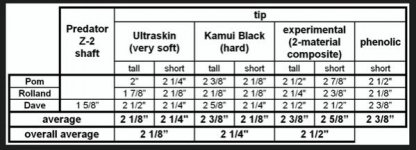
Tip hardness (for a wide range of typical cue tips) has no practical effect on the amount of squirt (cue ball deflection) a shaft causes. For more info (and experimental proof), see what causes squirt and NV D.15 - Cue and Tip Testing for Cue Ball Deflection (Squirt)

Enjoy,
Dave
 
It's about the spin to speed of shot ratio & for ALL things being equal the soft tip puts more spin to less speed than a hard tip.

Can a hard tip put as much spin on the ball as a soft tip? Yes...but it will then also put more speed on the ball.
Rick,

Practically speaking, the spin/speed ratio depends only on the tip contact point, not the tip hardness. For a given cue speed, a hard tip will typically impart more speed (and correspondingly more spin) than a soft tip, but the spin/speed ratio will be the same for both (if the tip contact point is the same). For equal CB speeds (i.e., for a given shot at the table, with given position requirements), the spin will be the same, regardless of the tip.

Further explanation and justification for these statements can be found in the paragraph beneath the bullets, and in the quotes from Mike Page and Bob Jewett, on the cue tip hardness resource page.

Regards,
Dave
 
Last edited:
Rick,

Practically speaking, the spin/speed ratio depends only on the tip contact point, not the tip hardness. For a given cue speed, a hard tip will typically impart more speed (and correspondingly more spin) than a soft tip, but the spin/speed ratio will be the same for both (if the tip contact point is the same). For equal CB speeds (i.e., for a given shot at the table, with given position requirements), the spin will be the same, regardless of the tip.

Further explanation and justification for these statements can be found in the paragraph beneath the bullets, and in the quotes from Mike Page and Bob Jewett, on the cue tip hardness resource page.

Regards,
Dave

Hi Dave,

I deleted a long reply as it would serve no good purpose.

Perhaps my statements should have been in reference to chalk impregnated soft tips only & at amounts nearing the miscue limits.

For instance, IMO for a soft shot one can get more spin with less speed using a soft chalk impregnated tip vs a hard non chalk impregnated tip.

Your tests & conclusions assume the same contact point with the same angle of cue tip approach. I was not speaking from those restrictive parameters

My statements were meant from a playing perspective of executing a shot. IMO the same cue with that chalk impregnated soft tip can be used to do things that that same cue with a hard non chalk impregnated tip simply can not do equally as well with the exact same results.

It's sort of like in golf when one has 'identical' wedges but one has 12* of sole bounce & the other has 3* of sole bounce. I know that is not an exact analogy, but some will understand what I mean.

My apologies for not clarifying that I was NOT speaking from the reference of 'scientific' testing.

In other words, we're not speaking of the exact same things.

Regards,
Rick

PS I think Hu has some additional parameters that come into play & one day when tested may explain some things better than we are capable at this time. Bob Meucci is using a long more flexible ferrule. There is 'wrap' & and different departure points I think.
 
Last edited:
Perhaps my statements should have been in reference to tip impregnated soft tips only & at amounts nearing the miscue limits.

For instance, IMO for a soft shot one can get more spin with less speed using a soft chalk impregnated tip vs a hard non chalk impregnated tip.
I agree 100%. A soft tip that holds chalk well will have a greater miscue limit (allowing for a larger amount of sidepsin) than a hard tip not holding chalk well. Having said that, a hard tip with chalk applied properly will have a very similar miscue limit (and same spin-generating capability) as a soft tip.

Sorry, but I must have misunderstood or misinterpreted your quoted post below. Regardless, we are in agreement in the matter above (I think).

Regards,
Dave

It's about the spin to speed of shot ratio & for ALL things being equal the soft tip puts more spin to less speed than a hard tip.

Can a hard tip put as much spin on the ball as a soft tip? Yes...but it will then also put more speed on the ball.
 
It all depends on how well the tip holds chalk.
Chalk creates friction between the cue ball and tip.

I'm sure if a soft tip and a hard tip held chalk equally the same, there would be a noticeable difference, but most hard tips are tips are made poorly and don't hold chalk well.

My new cue has a hard tip and I don't like it. I can run thrown randomly 15 balls on the table and run em 3 of 5 times. The tip glazes so every other outing requires a little picking to hold chalk. No problem, I just don't like the feel. If I use a house cue same weight it feels fine. Maybe it's a ferrule thing but I'm going Medium first.
 
I agree 100%. A soft tip that holds chalk well will have a greater miscue limit (allowing for a larger amount of sidepsin) than a hard tip not holding chalk well. Having said that, a hard tip with chalk applied properly will have a very similar miscue limit (and same spin-generating capability) as a soft tip.

Sorry, but I must have misunderstood or misinterpreted your quoted post below. Regardless, we are in agreement in the matter above (I think).

Regards,
Dave

Dave,

I think you know how difficult it can be at times putting some of this into the proper words & phrases with the qualifications that at times are necessary.

Believe me I see even you at times saying something that I understand because of other understanding but I question how others without that other understanding might take it.

There is very much going on for certain pool shots. I try to never think about any of it when playing. It's a much more simple cue this way, get that, kind of mindset.

Regards,
Rick

PS As to us agreeing, I always seem to see significance in the small differences that you tend to frame as insignificant. To me the word nearly is huge when it comes to playing pool. But yes we can agree on the words nearly & similar.
 
If there is a difference, then hence, there is a difference.

The video posted above said it fairly well in those few words. It's about the spin you get for the speed of travel & there is a difference.

Also, keep in mind that in most cases one is not talking about the total amount of actual deflection but instead one is concerned with the net amount.

If not hit too hard & not exactly on the equator of the ball, the swerve from the spin one gets from the off center hit that causes the deflection or squirt can reduce or negate the net effect of the squirt & the ball can even be sent to the other side of the line. I have a juiced, sanded down Predator 314 CAT shaft with a soft tip that I am actually afraid to use on long shots that I want to use some significant english because the ball will cross over much of the time. For 1/2 to maybe 3/4 of a table it's great, but given that extra distance it's scary.

It's about the spin to speed of shot ratio & for ALL things being equal the soft tip puts more spin to less speed than a hard tip.

Can a hard tip put as much spin on the ball as a soft tip? Yes...but it will then also put more speed on the ball.

At least those are my opinions based on my 47 years of playing with english & my 3 years of physics education.

Best 2 All,
Rick

Edit: Most of that means nothing to many & one should use what ever tip with which one is comfortable & suites one's style of play.

This response probably will satisfy why I feel the hit from my new cue. Ordered 18oz received 20oz. Cut bolt in half to make 18oz. I used the cue 20oz for couple weeks the hit felt good but the weight messed with my position play. Played 40+ years with 18oz. The heavier stick felt ok because it was matched up with the hard tip. Now a Medium tip should solve the feel problem.
 
Back
Top