Tips on keeping score

mworkman

AzB Silver Member
Silver Member
I joined a 14.1 league which just started up. In years past, they played line-up which was easy to keep score because all the balls were spotted after each turn. Now with the balls staying down untill its time to rerack, we are having trouble remembering how many balls were left on the table and we sometimes miscount. Any tips?
 
The league I was in we used a piece of paper... left side you, right side your opponent. Each side would have two columns... one for current rack and one for running total which made it very easy...

Basically, you just add the balls on table to your opponents rack score and the difference of 15 is how many you made for the current rack... at the end of each rack you just added your rack score to your total column and put a line underneath to visually show a new rack started at that point.

Hope that made sense...
 
The league I was in we used a piece of paper... left side you, right side your opponent. Each side would have two columns... one for current rack and one for running total which made it very easy...

Basically, you just add the balls on table to your opponents rack score and the difference of 15 is how many you made for the current rack... at the end of each rack you just added your rack score to your total column and put a line underneath to visually show a new rack started at that point.

Hope that made sense...

Yup, that's how I was taught too. In absence of counter on the table, I tend to use my cell phone. I create a text and just update the numbers throughout the match.
 
Yup, that's how I was taught too. In absence of counter on the table, I tend to use my cell phone. I create a text and just update the numbers throughout the match.

That right there sounds like a pretty simple app someone could make for cell phones... just replicate 4 counters on the phone you would scroll up and down...
 
I joined a 14.1 league which just started up. In years past, they played line-up which was easy to keep score because all the balls were spotted after each turn. Now with the balls staying down untill its time to rerack, we are having trouble remembering how many balls were left on the table and we sometimes miscount. Any tips?
Do you have strings of beads on the table? Are there score wheels in the table?
 
I am fortunate the room I play league has ball returns and rotary counters. Our scoresheet also spaces provided for keeping scores manually on the backside if the rotary counters dont work properly (spin freely).

Things I have found that help me keep track are...when my turn has ended I will count the number of balls in the ball return (pocketed balls) and mark them down...(example: if there is 7 balls down and your opponent has scored 2 in the rack, your run is 5). Or.....count the number of balls left on table and subtract from 15 to determine number of pocketed balls, subtract your opponents pocketed balls in the rack to determine your count. I feel when you are actually playing is not the time to keep track of your run..better things to concentrate on such as patterns etc.

It is also essential to get you run counted and recorded correcty before your opponent begins shooting. This should only take a few seconds. Always remember the ball count when reracking always should equal 14 (exception would be if the 15th ball was made on same shot as 14th ball).

-Dennis
 
Do you have strings of beads on the table? Are there score wheels in the table?


One of the tables has a string of beads which also has a ball return. The other table is drop pocket with no beads or score wheels. We do have a scoresheet which has totals for current turn and total. It just seems like its difficult to figure out how many balls where allready down before my turn started. Does anyone take the balls out of the pockets and put them in your own spot after each turn? That way you could just count how many balls you had in your hands unless of course you were stringing racks together. (I don't have to worry about that much)

Thanks for the responces. This is a great forum, and I enjoy checking in from time to time.
 
One of the tables has a string of beads which also has a ball return. The other table is drop pocket with no beads or score wheels. We do have a scoresheet which has totals for current turn and total. It just seems like its difficult to figure out how many balls where allready down before my turn started. Does anyone take the balls out of the pockets and put them in your own spot after each turn? That way you could just count how many balls you had in your hands unless of course you were stringing racks together. (I don't have to worry about that much)

Thanks for the responses. This is a great forum, and I enjoy checking in from time to time.
The standard way with beads is to keep the beads for the present rack separate (slightly) from your previous score. For example, you leave the table and note that you had 2 before that inning while your opponent has 4 from the rack. There are 6 on the table so 9 are gone. You must have just made 3 and you move them over to join the 2 making the rack score 5-4 in your favor. At the end of the rack, you reconcile the rack totals and move the beads over to join the totals.

If you have two score wheels per player, you can do the same thing, perhaps designating the inner wheels for the rack score and the outer wheels for the total scores.
 
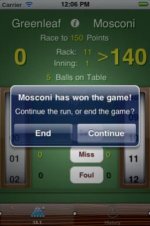
Playing with Dennis Walsh yesterday I was introduced to the iPad (and iPhone) app, Billiard Buddy. It works really well, especially on the iPad, which is larger. Dennis identified one problem with it (a foul on the opening break costs two points even if it's just a cue ball scratch). Tim, the developer, has already promised to fix this on the next release. It's free, but for a one-time 1.99 you get added features and no advertising.

It beats pencil and paper all to hell, as well as busted rail counters on Gold Crowns (they're all busted where we play). I kind of like the beads for tradition's sake, but my initial resistance to this new-fangled stuff has been overcome.
 
When I play I use a scorecard and count the remaining balls on the table. I then add that number to my opponents current rack score then subtract by 15 to get my current rack score.

Example: The total score is 28 to 0. I missed my breakshot on the 3rd rack and my opponent starts his run and his inning ends in the current rack. He counts the balls left on the table and there is 5. He adds that to my current rack score, which is 0. 5+0=5, then subracts that number by 15, which is 10. So his current rack score is 10.

This is the way I keep score.

So if you have the counters on the table it looks like this when Im playing

[0 ] [28 ] [10 ] [0 ]

Some people I play like the total score for the game on the Outside and the current rack on the inside counters. I perfer left to right, current rack on left, total points on the right.
 
Playing with Dennis Walsh yesterday I was introduced to the iPad (and iPhone) app, Billiard Buddy. It works really well, especially on the iPad, which is larger. Dennis identified one problem with it (a foul on the opening break costs two points even if it's just a cue ball scratch).

Has the opening break requirement been changed? In my BCA rule book it says any foul on the break is a two point deduction. I just looked at the WPA rules online and it says the same.
 
Has the opening break requirement been changed? In my BCA rule book it says any foul on the break is a two point deduction. I just looked at the WPA rules online and it says the same.

Here is what the WPA rule says:

4.3 Opening Break Shot
The following rules apply to the opening break shot:
(a) The cue ball begins in hand behind the head string.
(b) If no called ball is pocketed, the cue ball and two object balls must each be driven to a rail or the shot is a breaking foul. (See 8.4 Driven to a Rail.) This is penalized by subtracting two points from the breaker’s score. (See 4.10 Breaking Foul.) The non-breaking player may accept the balls in position or may require the breaker to play another opening break shot, until he satisfies the requirements for an opening break or the non-shooting player accepts the table in position.


So only if it is a "breaking foul", as defined above, is there a two point penalty.

Any other foul on the first shot, such as my favorite, "cue ball two rails into the top left pocket", would result in a one point penalty, so long as two other balls had hit the rail.

 
Last edited:

Attachments

  • BilliardsBuddy_7.jpg
    BilliardsBuddy_7.jpg
    14.9 KB · Views: 259
Here is what the WPA rule says:

4.3 Opening Break Shot
The following rules apply to the opening break shot:
(a) The cue ball begins in hand behind the head string.
(b) If no called ball is pocketed, the cue ball and two object balls must each be driven to a rail or the shot is a breaking foul. (See 8.4 Driven to a Rail.) This is penalized by subtracting two points from the breaker’s score. (See 4.10 Breaking Foul.) The non-breaking player may accept the balls in position or may require the breaker to play another opening break shot, until he satisfies the requirements for an opening break or the non-shooting player accepts the table in position.


So only if it is a "breaking foul", as defined above, is there a two point penalty.

Any other foul on the first shot, such as my favorite, "cue ball two rails into the top left pocket", would result in a one point penalty, so long as two other balls had hit the rail.

Dennis, I don't read it that way. It looks to me like even if two balls hit a rail and you scratch it still costs you two points.

BCA: "Starting player must either (1) designate a ball and a pocket into which that ball will be pocketed and accomplish the shot, or (2) cause the cue ball to contact a ball and then a cushion, plus cause two object balls to contact a cushion. Failure to meet at least one of the above requirements is a breaking violation
I don't see anything in either rule about a one point penalty. I see what you're getting at but it still looks like a two point penalty to me. Seems like a cue ball scratch would still count as a breaking foul.
 
Last edited:
Dennis, I don't read it that way. It looks to me like even if two balls hit a rail and you scratch it still costs you two points.

BCA: "Starting player must either (1) designate a ball and a pocket into which that ball will be pocketed and accomplish the shot, or (2) cause the cue ball to contact a ball and then a cushion, plus cause two object balls to contact a cushion. Failure to meet at least one of the above requirements is a breaking violation
I don't see anything in either rule about a one point penalty. I see what you're getting at but it still looks like a two point penalty to me. Seems like a cue ball scratch would still count as a breaking foul.

I don't see how you read it that way.

In the situation that I mentioned, cue ball hits the rack, two balls from the rack hit the rails, and cue ball hits the rail then scratches. That situation as described meets the requirement of #2 and therefore no "Breaking" violation has occurred.

Then you look at the other rules which would define the cue ball going in the drink as a one point foul.
 
I reproduce all the WPA relevant sections below. In short, if a breaking foul and a standard foul are committed on the same shot, it is considered a breaking foul. If the requirements of the opening break shot are met, a cue ball scratch is a standard foul and penalized by one point. A breaking foul does not count for the 3-foul rule.

4.3 Opening Break Shot
The following rules apply to the opening break shot:
(a) The cue ball begins in hand behind the head string.
(b) If no called ball is pocketed, the cue ball and two object balls must each be driven to a rail or the shot is a breaking foul. (See 8.4 Driven to a Rail.) This is penalized by subtracting two points from the breaker’s score. (See 4.10 Breaking Foul.) The non-breaking player may accept the balls in position or may require the breaker to play another opening break shot, until he satisfies the requirements for an opening break or the non-shooting player accepts the table in position.


4.9 Standard Fouls
If the shooter commits a standard foul, a point is subtracted from his score, balls are spotted as necessary, and play passes to his opponent. The cue ball remains in position except as noted below.


The following are standard fouls at 14.1:

6.1 Cue Ball Scratch or off the Table The cue ball is in hand behind the head string (see 1.5 Cue Ball in Hand).

etc. etc.

4.10 Breaking Foul
A breaking foul is penalized by the loss of two points as mentioned under 4.3 Opening Break Shot, as well as a possible re-break. If both a standard foul and a breaking foul happen on one shot, it is considered a breaking foul.


4.11 Serious Fouls
For Rule 6.14 Three Consecutive Fouls, only standard fouls are counted, so a breaking foul does not count as one of the three fouls. A point is subtracted for the third foul as usual, and then the additional fifteen-point penalty is subtracted and the offending player’s consecutive foul count is reset to zero. All fifteen balls are re-racked and the offending player is required to shoot under the requirements of the opening break.
 
Last edited:
Pushout's quotation of the BCA rules and my quotation of the WPA rules raises a question. The BCA rules say that on the opening break the cue ball must strike an object ball and then a cushion, as well as drive two object balls to a cushion.

The WPA rules say that the cue ball and two object balls must each strike a cushion.

What about a break where the breaker sends the cue ball to the foot rail and then into the pack, knocking two object balls to a rail and freezing the cue ball to the back of the pack, i.e., the cue ball hits a rail before hitting an object ball but not after? The WPA rules would seem to allow this. I wonder if that was intended or if it was just an oversight. This seems like a reasonable safety break if it is legal but I've never seen anyone do it.

Perhaps only Bob Jewett can answer this, or maybe I'm missing something.
 
Last edited:
I don't see how you read it that way.

In the situation that I mentioned, cue ball hits the rack, two balls from the rack hit the rails, and cue ball hits the rail then scratches. That situation as described meets the requirement of #2 and therefore no "Breaking" violation has occurred.

Then you look at the other rules which would define the cue ball going in the drink as a one point foul.

You may be right, seems like I remember this as being a two point foul but I may be wrong.
 
... What about a break where the breaker sends the cue ball to the foot rail and then into the pack, knocking two object balls to a rail and freezing the cue ball to the back of the pack, i.e., the cue ball hits a rail before hitting an object ball but not after? The WPA rules would seem to allow this. ...
This is an oversight. The intention was not to change this rule. The cue ball must go to a cushion after contact with an object ball. You are not permitted to bank to the back of the rack and stick your opponent.
 
Back
Top