
Training with Paper Spot idea.

Colin Colenso

AzB Silver Member
Silver Member
I'm surely not the first to use this training method but I'm finding it very useful for planning, learning angles and CB control.

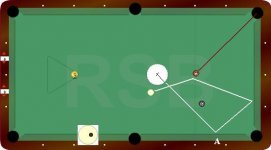
The diagram below pretty much explains it.

I cut out a paper circle, the width of an A4 piece of paper. There is a cross in the centre and a line to the edge showing the path the CB should travel toward the paper.

You put it where you want the CB to finish on every shot.

It helps not only to make you think where the best spot is for the CB, but also it makes you think about the angle the CB will come in from (see position A in diagram).

It will quickly correct misjudments as sometimes we don't think very carefully about where the CB needs to hit the rail.

Anyway, I wanted to recommend it to those who want a good way to boost their game.
 

Attachments

  • circle drill.JPG
    circle drill.JPG
    15.6 KB · Views: 349
Colin,

Joe Tucker's "Guaranteed Improvement" drill book uses a piece of paper as an end target for one-, two-, and three-rail drills. It's a great way to practice!

Barbara
 
Barbara said:
Colin,

Joe Tucker's "Guaranteed Improvement" drill book uses a piece of paper as an end target for one-, two-, and three-rail drills. It's a great way to practice!

Barbara
No doubt about Joe, he's always a step ahead:D

What I like about this drill, is it stops a player from getting lazy with the CB. So often we just think, I'll come down somewhere around here, without really thinking the exact center point which offers them the greatest margin of error for being good on the next shot.

When we do get those tight shots where we need to be spot on, our brain is not used to adapting to the task. This drill demands that each shot requires high precision.
 
Barbara said:
Colin,

Joe Tucker's "Guaranteed Improvement" drill book uses a piece of paper as an end target for one-, two-, and three-rail drills. It's a great way to practice!

Barbara

What may work as well or better is a piece of paper cut into a wedge. It can be adjusted so you have the ideal spot as well as the gray area you can get away with while concentrating on being on the correct side of the ball. You set the wedge with it's edge at the point where you begin to fall either too straight in or to the wrong side of the ball. It will let the player visualize where they can get within a reasonable margin of error and still be able to get to the next ball.
 
I use Two Business Cards when practicing. One where I want my Cue Ball to be after I sink ball (1) so it is in position for ball (2). One where I want my Cue Ball to be after I sink ball (2) so it is in position for ball (3).

Business Card are everywhere a a Great Free Training Aid... It a visual reminder.
 
I'm currently learning "the Sweet 16" shots as mapped out in Bob Henning's "the Pro Book".In his book (and on his DVD'S) he has you aiming for paper targets.Mostof his shots have you passing through or stopping at the center of the table.

If you pass through the center of the table, you can't scratch unless over course you go through it directly straight from corner to corner.he also includes other key target destination that are on other locations on the pool table.

I've only worked on 4 shots so far, however, having said that I'm thouroughly impressed for what I know it will do for my game once all 16 shots are learned.I've learned so much with just these 4 already.When I say 16 shots, there are lot of varations of those shots within the boundaries they encompass.
Once you know how to pass through the center of the table with all sorts of angles and english,that becomes your tangent line.You can then go left or right of center with english adjustments.

Using paper targets is excellent because it brings the speed control factor into the equation.The shots are known as "reference shots" and learning them is a much faster way than hitting millions of balls which will get you there, however, much slower.

bert Kinister also has simuliar training methods with his famous "60 minute workout", however, I like the way Henning has improved on Bert's orginal idea.

I also have a DVD featuring a target pool match between Buddy Hall, CJ Wiley, Davenport and Andam.They go through ten shots and set up a target with different point values for scoring.It's very intresting to see the pro's nail the target and also completley F... up.

In summary, I think using paper targets is an excellent idea.
RJ
 
I find it useful to use pennies or dimes to mark the spot on the table I would like the cueball to finish. I try to focus on getting the cueball to just roll up and stop as close as possible to the penny, this helps me to pick proper shape and play pin point position on every shot as oppossed to general area position. I also usually have pennies or dimes on me as I am a pool player, but hopefully with the IPT I'll have to switch to a big roll of hundreds. LOL

Bern
 
Big Bad Bern said:
I find it useful to use pennies or dimes to mark the spot on the table I would like the cueball to finish. I try to focus on getting the cueball to just roll up and stop as close as possible to the penny, this helps me to pick proper shape and play pin point position on every shot as oppossed to general area position. I also usually have pennies or dimes on me as I am a pool player, but hopefully with the IPT I'll have to switch to a big roll of hundreds. LOL

Bern

I'm not good enough to land on a dime so I use a Benjamin.
 
recoveryjones said:
I'm currently learning "the Sweet 16" shots as mapped out in Bob Henning's "the Pro Book".In his book (and on his DVD'S) he has you aiming for paper targets.Mostof his shots have you passing through or stopping at the center of the table.

If you pass through the center of the table, you can't scratch unless over course you go through it directly straight from corner to corner.he also includes other key target destination that are on other locations on the pool table.

I've only worked on 4 shots so far, however, having said that I'm thouroughly impressed for what I know it will do for my game once all 16 shots are learned.I've learned so much with just these 4 already.When I say 16 shots, there are lot of varations of those shots within the boundaries they encompass.
Once you know how to pass through the center of the table with all sorts of angles and english,that becomes your tangent line.You can then go left or right of center with english adjustments.

Using paper targets is excellent because it brings the speed control factor into the equation.The shots are known as "reference shots" and learning them is a much faster way than hitting millions of balls which will get you there, however, much slower.

bert Kinister also has simuliar training methods with his famous "60 minute workout", however, I like the way Henning has improved on Bert's orginal idea.

I also have a DVD featuring a target pool match between Buddy Hall, CJ Wiley, Davenport and Andam.They go through ten shots and set up a target with different point values for scoring.It's very intresting to see the pro's nail the target and also completley F... up.

In summary, I think using paper targets is an excellent idea.
RJ

I believe Kim Davenport was one of the creators of Target Pool. Too bad it is no longer available as a game. I saw it once at Top Shots in La Crosse WI USA. The gals that were playing it were getting pretty frustrated, except the lady who owned it. She was pretty good at it. I would love to get my hands on one of those target pool game packages.
 
i've done various types of drills using a paper target over the years. nice way of practicing.

however, i think it was Williebetmore that said his instructor had him using a business card as his target for the cue ball. now that would be tough. i dont think he ever revealed who that mystery instructor of his is though??? and i dont think he was referring to Mark Wilson, either.

DCP
 
Colin Colenso said:
I'm surely not the first to use this training method but I'm finding it very useful for planning, learning angles and CB control.

The diagram below pretty much explains it.

I cut out a paper circle, the width of an A4 piece of paper. There is a cross in the centre and a line to the edge showing the path the CB should travel toward the paper.

You put it where you want the CB to finish on every shot.

It helps not only to make you think where the best spot is for the CB, but also it makes you think about the angle the CB will come in from (see position A in diagram).

It will quickly correct misjudments as sometimes we don't think very carefully about where the CB needs to hit the rail.

Anyway, I wanted to recommend it to those who want a good way to boost their game.

I dont want to be picky but your diagram is wrong.:)
You cant come off those 2 rails and land the QB on the paper. Its impossible. After hitting rail A, the angle will widen and the path of the QB will be towards the corner pocket.

Gabber
 
Colin Colenso said:
I'm surely not the first to use this training method but I'm finding it very useful for planning, learning angles and CB control.

The diagram below pretty much explains it.

I cut out a paper circle, the width of an A4 piece of paper. There is a cross in the centre and a line to the edge showing the path the CB should travel toward the paper.

You put it where you want the CB to finish on every shot.

It helps not only to make you think where the best spot is for the CB, but also it makes you think about the angle the CB will come in from (see position A in diagram).

It will quickly correct misjudments as sometimes we don't think very carefully about where the CB needs to hit the rail.

Anyway, I wanted to recommend it to those who want a good way to boost their game.

Hey Colin,
For your info. In the early 1960's this type of drills were shown in a book by Willie Mosconi.
Lamar
 
Donovan said:
I believe Kim Davenport was one of the creators of Target Pool. Too bad it is no longer available as a game. I saw it once at Top Shots in La Crosse WI USA. The gals that were playing it were getting pretty frustrated, except the lady who owned it. She was pretty good at it. I would love to get my hands on one of those target pool game packages.

I know a pool hall locally that has that game in a glass display case.I'm not sure if it's for sale, but it could be.It would be pretty simple to make a target for scoring. I'm not sure what shots are laid out within the game, however, I do have the video of the ten shots the pro's were attempting on a DVD.You can allways make up your own shots.

That pool hall is far away, however, if I go there I'll attempt to buy the game and pass the info on your way.
RJ
 
I learned how to get position on shots by doing the "60minute workout" which is kinda the same thing, your trying to get the CB after you pot the OB, to a certain spot on the table.


dave
 
StormHotRod300 said:
I learned how to get position on shots by doing the "60minute workout" which is kinda the same thing, your trying to get the CB after you pot the OB, to a certain spot on the table.


dave

Did you learn how to do all the reference shots on the 60 minute workout.If so,did it really help your game?

Just wanted to know, because I have the DVD but am doing the Pro Book instead.
RJ
 
Colin Colenso said:
No doubt about Joe, he's always a step ahead:D

What I like about this drill, is it stops a player from getting lazy with the CB. So often we just think, I'll come down somewhere around here, without really thinking the exact center point which offers them the greatest margin of error for being good on the next shot.

When we do get those tight shots where we need to be spot on, our brain is not used to adapting to the task. This drill demands that each shot requires high precision.

Good Drill Colin, i remember this one time i was watching these guys play and the whole point of the game was the other player got to say where he wanted the cueball to be within a circle and the person shooting had to place the cueball there after potting the ball and man those guys were amazing if they didn't get the cueball where his opponent wanted it to be it wasn't far from it.
 
Old School

Jimmy Caras told me when I was 14 to cut out a
6" diameter piece of paper, put a quarter in the
middle and draw around it. He said when I can
make the shot and put the cue ball on the paper,
I would be getting pretty good, and when I could
land over half of my shots on the quarter circle,
that I would be getting real good.

I did what he told me which is probably why I am
known as a strong shape player today.
 
Donovan said:
I believe Kim Davenport was one of the creators of Target Pool. Too bad it is no longer available as a game. ... .
He was. I saw him at the IPT KotH in Orlando, and asked him if it was still available. The guy who was making/distributing them had told him it would cost too much to make another batch. You might find an old set at an older billiard supply store.

A description of Target Pool and a way you can make your own infinite variety of target pool shots is explained at: Target Pool, Revived
 
Barbara said:
Colin,

Joe Tucker's "Guaranteed Improvement" drill book uses a piece of paper as an end target for one-, two-, and three-rail drills. It's a great way to practice!

Barbara

That is a great little book. I think all the drills in it are useful.
 
instead of paper i use blue cue tip chalk to mark the table....it comes off easily or let it wear off.......
 
Back
Top