
You are using an out of date browser. It may not display this or other websites correctly.
You should upgrade or use an alternative browser.
You should upgrade or use an alternative browser.
v bottom points
- Thread starter RocketQ
- Start date


points
It seemwed for a long while that plain Janes and sneakys got popular along with the inlaid points. Many cuemakers (me included)got into the CNC thing and were making a lot of inlayed point cues to "show off" their skill with the new toys. Lots of people like the many point designs that can be done with CNC, and "Plain Jane's" are faster to build to up the inventory and for quick sales.
I recently have gone back to more traditional "V" grove points in more cues. I like them better and they have more of a personal touch than the machine made inlayed pointed cues.
I'm also a fan of re-cut and veneered points. These can't be done really well with CNC. You need the "V" bottom points.
I hate sneakys. I think they are an attempt to cheat by making your opponant think you are playing with a bar cue to get a mental upper hand. Some of today"s sneakys are really not sneakys at all. Some have ring work, joint collars and some even have wraps. I don't mind these at all. Every one recognizes that they are not bar cues.
In a dark pool room, the real sneakys are truely a cheat. JMHO.
It seemwed for a long while that plain Janes and sneakys got popular along with the inlaid points. Many cuemakers (me included)got into the CNC thing and were making a lot of inlayed point cues to "show off" their skill with the new toys. Lots of people like the many point designs that can be done with CNC, and "Plain Jane's" are faster to build to up the inventory and for quick sales.
I recently have gone back to more traditional "V" grove points in more cues. I like them better and they have more of a personal touch than the machine made inlayed pointed cues.
I'm also a fan of re-cut and veneered points. These can't be done really well with CNC. You need the "V" bottom points.
I hate sneakys. I think they are an attempt to cheat by making your opponant think you are playing with a bar cue to get a mental upper hand. Some of today"s sneakys are really not sneakys at all. Some have ring work, joint collars and some even have wraps. I don't mind these at all. Every one recognizes that they are not bar cues.
In a dark pool room, the real sneakys are truely a cheat. JMHO.

This statement is not correct. Some cue makers can do fantastic veneer work with CNCs.cuebuilder said:I'm also a fan of re-cut and veneered points. These can't be done really well with CNC. You need the "V" bottom points.
RocketQ said:Is it just me or are there not a whole lot of cues being built now with v bottom points. Most of the stuff I am seeing are inlaid or sneakys.
Few, if any factory cues are V-cut points any longer. The factories and many custom cue makers soon discovered that flat bottom points can be installed and really up-grade a plane cue at a nominal price. V-cut cues are much more labor intensive to build hence forth - a higher price. I make both flat bottom and half/splice v-bottom cues myself. I probably sell 5 flat bottom pointed cues to one v-groove cue. The market that I have is mostly younger players who like a big bang for the buck so to speak. Once the program for a flat bottom inlay has been drawn, variations of it can be used 1000's of times with no additional cost for re-programing. Some pockets may take up to 1.5 hours each to cut but since the machine is doing the work - the builder can be doing something else so there is not nearly as much time in manual labor involved and as everybody knows "time is money".
I, myself, like traditional V-bottomed points better but they do cost more as there is much more time and labor cutting the V's, the perfectly squared center inlays, and gluing up and mitering the veneers and then when turning, spending time to try and get the points perfect and no glue lines.
Dick
I agree if you are talking about fairly basic and simple CNC points. However, V-points are not that complicated, and once you are properly set up, can be done fairly efficiently and easily.rhncue said:Few, if any factory cues are V-cut points any longer. The factories and many custom cue makers soon discovered that flat bottom points can be installed and really up-grade a plane cue at a nominal price. V-cut cues are much more labor intensive to build hence forth - a higher price. I make both flat bottom and half/splice v-bottom cues myself. I probably sell 5 flat bottom pointed cues to one v-groove cue. The market that I have is mostly younger players who like a big bang for the buck so to speak. Once the program for a flat bottom inlay has been drawn, variations of it can be used 1000's of times with no additional cost for re-programing. Some pockets may take up to 1.5 hours each to cut but since the machine is doing the work - the builder can be doing something else so there is not nearly as much time in manual labor involved and as everybody knows "time is money".
I, myself, like traditional V-bottomed points better but they do cost more as there is much more time and labor cutting the V's, the perfectly squared center inlays, and gluing up and mitering the veneers and then when turning, spending time to try and get the points perfect and no glue lines.
A very complicated cnc program can take many many hours to design and cut. FAR longer than any V-points would take to make. These designs are few and far between though, so making a general statement, you are partially correct.
Sheldon,
I stand corrected. You are right. Some fine veneer work can be achieved with alot of time consuming programing as in some of the veneered windows in the butt sleeve that I see. I still like the look of the "V" cut points best.
I stand corrected. You are right. Some fine veneer work can be achieved with alot of time consuming programing as in some of the veneered windows in the butt sleeve that I see. I still like the look of the "V" cut points best.

I started with v point cues and then went on to pantograph then cnc. I still sell more cnc cues than anything but the v point cues are growing in demand for the last 2 years at least for me. Chris.
You guys just haven't been exposed to what's possible. This cue has FLOATING points with veneers of ivory, silver, and turquoise. And the points are pretty damned sharp. This is a pic of the unfinished forearm, and the silver isn't showing up in the pic too well. It has 2 silver veneers, one on each side of the turquoise.RocketQ said:Dickie, I prefer the v bottom also. The points come out so much sharper than any flat bottom point. It adds a touch of crisp to the finished lines.
This was just an observation from VF and some smaller show I have been to this year.
Attachments
Last edited:

Sheldon said:You guys just haven't been exposed to what's possible. This cue has FLOATING points with veneers of ivory, silver, and turquoise. And the points are pretty damned sharp. This is a pic of the unfinished forearm, and the silver isn't showing up in the pic too well. It has 2 silver veneers, one on each side of the turquoise.
while very nice, you can still tell theyre not " vee grooved " from 10 feet away.
points
When I was building vee points way back, and flat bottom points, I always made my flat bottom cavities come to a sharp point. Easily done if you have the know how.
Once a cuemaker on the west coast told me, Blud, nice VEE points, I said there not VEE points, he said yes they are, they come to a perfect point. Well, he was and still a high end cue maker, and couldn't tell the differance....DUH.
Flat bottom points looking down on them, will be narrower than vee's because with vee points, they are laying at a 45 deg. angle, looking straight down on them and shows more of the [side] edge of the venners, where flats are straight up, so you see less of the edge of the veeners...They look a little narrower, because of there angle.
It just requires a small tool to make them come to a ral sharp POINT. Not many know of this trick....
Time differance for me in the construction is about 1-1/2 hours longer for Vee points over all, compared to flats. I can cut Vee's out much faster than flats, because of the computer time and then the last pass is taking only about .005 thds, off........ Very slow crawl cut....sometimes called a clean cut...
These flat bottom cavites in some woods are harder to do than some of the softer woods, but if one takes his time, it can be done. I can normally take a 4 pointed flat bottom point, and make then POINTED in about 30 to 45 minutes, per 4 points..... As most of you cuemakers know, there's tricks and more tricks to our trade. Vee's are normally priced about 25% higher than flats, because of the know-how and a littlemore labor...
Happy holidays folks.
Blud
Hi Dick, your correct in your statements about Vee Points, they do take a little more time, not much,however, if done correctly, in my opinion,there the best points. A few others [ cuemakers], do flat bottom points, and always put an inlay over the radius at the top of the so called point. Anyone can do this and the points are even. Very easy to do....It's actually round...... My method with flat bottom points they are dead on and do come to a sharp POINT....with little work....rhncue said:Few, if any factory cues are V-cut points any longer. The factories and many custom cue makers soon discovered that flat bottom points can be installed and really up-grade a plane cue at a nominal price. V-cut cues are much more labor intensive to build hence forth - a higher price. I make both flat bottom and half/splice v-bottom cues myself. I probably sell 5 flat bottom pointed cues to one v-groove cue. The market that I have is mostly younger players who like a big bang for the buck so to speak. Once the program for a flat bottom inlay has been drawn, variations of it can be used 1000's of times with no additional cost for re-programing. Some pockets may take up to 1.5 hours each to cut but since the machine is doing the work - the builder can be doing something else so there is not nearly as much time in manual labor involved and as everybody knows "time is money".
I, myself, like traditional V-bottomed points better but they do cost more as there is much more time and labor cutting the V's, the perfectly squared center inlays, and gluing up and mitering the veneers and then when turning, spending time to try and get the points perfect and no glue lines.
Dick
When I was building vee points way back, and flat bottom points, I always made my flat bottom cavities come to a sharp point. Easily done if you have the know how.
Once a cuemaker on the west coast told me, Blud, nice VEE points, I said there not VEE points, he said yes they are, they come to a perfect point. Well, he was and still a high end cue maker, and couldn't tell the differance....DUH.
Flat bottom points looking down on them, will be narrower than vee's because with vee points, they are laying at a 45 deg. angle, looking straight down on them and shows more of the [side] edge of the venners, where flats are straight up, so you see less of the edge of the veeners...They look a little narrower, because of there angle.
It just requires a small tool to make them come to a ral sharp POINT. Not many know of this trick....
Time differance for me in the construction is about 1-1/2 hours longer for Vee points over all, compared to flats. I can cut Vee's out much faster than flats, because of the computer time and then the last pass is taking only about .005 thds, off........ Very slow crawl cut....sometimes called a clean cut...
These flat bottom cavites in some woods are harder to do than some of the softer woods, but if one takes his time, it can be done. I can normally take a 4 pointed flat bottom point, and make then POINTED in about 30 to 45 minutes, per 4 points..... As most of you cuemakers know, there's tricks and more tricks to our trade. Vee's are normally priced about 25% higher than flats, because of the know-how and a littlemore labor...
Happy holidays folks.
Blud
Almost all work was done with a .050. I did get out the .015 for the very tips of the forearm pockets.masonh said:very sharp looking Sheldon..015?
Most competent cuemakers probably could have built half a dozen fancy half-splices in the time I spent making those points. The finished product is absolutely stunning though, and sold for about 5 times what most V pointed cues go for.
Last edited:
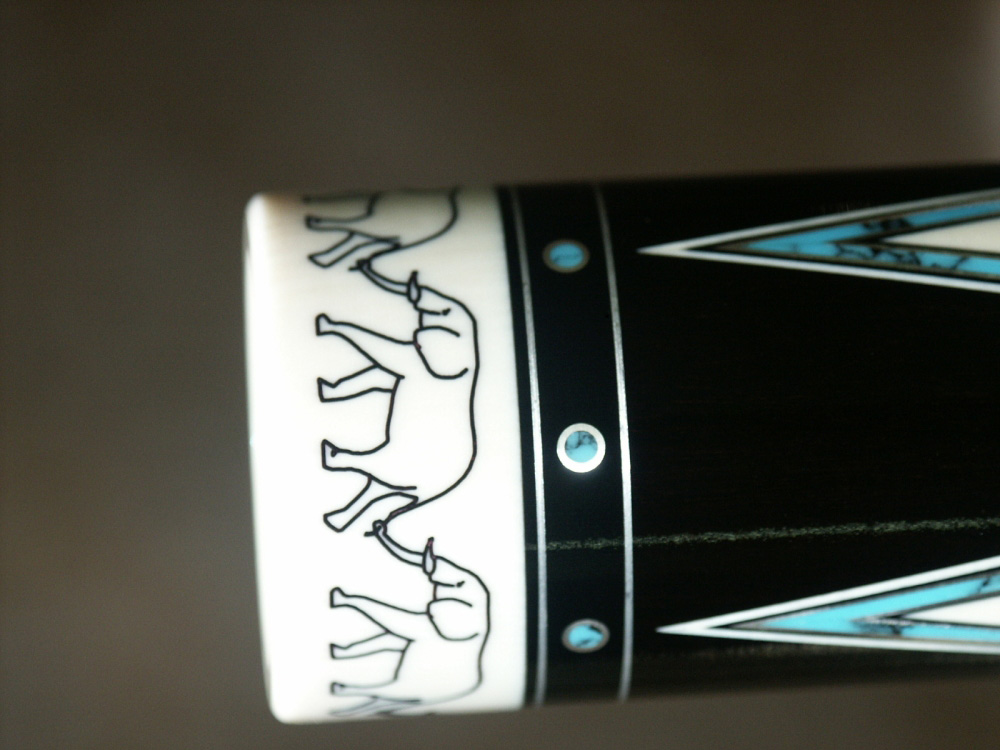
The sterling silver and turquoise is a big giveaway.merylane said:while very nice, you can still tell theyre not " vee grooved " from 10 feet away.


RocketQ said:Is it just me or are there not a whole lot of cues being built now with v bottom points. Most of the stuff I am seeing are inlaid or sneakys.
I have read the entire post, the last true V-Bottom / V-Spliced points I have seen ended with Brunswick's last runs. Today, I do not think anyone is building cues in the same manner that Brunswick did, if I am wrong please correct me.
Today with all the different point techniques being used at a glance it can be hard to distinguish truly spliced from inlay-ed points. However, the way a cue hits, the harmonics mainly will certainly show the difference. I have always been a fan of Craftsmanship, and unique design. Like it has been discussed throughout this thread, similar designs and even very unique designs can be accomplished with less man power today, to much more exacting standards than ever before. Now while this is a good thing for buyers in the cue market (it is flooded/ Prices are low) it is not a great thing for the cue maker, even though he has great deal of experience, and an eye for design.
I mean look at Dale Perry, his cues are truly a bargain compared to the standard production cue on the market today. Dale had to make a choice to continue cue building, continue to be known as a Custom cue maker or buy all the necessary equipment and mass produce cues so that quantity would carry him through. I know there is more to what Dale did than just what is above, but cue makers today in general are also putting themselves into very similar positions by building large numbers of similar cues very quickly. Another problem for cue makers is that while all these techniques are great for the task required of them they still do not compare to hands on Craftsmanship. This is because the public is also becoming wiser than they were concerning how cues are being made. Many people do still prefer the traditionally hand built, IE, hand cut or Pantograph cut inlays, V-bottom points, and the traditional methods of construction that were used before the advent of all the new techniques.
Another problem that todays Cue Makers are having concerning designs is that their Asian Counterparts can and due copy anything they are producing to day. This greatly adds to the flooded market especially for cues that mainly produced from CNC machining techniques. This problem will only get worse in the future because the main cost in building cues is not materials, it is however man hour's, and no cue maker in this country can compete or produce more for less cost. I mean even the Big production cue company's understand that they can not beat the prices for products being offered from these companies. To help themselves compete with this situation they have almost all begun to have inexpensive lines of cues,(some with their names on them) made in China. While to date these products do not compare in quality because of the materials used in their construction, this is changing very quickly!!!!!
Due to this, I totally believe that traditionally made products will maintain a better market value for collectors, and even discriminating players who understand what they are buying. In addition, the farther we move toward CNC techniques the closer building is moving to mass production and exact duplication.
In closing I think that all of the above will with time only increase the value of traditionally made cues, and since so many cue makers are changing their equipment for the new technology, future cue makers will lose the knowledge and ability to build in a traditional manner. This will only further increase the value of these items in the future.
Only time will tell for certain, but as I increase my abilities due to the lack of availability I am certainly staying traditional!!
Merry Christmas
manwon said:I have read the entire post, the last true V-Bottom / V-Spliced points I have seen ended with Brunswick's last runs. Today, I do not think anyone is building cues in the same manner that Brunswick did, if I am wrong please correct me.
Today with all the different point techniques being used at a glance it can be hard to distinguish truly spliced from inlay-ed points. However, the way a cue hits, the harmonics mainly will certainly show the difference. I have always been a fan of Craftsmanship, and unique design. Like it has been discussed throughout this thread, similar designs and even very unique designs can be accomplished with less man power today, to much more exacting standards than ever before. Now while this is a good thing for buyers in the cue market (it is flooded/ Prices are low) it is not a great thing for the cue maker, even though he has great deal of experience, and an eye for design.
I mean look at Dale Perry, his cues are truly a bargain compared to the standard production cue on the market today. Dale had to make a choice to continue cue building, continue to be known as a Custom cue maker or buy all the necessary equipment and mass produce cues so that quantity would carry him through. I know there is more to what Dale did than just what is above, but cue makers today in general are also putting themselves into very similar positions by building large numbers of similar cues very quickly. Another problem for cue makers is that while all these techniques are great for the task required of them they still do not compare to hands on Craftsmanship. This is because the public is also becoming wiser than they were concerning how cues are being made. Many people do still prefer the traditionally hand built, IE, hand cut or Pantograph cut inlays, V-bottom points, and the traditional methods of construction that were used before the advent of all the new techniques.
Another problem that todays Cue Makers are having concerning designs is that their Asian Counterparts can and due copy anything they are producing to day. This greatly adds to the flooded market especially for cues that mainly produced from CNC machining techniques. This problem will only get worse in the future because the main cost in building cues is not materials, it is however man hour's, and no cue maker in this country can compete or produce more for less cost. I mean even the Big production cue company's understand that they can not beat the prices for products being offered from these companies. To help themselves compete with this situation they have almost all begun to have inexpensive lines of cues,(some with their names on them) made in China. While to date these products do not compare in quality because of the materials used in their construction, this is changing very quickly!!!!!
Due to this, I totally believe that traditionally made products will maintain a better market value for collectors, and even discriminating players who understand what they are buying. In addition, the farther we move toward CNC techniques the closer building is moving to mass production and exact duplication.
In closing I think that all of the above will with time only increase the value of traditionally made cues, and since so many cue makers are changing their equipment for the new technology, future cue makers will lose the knowledge and ability to build in a traditional manner. This will only further increase the value of these items in the future.
Only time will tell for certain, but as I increase my abilities due to the lack of availability I am certainly staying traditional!!
Merry Christmas
Well, you've hit my main pet peeve squarely on top of the head. I agree with pretty much of what you say except for using the word pantograph and hand made in the sentence. Anyone who considers a pantograph any more hand made than a CNC is a hypocrite as far as I'm concerned. If you want to do inlays by hand then do it by hand with the use of drills, exacto-knives and chisels the same way as has been done since the first rock was put into a cue.
I don't build collector cues. Mine are built to play with. I keep hearing about this down turn in cue sales but I know in my case, this is the busiest I've been in 16 years of building cues.
Dick
Last edited:
What I've noticed is that the value of cues in general is down. The sales are still there, but unless you are talking customs or collectibles, it's a tougher market today.rhncue said:I keep hearing about this down turn in cue sales but I know in my case, this is the busiest I've been in 16 years of building cues.