
You are using an out of date browser. It may not display this or other websites correctly.
You should upgrade or use an alternative browser.
You should upgrade or use an alternative browser.
What to know when ordering a custom cue.
- Thread starter Urthred
- Start date

That is a good question!! What I like for anyone that is calling about a custom cue is:I was considering ordering a custom cue in the near future and seeing as I have no notion of how to really go about this I was wondering what you would like your customers to know(such as like what materials, or design,or weight, etc) when they place the order?
What kind of hit are you looking for. Stiff hit , soft or medium hit in a cue.
Color scheme, which leads to wood choices.
Balance point in the cue.
What size shaft you like. 13.0m/m 12.90 m/m 12.8 m/m ect. How long a taper you like the shafts to have.
Wrap or wrapless. Ex. Linen wrap Leather wrap or a wood handle.
What I would suggest is just to call one of us and talk to us about what you already know and go from there. Most of us have been doing this long enough that with some conversation we can figure out together what you are looking for.
Know the price range that you are comfortable with to have a cue built!
You cant get enough info on cues as we are all learning more and more everyday!
If I can be of any help feel free to give me a call. Even if you are not ordering from me!
Thanks
DOUG
I was considering ordering a custom cue in the near future and seeing as I have no notion of how to really go about this I was wondering what you would like your customers to know(such as like what materials, or design,or weight, etc) when they place the order?
When I take an order I ask the following questions:
1. full/splice or half/splice
2. weight
3. joint type (steel, half/steel, black phenolic. white aegis, natural phenolic)
4. type of pin (preferably radial)
5. type of wrap or what in handle area
6. type of forearm wood
7. type of butt collar wood
8. type of butt cap
9. length of cue
10.width of cue at butt cap
11. balance point
12. points or plain, v-bottom or flat bottom
13. veneers
14. inlays (shapes and materials)
15. deco-rings
16. number of shafts
17. size of shafts
18. length and type of ferrule
19. tip
I believe that has all or at least most of the bases covered.of the bases covered. This is usually done over a few e-mails. Once all of the parameters are agreed to I have the customer send me an e-mail with all of these parameters in it and that is what I go by and I then have a record if someone later forgets just what was ordered.
Dick


Can you describe what full splice means and what half splice means please? I've heard differing descriptions that never became clear to me. Thanks, Jim
A full splice is built the same as a standard house cue, being that the handle and points are one piece and continue from the handle area into the forearm as points. There is no A-joint in a full splice cue. A half splice cue is usually will have a A-joint in front of the wrap area and often has a deco-ring there. The prong and handle are two distinct pieces of wood joined usually by a tenon and bolt. Points are added by the use of either a V groove so that they are sharp at the tips and resemble a full/splice or the can be flat bottomed inlays added after the cue is built having more rounded points the radius of the cutter. The first picture is a full/splice, the second is a half/splice and the third is a flat bottomed inlay.

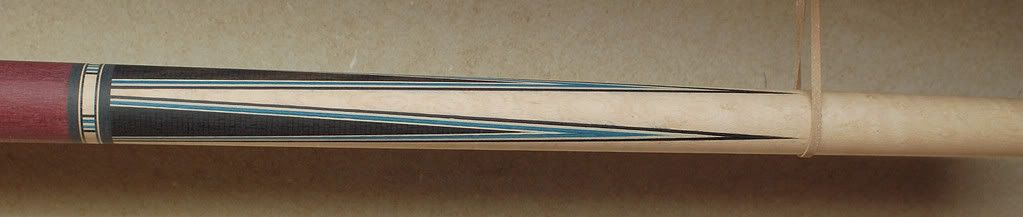

Dick

... The first picture is a full/splice...
What a nice cue, I assume it is one of yours Dick ? I may have to order another Cincinnati cue some day !
Dave

A full splice is built the same as a standard house cue, being that the handle and points are one piece and continue from the handle area into the forearm as points. There is no A-joint in a full splice cue. A half splice cue is usually will have a A-joint in front of the wrap area and often has a deco-ring there. The prong and handle are two distinct pieces of wood joined usually by a tenon and bolt. Points are added by the use of either a V groove so that they are sharp at the tips and resemble a full/splice or the can be flat bottomed inlays added after the cue is built having more rounded points the radius of the cutter. The first picture is a full/splice, the second is a half/splice and the third is a flat bottomed inlay.
Dick
that half splice in the middle looks very familliar. i wonder who the lucky person is that gets to shoot with that:grin: