
Where is the contact point, considering tip compression

iusedtoberich

AzB Silver Member
Silver Member
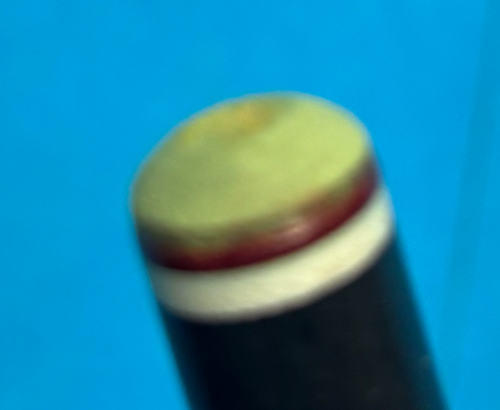
The top layer of my tip fell off the other night, and I've been playing with it in that state the past few sessions and I'm still playing the same that way. That got me thinking, when the tip compresses and strikes the CB, where is the theoretical "contact point". Is it at the center of the entire compressed contact patch? Is it at the center of where the force is, which may have a different center compared to the contact patch?

If I lost a layer, the compression of the entire tip would presumably be different. Would that change the effective contact point, even if the strike on the CB was on the side of the tip that still had its layer?

@Bob Jewett @dr dave
1787942885321.png
 
Just a wag here but since you're striking a round object(cb) with another round object(the tip) is there an actual 'point' of contact or more of an 'area of contact'?
 
If you're spinning the ball a lot, the contact patch won't be much in that missing part, so I wouldn't expect much change in play. It's when you hit closer to the center of the cue ball that I would expect slightly funny action.

The contact patch is typically a quarter inch across with the force largest near the center of the patch for a normal tip. I think the effective offset, which sets how much spin you are going to get, is a kind of weighted average over that area. If a half-moon is missing from the patch, the center is unlikely to be where you expect.

If you want to test for an effect, see if your stun draw works like you expect for intermediate distances below center.
 
may technically change but reality your ball still goes where you aim and acts naturally.

generally when i put on a new tip i put the whole big flat top 14mm thing on, and shoot unchanged for a time with it to let it break in. then a start slowly cutting pieces off it.

and i find i play my same speed with all the different configurations.

this also confirms in my mind how little your shape and size of tip really matters in actual play.
 
  • Like
Reactions: bbb
If you're spinning the ball a lot, the contact patch won't be much in that missing part, so I wouldn't expect much change in play. It's when you hit closer to the center of the cue ball that I would expect slightly funny action.
Visualizing the rounded tip as the surface of a ball, it looks like the edge of the flat part is at about 3/4 of maximum tip offset. Since the tip and ball always come together at identical apparent offsets from their respective centers, looks like Larry's tip will hit on the flat part with any less than ~3/4 spin.

pj
chgo
 
Just a wag here but since you're striking a round object(cb) with another round object(the tip) is there an actual 'point' of contact or more of an 'area of contact'?
The tip deforms and creates an area of pressure rather than a point force. The discussion is where the blob centroid of the shape is, as opposed to geographic center, and is there even a difference. If the centroid is different than the center then it is interesting as it would theoretically cause slight differences in spin. I think you would need FEM to figure this out.

Practically the difference is probably so small and so swamped by human error in actually getting the tip where it is wanted that it turns into a recreational physics problem.
 
The tip deforms and creates an area of pressure rather than a point force. The discussion is where the blob centroid of the shape is, as opposed to geographic center, and is there even a difference. If the centroid is different than the center then it is interesting as it would theoretically cause slight differences in spin. I think you would need FEM to figure this out.

Practically the difference is probably so small and so swamped by human error in actually getting the tip where it is wanted that it turns into a recreational physics problem.
Yes, that's what I was after. For example your software calculates the contact point based on the resultant spin of the CB, if the tip was a single point, correct? Now, is that contact point really the single tangent point where the tip touches the ball (pretending the tip and the ball were uncompressible), or in real life, is it a different point due to the compression of the tip?
 
Yes, that's what I was after. For example your software calculates the contact point based on the resultant spin of the CB, if the tip was a single point, correct? Now, is that contact point really the single tangent point where the tip touches the ball (pretending the tip and the ball were uncompressible), or in real life, is it a different point due to the compression of the tip?
For the DigiBall I use the simple rigid physics body model with speed estimation to find the contact point. I then work backwards and draw the tip outline as a result of the contact point. I use spherical geometry for that, no compression. The speed estimator error and angular resolution error is larger than any blob centroid offset so I am not near that level of detail.

As I said it would be neat to do the FEM as a curiosity.
 
Back
Top