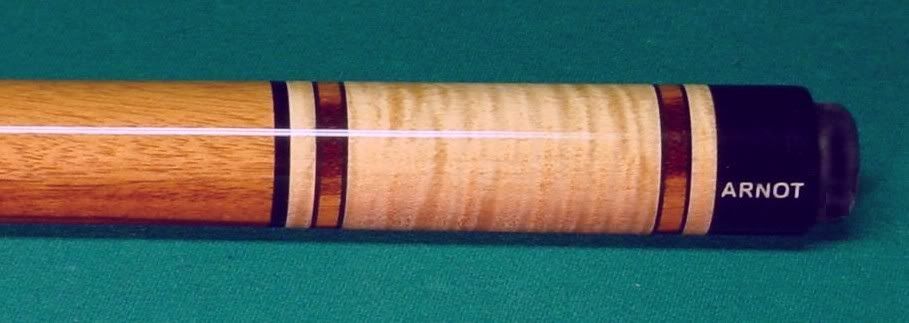
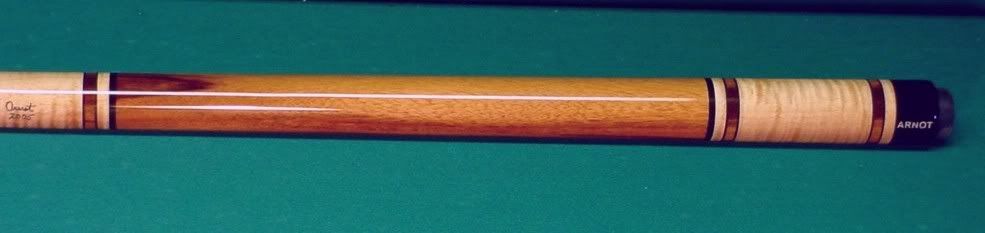
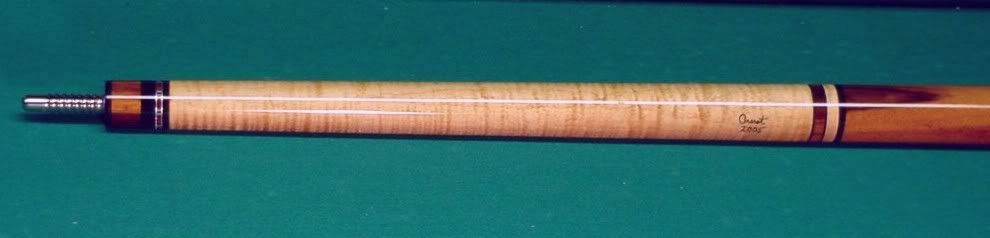
wooden joint sleeves

perspicaz

o-^-*-^-o
Silver Member
Hi!

I know most joints have stainless steel or phenolic sleeves, but I sometimes see wooden (cocobolo, bocote or maple for example) sleeves.

Are these wooden sleeves convenient for a radial pin or are they more fragile than the SS or phenolic counterparts?

I am going to order a cue and, while I find the wooden sleeves more attractive, I am worried they are going to crack easily.

Thanks.
 
perspicaz said:
Hi!

I know most joints have stainless steel or phenolic sleeves, but I sometimes see wooden (cocobolo, bocote or maple for example) sleeves.

Are these wooden sleeves convenient for a radial pin or are they more fragile than the SS or phenolic counterparts?

I am going to order a cue and, while I find the wooden sleeves more attractive, I am worried they are going to crack easily.

Thanks.

Last week I put a new tip on a Q I made 18 years ago. It has a Bacote joint. This is one of many wooden jointed Qs that I have made, including my personal jump/ break Q. It has 2 Cocobolo joints...JER
 
perspicaz said:
Hi!

I know most joints have stainless steel or phenolic sleeves, but I sometimes see wooden (cocobolo, bocote or maple for example) sleeves.

Are these wooden sleeves convenient for a radial pin or are they more fragile than the SS or phenolic counterparts?

I am going to order a cue and, while I find the wooden sleeves more attractive, I am worried they are going to crack easily.

Thanks.

Besides the woods JER mentioned ebony, especially Gaboon, also makes for a very strong and durable joint material.

Bob Flynn
Denali Pool Cues
 
As long as the cue is used for what it was intended there is no problem with a wood joint sleeve. Chris.
 
Ages ago I made a pair of cues with cocobolo joints and they have never cracked to my knowledge...they have a very distinct feel to them...
 
I prefer to use wood joints. The four I like most are Cocobolo, Bubinga, Morado, and Bloodwood. I am not one much for stainless or phenolic although in a breaker phenolic is thew way to go IMO.
 
think about it. if wood joints were a problem, why would everybody and his brother still make sneaky petes ? :p
 
Joint Collars

perspicaz said:
Hi!

I know most joints have stainless steel or phenolic sleeves, but I sometimes see wooden (cocobolo, bocote or maple for example) sleeves.

Are these wooden sleeves convenient for a radial pin or are they more fragile than the SS or phenolic counterparts?

I am going to order a cue and, while I find the wooden sleeves more attractive, I am worried they are going to crack easily.

Thanks.

The purpose of a joint collar is to prevent the forearm and shaft from spliting. Phenolic is much stronger than wood and is the best material from a strength standpoint.

A wood joint collar is not nearly as strong as phenolic.

Good Cuemaking,
 
Arnot Wadsworth said:
The purpose of a joint collar is to prevent the forearm and shaft from spliting. Phenolic is much stronger than wood and is the best material from a strength standpoint.

A wood joint collar is not nearly as strong as phenolic.

Good Cuemaking,

Hi Arnot, I agree wholly. Wood is not as strong as the modern plastics & phenolics, but I for one have always liked to keep my Qs simple. I love the look of beautiful wood & if I can use it as a joint material, have it perform well & add to the uniqueness of my work, I'll go for it. If any part should fail on my Qs, I will repair or replace it. So far none of these wooden joints have been back, with a failure. The 1st Q I ever saw with a wooden joint collar, was a Q by Ray Schuler in the 80's. I was blown away by the unusual beauty of a Cocobolo joint( my favorite wood, by the way). I couldn't wait to try it & have made I have made a 1/2 dozen or so every year since. Hope this finds you & yours well...JER
 
I know this is probably overkill but if strength is an issue why not put a phenolic sleeve under the wood collar. To add strength it only need to be 0.030" thick.
 
Wood Joint Collars (Examples)

RocketQ said:
I know this is probably overkill but if strength is an issue why not put a phenolic sleeve under the wood collar. To add strength it only need to be 0.030" thick.

That is one way to achieve strength but here is the method I use. Click on the thumbnail below for a better view:


Good Cuemaking,
 
Question......

For those that do use wood for a joint collar material.

How exactly do you install them? Do you bore the wood to form a "tube" of wood and install over a tenon (like installing phenolic tube) or do you cut a solid piece with a tenon that extends down into the forearm? or?????

Don't know if I described my question well enough :confused:
 
Arnot Wadsworth said:
That is one way to achieve strength but here is the method I use. Click on the thumbnail below for a better view:


Good Cuemaking,
Great rings... I didn't think that would look right but once again I am wrong. Great rings....
 
Bill the Cat said:
For those that do use wood for a joint collar material.

How exactly do you install them? Do you bore the wood to form a "tube" of wood and install over a tenon (like installing phenolic tube) or do you cut a solid piece with a tenon that extends down into the forearm? or?????

Don't know if I described my question well enough :confused:
Just like the phenolic... Some thread I do not.
 
Thanks everyone for all the replies. :)

I see everybody cites cocobolo... but I have seen maple and tulipwood joint collars too, are these suitable woods also?
 
How about the dymondwood? I have made some joint collars from it before and they turned out very good. Any others use it much?
 
Back
Top