
You are using an out of date browser. It may not display this or other websites correctly.
You should upgrade or use an alternative browser.
You should upgrade or use an alternative browser.
Latest activity
Filters
Show only:


Tom Storm, Razor pool cue
- By Smitty2Fiddy
- For Sale Items
- 0 Replies
Forearm: Dark-stained wood featuring four prominent long inlaid points.
Point wood: Light colored wood outlined by a multi-veneer combination of yellow and green.
But Sleeve: Matches the forearm styling with four long, elongated oval accents containing alternating green and yellow pearlized centers.
Butt weight: 16oz
Cue/Shafts length: Standard adult length Butt is 29 inches and the shafts are 29 inches.
Wrap: Textured, black-and-white speckled Irish linen wrap.
Joint material: Polished stainless steel collar
Joint pin: Male steel pin extending from the butt, featuring a pilot top. Piloted 5/16 x 14 pin.
# of Shafts: 2 shafts.
Shaft 1: Standard weight 4.2oz. Tip size 13mm. Condition lightly played with some natural wood aging.
Shaft 2: Same size, weight, and condition of shaft 1.
Ferrule Material: Juma
Tips: Leather tips medium hardness.
Weight Bolts: Removable weight bolt system located under the rubber bumper at the bottom of the butt cap, allowing adjustable tuning.
Taper roll: Butt good, Shaft 1 good, shaft 2 slight arch.
Price: 650
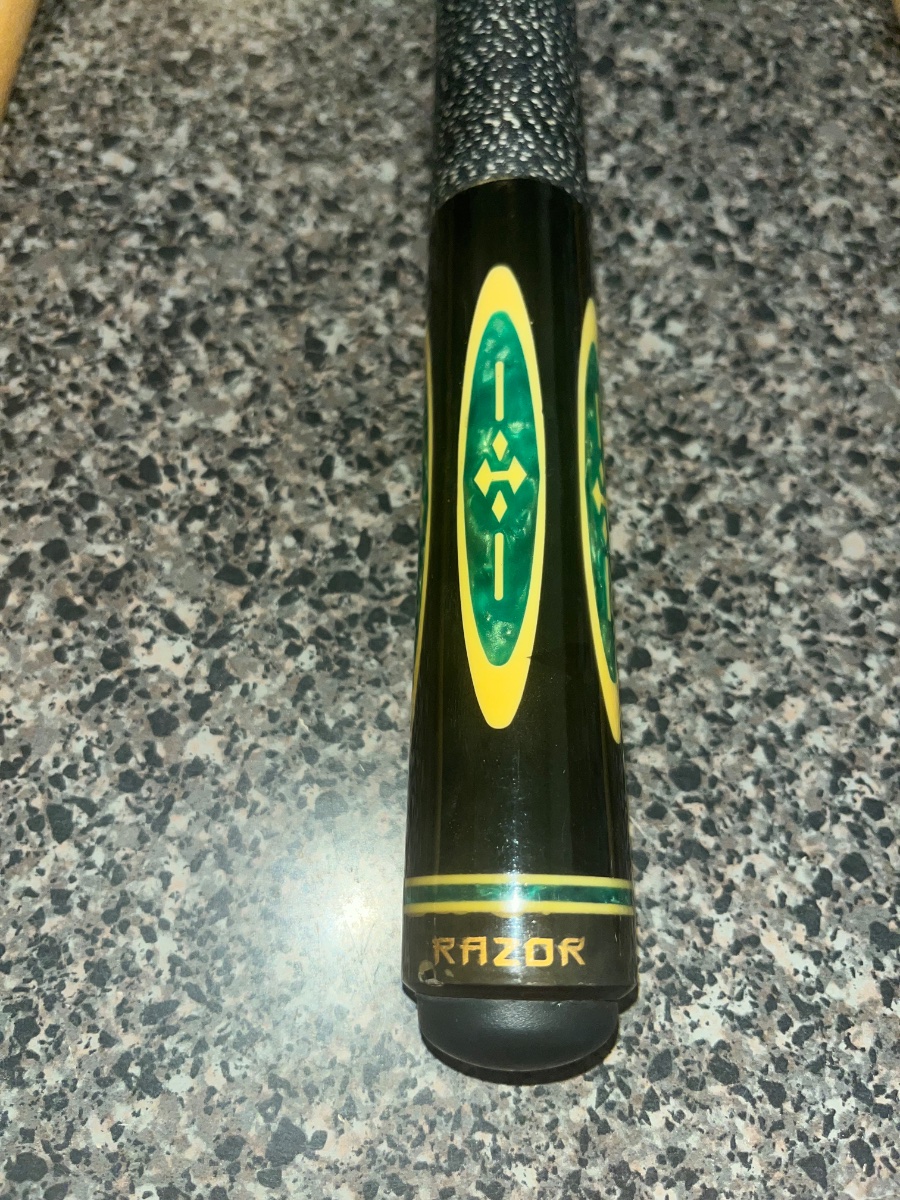
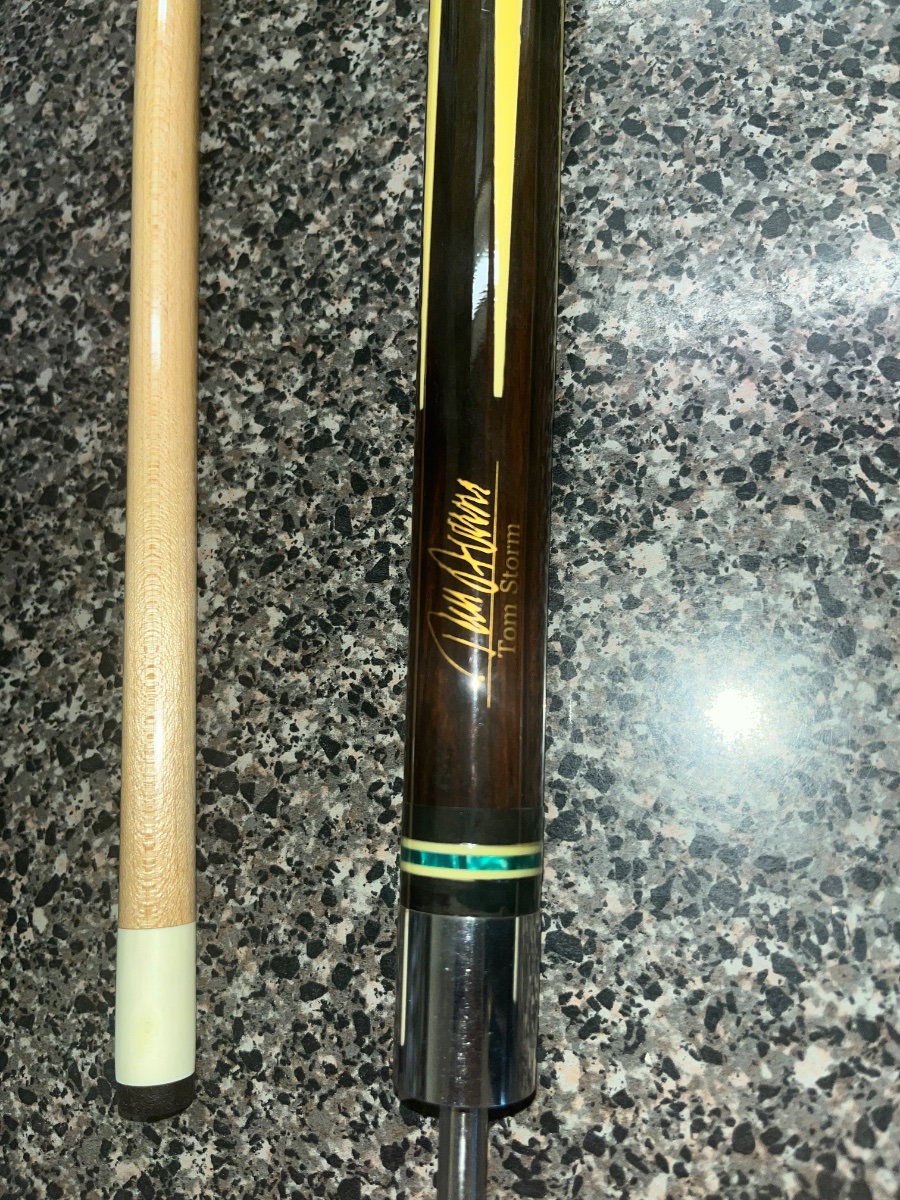
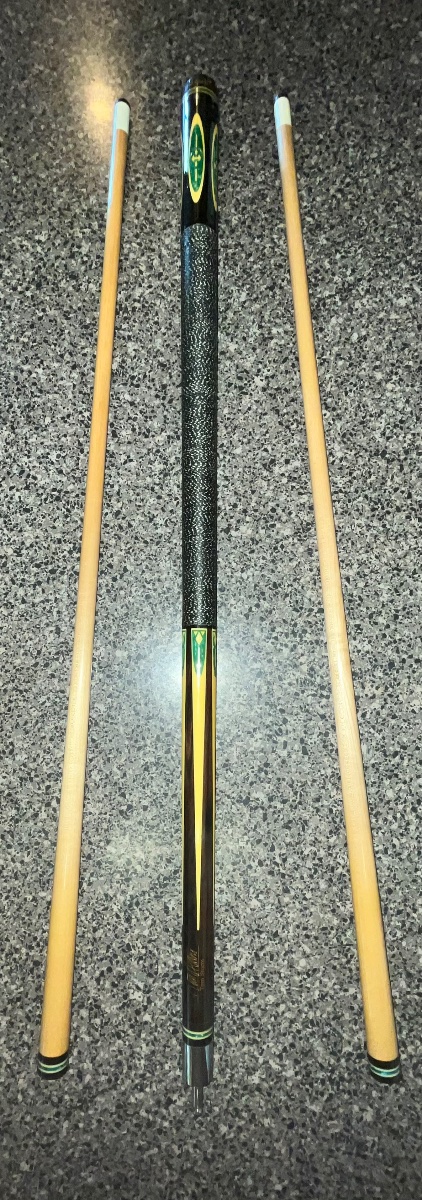
Point wood: Light colored wood outlined by a multi-veneer combination of yellow and green.
But Sleeve: Matches the forearm styling with four long, elongated oval accents containing alternating green and yellow pearlized centers.
Butt weight: 16oz
Cue/Shafts length: Standard adult length Butt is 29 inches and the shafts are 29 inches.
Wrap: Textured, black-and-white speckled Irish linen wrap.
Joint material: Polished stainless steel collar
Joint pin: Male steel pin extending from the butt, featuring a pilot top. Piloted 5/16 x 14 pin.
# of Shafts: 2 shafts.
Shaft 1: Standard weight 4.2oz. Tip size 13mm. Condition lightly played with some natural wood aging.
Shaft 2: Same size, weight, and condition of shaft 1.
Ferrule Material: Juma
Tips: Leather tips medium hardness.
Weight Bolts: Removable weight bolt system located under the rubber bumper at the bottom of the butt cap, allowing adjustable tuning.
Taper roll: Butt good, Shaft 1 good, shaft 2 slight arch.
Price: 650
Could straight pool thrive with a gimmick format?
On the other hand.....
I didn't see it -- and I certainly wouldn't have watched the whole thing -- but I believe in one of Charlie Williams' World events, there was a five and a half hour match. I think it was to 150. Worse than one pocket.
If you're going to have a competition, you need to stay on schedule, attract a paying audience, and not drive viewers and players away by boring them to death. Mosconi, Butera, Orcullo, and Shaw have shown us that you don't need 50 seconds per shot.
A game clock like in chess -- not a shot clock -- can solve the snail problem. I think a 20/10 shot clock could still be playable, but it would eliminate maybe a quarter of all players. A problem is that it requires staff to run it.

Yeah, unfortunately I was there. It was SVB vs Max Eberle. Thankfully Max scratched on a side pocket breakshot needing less than a rack (5 balls I think) or we'd have had to endure an 8 hour final match. It was painful.

Is it time to play one pocket??

- By GoldCrown
- Main Forum
- 129 Replies
Consider Tom Wirth’s book. 1p A game of controlled aggression. It handles almost every typical situation. It might look strange at first but you’ll understand things as they happen. Best way to get started is get started ..you will learn something each and every time you play. Start with the break and the returnLet me just say thank you to all the members who have given advice and tried to help me figure this out.
It's been in my craw for awhile.
McDermott GS Cues -- Where's the Love?
- By Lowell
- Main Forum
- 24 Replies
I really like the way the double wash green stain one looks. I could see myself buying one some day.
Average Joes Pool on youtube reviewed this (in blue double wash stain) and had nothing but great things to say about the cur.
Average Joes Pool on youtube reviewed this (in blue double wash stain) and had nothing but great things to say about the cur.
1984 Ray Schuler?

- By cue fix
- Cue & Case Gallery
- 6 Replies
I am pretty sure he did and the P is most likely for Pro taper. Years ago I could find this info easily, but now it is hard to findThank you. I went back and looked at it again, and I think you may be right that it is 116 rather than 911. It is very small, and I originally read it as 911. The possibility that it is 116 grams makes a lot of sense. Interestingly, the dealer's handwritten card also contains “472/116/750 P.” Do you know whether Schuler marked shaft weights in grams on the shaft itself? And if so, does the “P” indicate a taper?
Is it time to play one pocket??
- By R2PQZ
- Main Forum
- 129 Replies
The best time to play for me is when my rent is due!
$3000 BU Exam Challenge – Draw and Follow Mastery – Enter Online for Free

- Main Forum
- 72 Replies
The Pro Book is a great book for learning speed control and a variety of mixtures of english, angle, and speed, all directed for one specific outcome for a given shot. If one drills with "The Pro Book", one would gain a vast functional framework from which to execute a wide variety of shots during competition.
There are sections for "standard" shots, safeties, kick safeties, kicks, and banks.
There are sections for "standard" shots, safeties, kick safeties, kicks, and banks.
Are high end predators hard to sell on the secondary market?
- By Lowell
- Main Forum
- 86 Replies
I still prefer Predator LD wood shafts over CF any day. Personally, I think that the best shaft i ever had was a Predator Z2 S tuned. Of course, they are marketing genius. But, I really liked they used a lot of testing and was striving to make the best equipment available. I liked it that they had high end custom cuemakers making butts. Bill Stroud, Paul Drexler, Samsara, Jacoby and Pechauer instead of going the cheap route. Its crazy how marketing and sponsorship works. Sponsorship and marketing influenced my choice of a cue when i was young and it still influences the young generation today. Put your product into the hands of a pro and it is not only that pro that is winning major tournaments it is the cue that has won also or the equipment. As a young player getting into the game it was Meucci for me because that was what was in the hands of some of the top pros like strickland and there was always ads in magazines and pool rooms always had the Meucci branded display case full of Meucci's. Before the 80's major sponsorship of pro players was pretty non existent. Players were using mostly random custom cues. It was the makers or manufacturers that put out production cues that was fortunate enough to capitalize on this. they had the funds to sponsor and put their product into the hands of pros. So now its production cues and shafts that young people are seeing winning major tournaments not customs. So thats why young players have no interest or even know one custom cue from another. So back to the OP. Young players are more focused on the shaft now. But good news it is still Predator and Cuetec. The butts whether made by Josswest or a butt made in the Republic of China doesnt matter to them. Putting CF into the hands of pros has almost destroyed the the image of wood shafts. They look at it as the old man and his muscle car. Trying to sell predator cues with LD wood shafts has diminished. The young buyer is looking at it like well it is a Predator but i still have to buy a Revo and leave the predator 314 in the case. So it is a big expense.
I see young guys and gals with wood shaft Meuccis all the time at the pool halls.
I agree that the Predator fanboys are likely to want the Revo though, even though many extremely good pro pool players use Predator wood shafts (most notably Carlo Biado).
Willie hoppe cue and Brunswick case help
- By Logandgriff
- Main Forum
- 10 Replies
I'm not a Hoppe expert but I've owned two and seen a bunch and this one doesn't look right to me. If it's real, it is the worst looking one I've ever seen.
[emoji1652]PREDATOR LE DOUBLE BUTTERFLY[emoji1652]

- By ga9ball
- For Sale Items
- 3 Replies
[emoji249][emoji249][emoji249][emoji249]
Sent from my iPhone using Tapatalk
Sent from my iPhone using Tapatalk
[emoji249]NEW TIGER EYE ROSE GOLD BK RUSH[emoji257]
- By ga9ball
- For Sale Items
- 3 Replies
[emoji257][emoji257][emoji257][emoji257]
Sent from my iPhone using Tapatalk
Sent from my iPhone using Tapatalk
Are high end predators hard to sell on the secondary market?

- By jlrowe
- Main Forum
- 86 Replies
I still prefer Predator LD wood shafts over CF any day. Personally, I think that the best shaft i ever had was a Predator Z2 S tuned. Of course, they are marketing genius. But, I really liked they used a lot of testing and was striving to make the best equipment available. I liked it that they had high end custom cuemakers making butts. Bill Stroud, Paul Drexler, Samsara, Jacoby and Pechauer instead of going the cheap route. Its crazy how marketing and sponsorship works. Sponsorship and marketing influenced my choice of a cue when i was young and it still influences the young generation today. Put your product into the hands of a pro and it is not only that pro that is winning major tournaments it is the cue that has won also or the equipment. As a young player getting into the game it was Meucci for me because that was what was in the hands of some of the top pros like strickland and there was always ads in magazines and pool rooms always had the Meucci branded display case full of Meucci's. Before the 80's major sponsorship of pro players was pretty non existent. Players were using mostly random custom cues. It was the makers or manufacturers that put out production cues that was fortunate enough to capitalize on this. they had the funds to sponsor and put their product into the hands of pros. So now its production cues and shafts that young people are seeing winning major tournaments not customs. So thats why young players have no interest or even know one custom cue from another. So back to the OP. Young players are more focused on the shaft now. But good news it is still Predator and Cuetec. The butts whether made by Josswest or a butt made in the Republic of China doesnt matter to them. Putting CF into the hands of pros has almost destroyed the the image of wood shafts. They look at it as the old man and his muscle car. Trying to sell predator cues with LD wood shafts has diminished. The young buyer is looking at it like well it is a Predator but i still have to buy a Revo and leave the predator 314 in the case. So it is a big expense.
Load more