
You are using an out of date browser. It may not display this or other websites correctly.
You should upgrade or use an alternative browser.
You should upgrade or use an alternative browser.
Kicking with top/bottom spin
- Thread starter hwest
- Start date


Bottom makes it come off the rail long. I think that is what you are asking. Good luck!

I think he meant to say that it *shortens* the angle (rather than increases it).
Using draw to kick is sort of similar to using Inside English, except that instead of changing the angle of rebound, you're instead arcing the path of the cue ball after contact with the cushion. Follow obviously has a reverse effect.
EDIT: PS. Welcome to the site hwest

Last edited:

When kicking of one rail, how does top/bottom spin affect the path of the cue ball. To me it seems the spin makes the QB curve after contacting the rail. Could anybody clear it for me?
Kicking with bottom shortens the angle, and kicking with bottom is harder to judge and you should only kick with bottom when you have to... in my opinion.

The way the surface of the QB interacts with the surface of the felt is very subtle to the eye... Top or bottom english will affect the angle in which the QB would travel in relation to a perfect standard roll (very hard to achieve) after it makes contact with a rail. Top will cause the ball to essentially push itself forward and the result after making contact with a rail is it will want to resume its forward momentum at a greater rate because of the spin that has been applied to the ball thus making the ball leave the rail at a wider angle. Bottom will do the opposite. Although the QB looks like it is not spinning left, right, forward, or backward it almost certainly is because there is little friction between the two surfaces, but when the ball impacts the felt (in a masse, jump, or when it contacts a rail) the spin that was applied will become very apparent. (of course this all depends on how much force was applied to the QB as well as at what angle the cue was in relation to the table)
Last edited:

The swerve depends on the angle going into the first rail. You're actually drawing off the rail just as you do off a ball and has similar effect.
To calculate the difference simply set up the same shot say kick from corner to corner.
Just pay attention to what you're doing and where the ball lands then make the adjustments. Generally with draw you shorten up 1/2 diamond with relative ease. More with an excellent stroke or dirty equipment.
To calculate the difference simply set up the same shot say kick from corner to corner.
Just pay attention to what you're doing and where the ball lands then make the adjustments. Generally with draw you shorten up 1/2 diamond with relative ease. More with an excellent stroke or dirty equipment.

Playing 3c really illustrates the differences in action of all spins. It is an eye-opener.

When kicking of one rail, how does top/bottom spin affect the path of the cue ball. To me it seems the spin makes the QB curve after contacting the rail. Could anybody clear it for me?
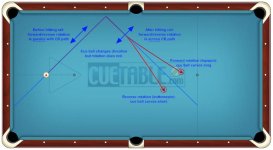
As this drawing shows, when the CB changes direction off the rail its spin does not change direction. That means that forward or reverse spin which was rotating parallel with the CB's path before hitting the rail is rotating across the CB's path after hitting the rail - this across-the-path rotation is what causes the CB to curve after hitting the rail.
Forward rotation (topspin) can be the result of the CB rolling naturally or of hitting high on the CB. Reverse rotation (backspin) can only be the result of hitting low on the CB.
pj
chgo
Last edited:

Kicking with bottom shortens the angle, and kicking with bottom is harder to judge and you should only kick with bottom when you have to... in my opinion.
Donny, when you're trying to kick with a high degree of accuracy, do you prefer to use follow and try to judge how much the angle is going to widen, or do you prefer to use center-ball in an effort to achieve something closer to the geometric angle?
Thanks,
Aaron

Donny, when you're trying to kick with a high degree of accuracy, do you prefer to use follow and try to judge how much the angle is going to widen, or do you prefer to use center-ball in an effort to achieve something closer to the geometric angle?
Thanks,
Aaron
I'm not Donny (heaven knows), but I've thought about this for my own play and have decided I like the CB to be "rolling naturally" because that's the easiest and most consistent amount of vertical rotation to give it - you don't have to estimate distance, speed and tip placement precisely as with other kinds of spin.
pj
chgo
I'm not Donny (heaven knows), but I've thought about this for my own play and have decided I like the CB to be "rolling naturally" because that's the easiest and most consistent amount of vertical rotation to give it - you don't have to estimate distance, speed and tip placement precisely as with other kinds of spin.
pj
chgo
Unless I am kicking a ball that is right near the rail and I want to stop CB there and send other ball away, I prefer sliding the CB, hitting centerball.
I am not Donny either
Last edited:
I'm not Donny (heaven knows), but I've thought about this for my own play and have decided I like the CB to be "rolling naturally" because that's the easiest and most consistent amount of vertical rotation to give it - you don't have to estimate distance, speed and tip placement precisely as with other kinds of spin.
pj
chgo
Yeah, that's my current thinking as well, although I do wonder at times if I'd be better served with a sliding cueball. I'm sure like a lot of things it depends to a high degree on the specific shot. I'm always looking for that "silver bullet" piece of wisdom that will instantly make me kick better, all the while knowing that the answer is just tons of practice. Damn, I guess that means I'll just have to play more pool.

Aaron
Unless I am kicking a ball that is right near the rail and I want to stop CB there and send other ball away, I prefer sliding the CB, hitting centerball.
I am not Donny either
I'm going to have to play with that some more. I suspect I'll find that it's much more accurate on certain kicks. Now, do you play it like a stop shot (ie:, cueball sliding at the point when it contacts the cushion), or do you just cue center ball and let it roll if it wants to? I would think it would be a bit trickier to try to play it like a stop shot, since even a slight amount of draw at the contact point could result in a narrower angle.
Thanks, not Donny.
Aaron


This is a great topic--thanks to all replying.

FYI, video demonstrations of this and other kick and bank effects can be found here:When kicking of one rail, how does top/bottom spin affect the path of the cue ball. To me it seems the spin makes the QB curve after contacting the rail. Could anybody clear it for me?
Regards,
Dave
As this drawing shows, when the CB changes direction off the rail its spin does not change direction.
That's not quite true. The component of the rotation that's perpendicular to the cushion gets noticably reduced from the contact with the rail (as we discussed in the clean vs dirty balls thread), while the parallel component doesn't. That means follow/draw direction after contact becomes more parallel to the cushion in all cases.
It doesn't change the qualitative nature of your nice diagram that much, but I think it's an interesting detail that's worth mentioning and helps builds better intuitions.
Robert
Good point. Here are some videos demonstrating the spin-changing effects for near straight-on kick shots:That's not quite true. The component of the rotation that's perpendicular to the cushion gets noticably reduced from the contact with the rail (as we discussed in the clean vs dirty balls thread), while the parallel component doesn't. That means follow/draw direction after contact becomes more parallel to the cushion in all cases.
HSV A.117 - straight-on kick shot at fast speed with follow, stun, and draw
HSV A.118 - straight-on kick shot at slow speed with follow, stun, and draw
HSV A.119 - straight-on kick shot of a polished ball at fast speed with follow, stun, and draw
HSV A.120 - straight-on kick shot of a polished ball at slow speed with follow, stun, and draw
HSV B.15 - straight-on kick shot rebound losses and spin changes for roll, stun, and draw shots
NV B.18 - Kick shot cue ball hold shot example with Tom Ross
NV B.27 - Rail-first draw kick safety, with Tom Ross
HSV A.118 - straight-on kick shot at slow speed with follow, stun, and draw
HSV A.119 - straight-on kick shot of a polished ball at fast speed with follow, stun, and draw
HSV A.120 - straight-on kick shot of a polished ball at slow speed with follow, stun, and draw
HSV B.15 - straight-on kick shot rebound losses and spin changes for roll, stun, and draw shots
NV B.18 - Kick shot cue ball hold shot example with Tom Ross
NV B.27 - Rail-first draw kick safety, with Tom Ross
Enjoy,
Dave
Great stuff, dr dave. GREAT.