I am getting ready to assemble a cue, curly maple forearm with a cocobolo handle and a curly maple butt sleeve. No inlays nothing fancy just some rings at A,B,C,D,E. My ringwork is going to be black phenolic,thin aluminum, black phenolic. My question is what do I do to keep the rings from feeling like they are rising. I know it is really the wood around it shrinking but I hate the way it feels. Kind of makes the cue seem cheap. Just my opinion. Any help would be greatly appreciated.:frown:

You are using an out of date browser. It may not display this or other websites correctly.
You should upgrade or use an alternative browser.
You should upgrade or use an alternative browser.
How to keep rings from rising.
- Thread starter seahorse1877
- Start date

File/sand the rings below the wood and seal them back up to the wood's level with CA glue. This helps hold them down after the cue is finished. I'm told with metal rings in wood there is no permanent solution due to the differences in expansion/contraction rates of the materials. Uh, if anyone else has any other suggestions, please let me know!!!
Good cue making,
Alan
Good cue making,
Alan

I am getting ready to assemble a cue, curly maple forearm with a cocobolo handle and a curly maple butt sleeve. No inlays nothing fancy just some rings at A,B,C,D,E. My ringwork is going to be black phenolic,thin aluminum, black phenolic. My question is what do I do to keep the rings from feeling like they are rising. I know it is really the wood around it shrinking but I hate the way it feels. Kind of makes the cue seem cheap. Just my opinion. Any help would be greatly appreciated.:frown:
You are correct in that rings DO NOT rise, wood shrinks if it is not properly seasoned.
I suggest you start with properly seasoned dry wood. Using the black phenolic rings bordering the aluminum rings will also help because the phenolic will not shrink so you will not feel as great a difference between the two materials as you move your fingers over the two materials.
I also take the edge of a file and slightly undercut all metal rings being careful not to touch the black phenolic.
Good Luck,
I am getting ready to assemble a cue, curly maple forearm with a cocobolo handle and a curly maple butt sleeve. No inlays nothing fancy just some rings at A,B,C,D,E. My ringwork is going to be black phenolic,thin aluminum, black phenolic. My question is what do I do to keep the rings from feeling like they are rising. I know it is really the wood around it shrinking but I hate the way it feels. Kind of makes the cue seem cheap. Just my opinion. Any help would be greatly appreciated.:frown:
Easiest way is to not use rings and make sure your wood is properly dried. When doing metal rings I undercut them a little bit with either a single point on the lathe or a tri-sided mini file.
Dick
If the alum. ring is sandwiched btwn. phenolic then how is it that the wood is shrinking. The wood has nothing to do with it nor does the phenolic. Neither one is shrinking. It's 'pinch-down' of the finish.
As the applied finish ages, it continues to cure. As part of the curing process, it contracts or 'pinches-down' on whatever it's applied to. This phenomena is very real. Ask any auto-body painter.
What complicates this is that the metal rings don't sand down as readily as the mtrls. adjacent to them, be it wood, phenolic or whatever so even though you think that the rings are sanded flush with everything else on the cue, they really aren't. Aluminum rings are the lesser offender here because they do sand down more easily than nickel silver, stainless steel, and etc.
As long as buyers insist on having metal deco rings in cues, this problem will persist. About the only remedy that comes to mind is to coat the cue with a substrate sealer that is so hard that it doesn't allow the clear top coat to pinch-down any further than the top surface of the substrate itself.
Dick Neighbors applies a UV cure substrate under his clear-coat and I'd be anxious to ask him if this cured this problem for him and is he able to detect pinch-down on the rings after the cue has aged somewhat.
Another substrate coating that Prather informed me of many years ago was to entirely seal the cue with CA before applying the clear-coat. This could have several benefits; sealing oily/resinous wood, filling pores in porous wood thereby reducing the number of times the cue will see the spray booth and possibly preventing the pinch-down effect on metal rings. The one remaining question I have is how well does it allow for full transparency or D.O.I. (distinction of image). I guess I'll just have to try it and find out.
FWIW, I have many cues out in the area that I built many years ago using alum. deco-rings and to this day, you still can't feel the rings. No substrate was used, just clear-coat.
As the applied finish ages, it continues to cure. As part of the curing process, it contracts or 'pinches-down' on whatever it's applied to. This phenomena is very real. Ask any auto-body painter.
What complicates this is that the metal rings don't sand down as readily as the mtrls. adjacent to them, be it wood, phenolic or whatever so even though you think that the rings are sanded flush with everything else on the cue, they really aren't. Aluminum rings are the lesser offender here because they do sand down more easily than nickel silver, stainless steel, and etc.
As long as buyers insist on having metal deco rings in cues, this problem will persist. About the only remedy that comes to mind is to coat the cue with a substrate sealer that is so hard that it doesn't allow the clear top coat to pinch-down any further than the top surface of the substrate itself.
Dick Neighbors applies a UV cure substrate under his clear-coat and I'd be anxious to ask him if this cured this problem for him and is he able to detect pinch-down on the rings after the cue has aged somewhat.
Another substrate coating that Prather informed me of many years ago was to entirely seal the cue with CA before applying the clear-coat. This could have several benefits; sealing oily/resinous wood, filling pores in porous wood thereby reducing the number of times the cue will see the spray booth and possibly preventing the pinch-down effect on metal rings. The one remaining question I have is how well does it allow for full transparency or D.O.I. (distinction of image). I guess I'll just have to try it and find out.
FWIW, I have many cues out in the area that I built many years ago using alum. deco-rings and to this day, you still can't feel the rings. No substrate was used, just clear-coat.

If the alum. ring is sandwiched btwn. phenolic then how is it that the wood is shrinking. The wood has nothing to do with it nor does the phenolic. Neither one is shrinking. It's 'pinch-down' of the finish.
As the applied finish ages, it continues to cure. As part of the curing process, it contracts or 'pinches-down' on whatever it's applied to. This phenomena is very real. Ask any auto-body painter.
What complicates this is that the metal rings don't sand down as readily as the mtrls. adjacent to them, be it wood, phenolic or whatever so even though you think that the rings are sanded flush with everything else on the cue, they really aren't. Aluminum rings are the lesser offender here because they do sand down more easily than nickel silver, stainless steel, and etc.
As long as buyers insist on having metal deco rings in cues, this problem will persist. About the only remedy that comes to mind is to coat the cue with a substrate sealer that is so hard that it doesn't allow the clear top coat to pinch-down any further than the top surface of the substrate itself.
Dick Neighbors applies a UV cure substrate under his clear-coat and I'd be anxious to ask him if this cured this problem for him and is he able to detect pinch-down on the rings after the cue has aged somewhat.
Another substrate coating that Prather informed me of many years ago was to entirely seal the cue with CA before applying the clear-coat. This could have several benefits; sealing oily/resinous wood, filling pores in porous wood thereby reducing the number of times the cue will see the spray booth and possibly preventing the pinch-down effect on metal rings. The one remaining question I have is how well does it allow for full transparency or D.O.I. (distinction of image). I guess I'll just have to try it and find out.
FWIW, I have many cues out in the area that I built many years ago using alum. deco-rings and to this day, you still can't feel the rings. No substrate was used, just clear-coat.
You'll regret you ever tried it if you care about how your cues will look 2-3-5 years from now. One simple test for you to try.....coat a piece of wood with CA...spray clear on it....bang it against something that would represent the rail on a table.
<~~~just sharing some past experiences................

The way to keep rings stable do the following steps
1 sand both sides of rings 180 sand paper
2 use west system slow dry and pressure
3 when finishing a cue never use over 220 paper or sealer will not stick properly
4 following these steps gives you your best results
5 use dried or stabilized wood
do the following you should have no problems uv finish is also a great way to go.
Do not use fine grit paper or you will have problems with sticking
1 sand both sides of rings 180 sand paper
2 use west system slow dry and pressure
3 when finishing a cue never use over 220 paper or sealer will not stick properly
4 following these steps gives you your best results
5 use dried or stabilized wood
do the following you should have no problems uv finish is also a great way to go.
Do not use fine grit paper or you will have problems with sticking

I am getting ready to assemble a cue, curly maple forearm with a cocobolo handle and a curly maple butt sleeve. No inlays nothing fancy just some rings at A,B,C,D,E. My ringwork is going to be black phenolic,thin aluminum, black phenolic. My question is what do I do to keep the rings from feeling like they are rising. I know it is really the wood around it shrinking but I hate the way it feels. Kind of makes the cue seem cheap. Just my opinion. Any help would be greatly appreciated.:frown:
This is a problem that few cue makers have ever completely mastered. In fact consistently McDermott is the best Manufacturer both custom and production that I have seen to date and they will not talk about the process they are using.
From what I have seen Metals that are more resistant to corrosion also seem to move less, such as Gold, Platinum. Most movement I have seen is caused by expansion and contraction, due to varying temperatures and humidity levels that the cue is stored in. This expansion and contraction is also encountered with other materials beside metals. The reason this happens is because materials will expand and contract at different rates do to their hardness. In most cases what you feel is the finished that has been pushed up because of movement from below it. Finish unlike the materials it covers is not very flexible and it will crack under repeated pressure. Glues will also break down due to expansion and contraction, which can cause failures of many parts of a cue.
If I were you I would rethink using Aluminum ring work, there are many others materials you will have less problems with long term. If you don't wnat to have the problems you are talking about don't use metal!!
Take care

From past experience I have also noticed when finishing my own cues or others, you have to be careful not to sand, wet sand, or buff out at a speed to high that the finish heats up and causes breakdown and separation. Just a thought. I agree with everyone who says over sand the metal with a small file and absolutely seal before spraying. I use finish epoxy but still think I could do better.
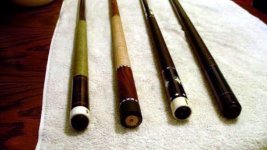 OK figured out how to post pictures.
Last edited:
Just some of the cues I built.
The cocobolo w/curly wrap is just ready for final sanding and finishing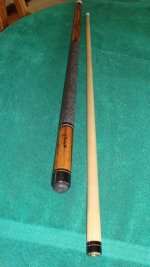
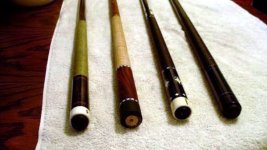

The cocobolo w/curly wrap is just ready for final sanding and finishing
Last edited:
What grit?
What grit of sandpaper would you suggest? And this may sound stupid but what is CA? Sorry, just trying to understand. Thanks
The way to keep rings stable do the following steps
1 sand both sides of rings 180 sand paper
2 use west system slow dry and pressure
3 when finishing a cue never use over 220 paper or sealer will not stick properly
4 following these steps gives you your best results
5 use dried or stabilized wood
do the following you should have no problems uv finish is also a great way to go.
Do not use fine grit paper or you will have problems with sticking
What grit of sandpaper would you suggest? And this may sound stupid but what is CA? Sorry, just trying to understand. Thanks
What grit of sandpaper would you suggest? And this may sound stupid but what is CA? Sorry, just trying to understand. Thanks
There is nothing stupid about your Question, the sand paper grit he suggested was 180, and CA = Cyanoacrylate commonly none as Super Glue.
Hope this helps

my bud dennis dieckman told me a couple years ago, stay away from using metal rings
yeah, that sounds good, but in reality, a lot of folks like the looks
i like the looks too, but i hate doing the damn things
because i worry about the inherent problems with metal rings, i honestly try to avoid them
i dont know about the rest of the builders on here, but i just do not feel that the bond of any glue/epoxy, no matter what brand or formula it is, is a good on metal as it is on wood or phenolic
but, if i do use metal rings, i've been doing something for about a year or so with them,
i cant say that it's better or worse than the typical installation, but i figured it cant hurt
example: take a ring pak that has a metal ring, in between a couple other rings of either wood or phenolic,
i take a small , aprrox. 1/8th " grinding tool in a dremel tool, and make a few 1/2 moon grooves on the inside diameter of the metal ring,
to act as , for lack of a better term, a "bridge" from the wood rings thru the metal to the next wood ring
who knows, very well could be just a waste of time and effort
even with that in mind, it still wont prevent the problem the OP brought up about feeling the rings
i'd like to learn more about kj's "pinch down"
i havent heard that term until i saw his post
> my personal cue, in progress, has no metal rings :thumbup:
yeah, that sounds good, but in reality, a lot of folks like the looks
i like the looks too, but i hate doing the damn things
because i worry about the inherent problems with metal rings, i honestly try to avoid them
i dont know about the rest of the builders on here, but i just do not feel that the bond of any glue/epoxy, no matter what brand or formula it is, is a good on metal as it is on wood or phenolic
but, if i do use metal rings, i've been doing something for about a year or so with them,
i cant say that it's better or worse than the typical installation, but i figured it cant hurt
example: take a ring pak that has a metal ring, in between a couple other rings of either wood or phenolic,
i take a small , aprrox. 1/8th " grinding tool in a dremel tool, and make a few 1/2 moon grooves on the inside diameter of the metal ring,
to act as , for lack of a better term, a "bridge" from the wood rings thru the metal to the next wood ring
who knows, very well could be just a waste of time and effort
even with that in mind, it still wont prevent the problem the OP brought up about feeling the rings
i'd like to learn more about kj's "pinch down"
i havent heard that term until i saw his post
> my personal cue, in progress, has no metal rings :thumbup:
Last edited:
my bud dennis dieckman told me a couple years ago, stay away from using metal rings
yeah, that sounds good, but in reality, a lot of folks like the looks
i like the looks too, but i hate doing the damn things
because i worry about the inherent problems with metal rings, i honestly try to avoid them
i dont know about the rest of the builders on here, but i just do not feel that the bond of any glue/epoxy, no matter what brand or formula it is, is a good on metal as it is on wood or phenolic
but, if i do use metal rings, i've been doing something for about a year or so with them,
i cant say that it's better or worse than the typical installation, but i figured it cant hurt
example: take a ring pak that has a metal ring, in between a couple other rings of either wood or phenolic,
i take a small , aprrox. 1/8th " grinding tool in a dremel tool, and make a few 1/2 moon grooves on the inside diameter of the metal ring,
to act as , for lack of a better term, a "bridge" from the wood rings thru the metal to the next wood ring
who knows, very well could be just a waste of time and effort
even with that in mind, it still wont prevent the problem the OP brought up about feeling the rings
i'd like to learn more about kj's "pinch down"
i havent heard that term until i saw his post
> my personal cue, in progress, has no metal rings :thumbup:
When I get a "pinch down".....I just adjust the boys and that usually takes care of it!
you missed your callingWhen I get a "pinch down".....I just adjust the boys and that usually takes care of it!

letterman should be contacting you soon
you missed your calling
letterman should be contacting you soon
Been waiting all week for the call.............I think I'll just go cut some wood.
you got time to shoot the breeze ????Been waiting all week for the call.............I think I'll just go cut some wood.
you got time to shoot the breeze ????
Google Ruland Manufactures and look under beam couplers..........
email yours.......
Last edited: