Question about Angled Sanding Mandrels

scdiveteam

Rick Geschrey
Silver Member
Hi,

I have been using a set of straight carbide sanding mandrels for my joints after clear coat is applied. I was thinking about having another set made and was wondering if anyone has experience with mandrels that are ground to match the taper geometry.

I thought that if I have new ones made at my .850 finish size with the taper angle, then I could have my current ones ground down to a smaller dia. and also match the geometry taper for sanding my epoxy substrate also.

Since using the mandrels I have noticed that my geometry thru the joint does not look absolutely correct to my eye and I thought that the angle would make it perfect perfect thru the joint area.

Thanks in advanced for any info.:help:

Rick G
 
How do you hand sand in parabolic motion ?

I only care about the mandrel for the butt to taper down.
The shaft's can be flat.
 
I dont see how it would make a diffrence?

your only looking for the end diameter at the face right?

I dont use sanding mandrels but would like to get some in the future, could someone enlighten me?
 
I dont see how it would make a diffrence?

your only looking for the end diameter at the face right?

I dont use sanding mandrels but would like to get some in the future, could someone enlighten me?

Rocketman makes them.
Just tell him your forearm's taper.

If you place a credit card where the two meet ( like you're swiping the card ) you shouldn't see daylight.
If you see daylight, you sanded the edge to make the two edges the same size .
If you sanded right, the angles should'nt have changed.
 
Last edited:
How do you hand sand in parabolic motion ?

I only care about the mandrel for the butt to taper down.
The shaft's can be flat.

Joe,

My shaft taper is designed to match my butt through the joint area. Our parabolic taper kicks in a little downstream of the joint.

All kidding aside, why would I not want the "shaft" mandrel to also be tapered to get a more uniform contour thru the entire joint to match the line of the extended butt geometry?

Rick
 
Joe,

1. My shaft taper is designed to match my butt through the joint area. Our parabolic taper kicks in a little downstream of the joint.

2. All kidding aside, why would I not want the "shaft" mandrel to also be tapered to get a more uniform contour thru the entire joint to match the line of the extended butt geometry?

Rick
1. But, they curve , right ? They are not on a straight angle . I have no clue how one would hand sand on a curve .

2. If you sand following that contour , it will stay with that contour unless you gouge the edges . You can't do that with the forearm b/c if you follow the contour the edge of the sand paper will go UP unless the carbide tapers down.
On the shaft, when you sand, even if the carbide is flat , the edge of the sand paper stays with the angle of the shaft if you sand right.

Done right, you won't do much sanding. Just 320 grit, skewed to sand the joint area lightly while on high speed turning. Watch the chuck.
 
mandrel ground to taper

I may be not seeing something, but the mandrel does not affect much more than depth of cut and concentricity about a center axis? The taper is usually 0.014 per inch. Most mandrels I have seen are less than an inch of carbide, unless the mandrel were very long would the sandpaper follow the taper of the wood and only be affected by the carbide for the depth of cut, unless we sand with too much pressure on the wood, then we destroy our taper? If one sanded too aggressively, then even a tapered mandrel would not correct that issue? My mandrels have a 1/2 inch length, I cannot see a 0.0035 radius taper being much of an influence. I can be missing the point here I suppose. But it is an interesting discussion, thanks for bringing this up !
 
I may be not seeing something, but the mandrel does not affect much more than depth of cut and concentricity about a center axis? The taper is usually 0.014 per inch. Most mandrels I have seen are less than an inch of carbide, unless the mandrel were very long would the sandpaper follow the taper of the wood and only be affected by the carbide for the depth of cut, unless we sand with too much pressure on the wood, then we destroy our taper? If one sanded too aggressively, then even a tapered mandrel would not correct that issue? My mandrels have a 1/2 inch length, I cannot see a 0.0035 radius taper being much of an influence. I can be missing the point here I suppose. But it is an interesting discussion, thanks for bringing this up !

OV,

I was thinking about .007 in one inch so I concur with your observation. I understand what you are saying but I can see the transition zone looks funny with my eye. Before using the mandrels my concentricity after machining is close to perfect. I only sand very lightly on my joints to change the RMS finish to a 320 scratch. After the epoxy and clear coat, I would loose some concentricity due to build up. I use to wet sand the entire joint area to match up and after buffing I would see a smooth transition of the taper through the joint.

I use more clear than most CMs that I know and before the mandrels it was not a problem. By going to the mandrels I have opened up another problem. John Spitz suggested to me that this problem may be amplified because I use so much clear build up. I am going to layoff a little on the clear mill thickness. When I look at my finished cue now, I see a tapered butt, then a slightly flat joint flowing into a tapered shaft. I am very careful in my sanding as not to make this happen but alas I can see it with my eye and I can't accept that look. The concentricity is perfect but the joint looks funny.

I know I am going to go with two sets of mandrels and have them tapered. One for epoxy substrate sand and One for finish sand.

My shafts have a parabolic taper but the main sweeping curve does not start at the Joint as it is a little past the joint. Joey keeps bringing this point up and even after I answer his point he seems to want to bring it up again. Also I don't get his reasoning regarding his suggestion concerning not tapering the shaft mandrel.

I was just looking for input from others with more experience than I who has been through this process.

The only reason I went to the mandrels was to establish a exact dimension with concentricity so that I can produce an interchangeable shaft standard for my cues. It is not as easy as I thought it would be.

Thanks,

Rick

Sweep does not start at the joint.

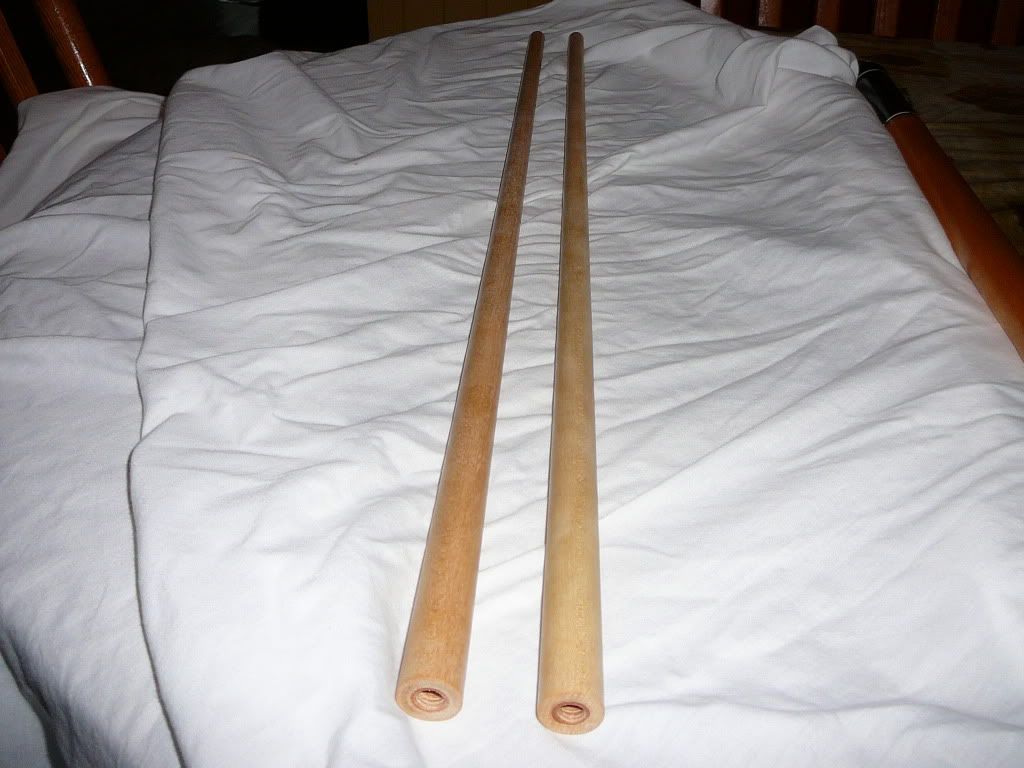
P1050945.jpg
 
Last edited:
I had this discussion with Tommy Migliore when I was designing my mandrels. He pretty much confirmed my feelings on the matter, which is that the taper doesn't mean jack. I trusted him and my own gut feelings & bought the set with no taper. Exactly as I thought, the straight cut meant nothing. My shafts & butts match dead nuts every time and I use straight cut mandrels. Others may feel differently or have different experiences but in my situation, tapered mandrels offer nothing more or less than straight mandrels.
 
I had this discussion with Tommy Migliore when I was designing my mandrels. He pretty much confirmed my feelings on the matter, which is that the taper doesn't mean jack. I trusted him and my own gut feelings & bought the set with no taper. Exactly as I thought, the straight cut meant nothing. My shafts & butts match dead nuts every time and I use straight cut mandrels. Others may feel differently or have different experiences but in my situation, tapered mandrels offer nothing more or less than straight mandrels.

Eric,

Thats what I thought also before putting the mandrels into my process. I think my problem has to do with overshooting my final with too much clear and having to bring it back to the final dimension again. I am going to tweak my clear mill thickness and foundation before I start taper grinding any mandrels.

Thanks for your thoughts,

Rick
 
Eric,

Thats what I thought also before putting the mandrels into my process. I think my problem has to do with overshooting my final with too much clear and having to bring it back to the final dimension again. I am going to tweak my clear mill thickness and foundation before I start taper grinding any mandrels.

Thanks for your thoughts,

Rick

It helps if you sand the cue very evenly end to end, before mating to the arbor. It's fine to overbuild at the joint. In fact, it's a good thing. Just be sure to sand the cue very evenly, getting the finish straight one end to the other, and stop sanding just when you are about to break through on the arbor. From there you fine tune your technique for the specific area. The trick with arbors is in the sanding. It takes practice & some thought to figure it out but once you do, it'll make things so easy. There's another step that's critical for me, personally, but i'm not going to post it on the forum. I don't keep much to myself or consider any knowledge as "secret", but at the same time i'm not going to openly share something that cost me a lot of grief & money to figure out. Next time i'm through Chicago area i'll stop by & show it to you. Makes all the difference in the world.
 
Back
Top